NC Republicans promised to expand voting access. Here's what the data shows
Published in News & Features
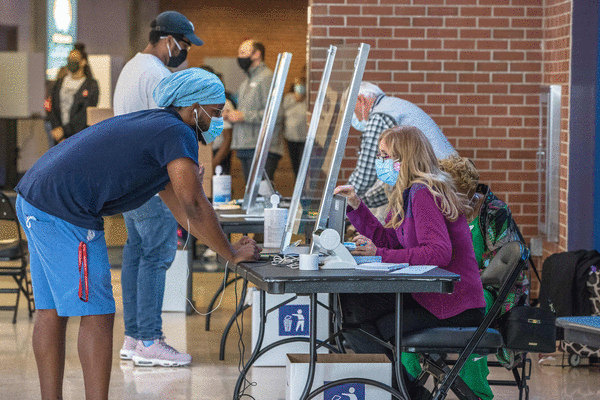
RALEIGH, N.C. — After his party took control over North Carolina’s election boards last year for the first time in nearly a decade, Republican Dallas Woodhouse made a promise: that the 2026 election would feature more voting opportunities than ever before.
With early voting plans now finalized statewide, the data offers some insight into whether that promise was fulfilled.
In total, the state’s 100 counties will offer more voting sites and more voting hours than in the last comparable election, the 2022 midterms. However, these gains also came alongside major cuts to Sunday voting and the rejection of some high-profile campus polling sites.
The plans were completed last week after a contentious 12-hour State Board of Elections meeting in which the Republican majority frequently clashed with the board’s two Democrats over how to resolve disagreements in the 20 counties that had failed to unanimously approve an early voting plan on their own.
Also hanging over the meeting was the summer of controversy regarding Woodhouse, the state auditor’s former elections liaison, and his attempts to influence early voting plans.
Woodhouse was hired to be the auditor’s “eyes and ears on the ground” after state lawmakers stripped Gov. Josh Stein of his appointments to election boards and transferred them to Auditor Dave Boliek, a Republican.
While serving in that newly created role, a series of leaked texts showed Woodhouse, who previously led the North Carolina Republican Party, encouraging county election officials to cut Sunday voting and eliminate a campus voting site. He resigned from the auditor’s office last month.
In a statement released after the meeting, Woodhouse said the finalized early voting schedule vindicated his promise that the state would increase voting access.
“It’s a proud day for North Carolina voters and for me personally, as the GOP-majority state board gave final approval to a comprehensive 2026 early-voting plan that offers unprecedented voter access for any North Carolina midterm election in history,” he said. “... Many of the partisan myths spread by left-leaning activists and Democrats angry that they no longer have sole control over elections were laid bare as naked partisan rhetoric.”
Chris Cooper, a political scientist at Western Carolina University, said the overall plan presents mixed results for Democrats and Republicans.
“The data are clear, but the interpretation is in the eye of the beholder,” he said. “This is not a clear win for either side, in my perspective.”
Total sites, hours increase
Statewide, North Carolina will host 368 voting sites this year — nine more than in 2022. This also means the state will offer roughly 1,300 more total voting hours.
However, according to Cooper, this increase may not keep up with North Carolina’s growing population. Compared to 2022, there will be nearly 3% fewer sites per 10,000 voters this year.
Cuts to Sunday voting
Sunday voting has long been a point of contention in North Carolina politics — and this year was no different.
But while 2022’s elections were overseen by Democratic majorities which generally upheld Sunday voting, this year’s elections are overseen by Republicans, who generally oppose it.
This year, 17 counties will host at least one day of Sunday voting — a sharp decrease from the 40 counties that offered it in 2022.
Republicans have long sought to limit Sunday voting in North Carolina, arguing that it presents staffing difficulties as well as religious concerns. But Democrats have supported the practice, saying it gives working voters more chances to cast their ballots. Research shows Black voters are also more likely to use Sunday voting.
Text messages obtained through a public records request showed that Woodhouse anticipated backlash to cutting Sunday voting, writing in one message to a county official: “We are going to get (expletive) removing Sundays in so many places.”
In several cases, Woodhouse suggested adding more Saturday voting opportunities to make up for the lost Sundays. Cooper’s research found that the 2026 elections will have 415 more total hours of Saturday voting than 2022. All counties are required to provide voting on the Saturday directly before the election, but they can choose to hold voting on the prior two Saturdays as well.
A mixed bag on campus voting sites
Some of the most intense debates over this year’s early voting plans dealt with whether to host polling sites on college campuses.
The state board’s Republican majority shot down a proposal to open sites at UNC Greensboro and NC A&T State University, neither of which had hosted early voting in the 2022 midterms.
And the debate over a polling site at Western Carolina University sparked the first controversy over Woodhouse’s involvement in elections after Republican members of the Jackson County board said they’d been pressured by the auditor’s office to vote against it. The state board ended up voting in favor of keeping a site at WCU.
But it’s difficult to definitively say if college voting sites increased or decreased in total between 2022 and now.
Some longtime polling sites, such as Chapel of the Cross in Chapel Hill, are directly adjacent to college campuses, while technically not being connected to the university. Other sites located on university property are still significantly separated from the main campus, like the business services center at NC State University.
When counting only polling sites located directly on university or community college property, there will be 17 sites this year — the same amount as 2022.
However, Cooper’s research found a slight decrease in campus voting sites when filtering out those at community colleges: going from 11 in 2022 to nine this year.
Unlike most universities, community college students do not usually live on campus. Students who do live at their university have argued they need campus polling sites to make up for the fact that many of them do not have cars or other reliable transportation off campus.
_____
©2026 Raleigh News & Observer. Visit newsobserver.com. Distributed by Tribune Content Agency, LLC.






Comments