US-Iran truce collapses as attacks worsen and blockade returns
Published in News & Features
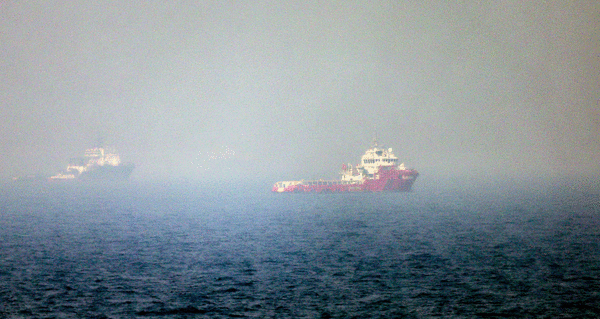
The interim peace between the U.S. and Iran effectively collapsed after American forces reimposed a naval blockade and launched another wave of airstrikes, while Tehran attacked more oil tankers sailing through the Strait of Hormuz.
U.S. President Donald Trump’s decision to restart a blockade of Iranian ports overnight came after hostilities between the two sides worsened in the past week, with tensions centered on control of the strait.
Traffic through the all-important waterway has dwindled and oil has surged 20% since attacks rekindled, with Brent trading above $86 a barrel.
The U.S. launched airstrikes at military sites in several southern Iranian towns and cities over a five-hour period on Monday night. Iran targeted U.S. bases in Jordan and Bahrain, and hit two oil tankers from the United Arab Emirates with cruise missiles. The latter attack killed an Indian crew member and wounded about eight others.
Iran’s Islamic Revolutionary Guard Corps said the tankers had ignored warnings and that the U.S. had “incited” them to deviate from navigating channels approved by Tehran.
The latest incident adds to a spate of shipping attacks by Iran, including on Saudi Arabian and Qatari tankers, since July 7. The U.S. has reacted by firing upon hundreds of Iranian military targets, prompting counterstrikes by Tehran on American allies such as Kuwait and Bahrain.
The preliminary deal from last month was ambiguous about the Hormuz strait. Each side claims the other has breached the terms of the so-called memorandum of understanding. The U.S. said the document allowed for free passage of ships through the waterway, while Iran claims it was given the right to manage traffic.
Trump, late on Tuesday, said the strait was “open” but added to the chaos for energy companies and shippers by saying he would demand a reimbursement fee of 20% on all cargo shipped through. That would account “for any and all costs necessary to do the job of providing safety and security to this very volatile section of the World,” he said on Truth Social.
He said the process would “begin immediately.” Still, it was unclear if the U.S. was charging ships as of Tuesday. The comments counter months of U.S. statements that there can be no tolls or fees for the chokepoint, through which one fifth of the world’s oil and liquefied natural gas were flowing before the war erupted, in late February.
Other states, including major Gulf Arab energy exporters and Asian importers, may balk at having to pay a 20% fee. That would add roughly $32 million to the cost of sailing the largest tankers, which can hold 2 million barrels, through Hormuz at today’s prices.
The White House did not provide other details on Trump’s proposal, including how fees would be administered or whether the proposal had been communicated to U.S. allies in the region such as Saudi Arabia, Qatar and the UAE.
More than 10 people involved in shipping markets, including a handful whose ships have passed through Hormuz in recent weeks, said they were blindsided by Trump’s announcement of fees on cargoes crossing the waterway. They said it was too early to know what the plan might look like in practice and how it would shape their decisions about transit.
Iran insists ships obtain its permission and follow approved routes. The renewed U.S. naval blockade may further weaken its beleaguered economy and prompt it to strike more often at commercial vessels. The number of vessels transiting through the strait fell to the lowest level in a month on Sunday, according to Bloomberg ship-tracking data.
Iranian Foreign Minister Abbas Araghchi mocked Trump’s proposal and his claim the U.S. was the “GUARDIAN” of the Hormuz strait.
“POTUS is absolutely right,” Araghchi posted on X. “Whoever provides secure and safe passage of commercial vessels through the Strait of Hormuz should be compensated for this service. 20% is of course too much. We will be fair.”
Trump’s latest declaration and the increased U.S. strikes underscore his precarious position just over three weeks after signing the MOU. That deal helped lower gasoline prices in the U.S., raising his Republican Party’s hopes ahead of midterm elections in November.
“At least rhetorically, Trump appears to be trying to play the Iranians at their own game,” said Holly Dagres, a senior fellow at the Washington Institute for Near East Policy. “Rest assured, the Iranians won’t be giving up the strait that easily.”
Plan roadblocks
Trump’s fee proposal would be difficult to implement and risk a blowback from U.S. industries and allies, while potentially conflicting with international law if applied broadly beyond escorted vessels.
Under international law, ships generally are allowed free passage through waterways such as Hormuz. There can, however, be charges for specific navigation or other services that ships need.
The International Maritime Organization reiterated that it “stands firmly against charging fees for passage through straits used for international navigation.”
In recent weeks, U.S. forces have escorted tankers and commercial ships along a southern route further from Iran’s shores. Analysts have said maintaining lasting control of the strait would require a much larger military operation, potentially involving ground troops, which Trump has been unwilling to undertake.
An attack by the Iran-backed Houthis on Saudi Arabia on Monday, the worst in several years, has also raised concerns about the possibility of the Yemeni rebels being dragged into the wider regional conflict in the Middle East.
State-run Al Ekhbariya TV reported that Saudi Arabia defense systems dealt with Houthi missiles, without saying whether Riyadh would retaliate.
©2026 Bloomberg L.P. Visit bloomberg.com. Distributed by Tribune Content Agency, LLC.






Comments