SpaceX knocks out Florida launch while prepping for Texas Starship mission
Published in News & Features
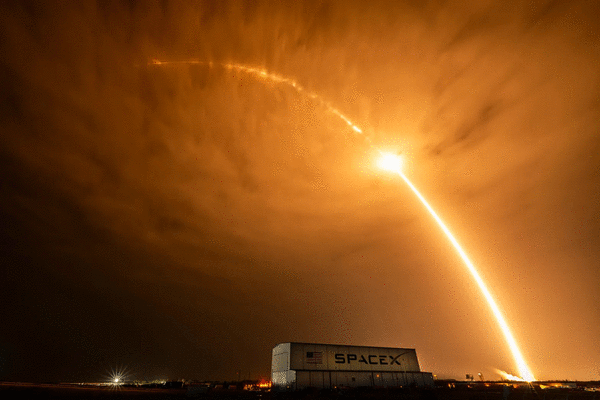
ORLANDO, Fla. — SpaceX tallied another Starlink mission early Tuesday on the Space Coast where it was business as usual, while in Texas the company continued to prep for the next launch of its powerful Starship and Super Heavy.
The Florida launch saw a Falcon 9 rocket lift off amid predawn night skies on the Starlink 10-45 mission with 29 Starlink satellites from Cape Canaveral Space Force Station’s Space Launch Complex 40 at 5:10 a.m.
The first stage booster flew for the 28th time and made a recovery landing downrange on the droneship A Shortfall of Gravitas stationed in the Atlantic.
It was the 47th launch on the Space Coast in 2026 with SpaceX responsible for all but seven of them.
But in Texas, the efforts to get to the 13th test flight of Starship got the OK to go for launch this week from the government.
That’s because the Federal Aviation Administration on Monday announced it had accepted the mishap investigation for the in-development rocket’s 12th mission, which flew in May. On that flight, the Super Heavy booster came hurtling back to the Gulf out of control, although it resulted in no injuries or damage to public property.
“The final mishap report cites two most probable root causes for the loss of the Super Heavy booster as heat effects on propulsion system components during the ascent and erroneous engine alarm system settings,” reads a statement from the FAA. “SpaceX identified four corrective actions, including vehicle hardware and software configuration updates to prevent a reoccurrence of the event.”
So with that out of the way, SpaceX is geared up to now tackle Flight 13, which will once again be a suborbital test mission targeting launch during a 90-minute launch window Thursday that opens at 6:45 p.m. EDT.
The company last Friday performed a full-duration static hot fire of the 33 engines on the Super Heavy booster tapped for this flight.
This would mark the second flight of the new Version 3 design of the rocket, which will try to accomplish what the booster could not on the last mission — a controlled landing in the Gulf.
Meanwhile, the upper stage will attempt again to fly more than halfway around the world, deploy 20 real Starlink satellites for the first time as opposed to simulators, relight a single Raptor engine in space, and then make a controlled descent and splashdown in the Indian Ocean off the west coast of Australia.
The previous flight flew without one of its three Raptor vacuum engines after it burned out about 40 seconds after stage separation.
Even though the Starlink satellites are real, they won’t be in space for long as they will follow the Starship upper stage’s suborbital trajectory and burn back up in Earth’s atmosphere about 20 minutes after deployment.
SpaceX will attempt to have their solar arrays extend and connect to the larger Starlink constellation with high-capacity lasers before they descend back to the planet. Some of them will use cameras to scan Starship’s heat shield as well.
The company continues to try and get Starship to an acceptable operational configuration. For now, all launches have been from Texas, but SpaceX is aiming to bring Starship to Florida to launch from the site under construction at Kennedy Space Center’s Launch Complex 39-A.
The Space Force is prepared to support a first Florida launch that could come before the end of the year.
SpaceX also has a pair of Starship launch towers planned for Canaveral’s Launch Complex 37, the former launch site for United Launch Alliance’s Delta IV Heavy rockets, but those won’t be ready until 2027.
-------------
©2026 Orlando Sentinel. Visit at orlandosentinel.com. Distributed by Tribune Content Agency, LLC.






Comments