Feds quietly share evidence in Good and Pretti shootings with Minnesota investigators
Published in News & Features
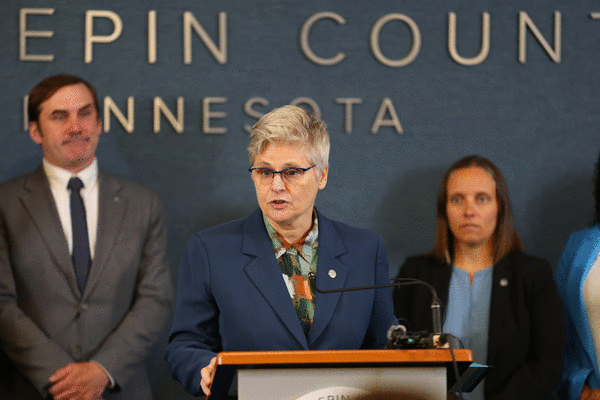
After months of refusing to do so, the Justice Department has turned over a substantial amount of evidence from its investigations into the killings of Renee Good and Alex Pretti during Operation Metro Surge to state investigators, a person familiar with the investigation but not authorized to speak publicly about the details confirmed to the Minnesota Star Tribune.
The evidence, which has been changing hands for several days without acknowledgment by the federal government or Minnesota law enforcement officials, includes the SUV Good was driving when she was shot and killed by Immigration and Customs Enforcement (ICE) agent Jonathan Ross.
The vehicle was transferred to the Minnesota Bureau of Criminal Apprehension (BCA) more than a week ago, this person confirmed. The SUV had been in federal custody since Good was killed on Jan. 7 in south Minneapolis.
Additional digital and physical evidence from the killings was turned over in the last several days, the source said, adding that state law enforcement officials consider the evidence comprehensive.
The Trump administration’s previous unwillingness to share evidence led the state of Minnesota to file an unprecedented lawsuit against the federal government in U.S. District Court for the District of Columbia earlier this year.
That lawsuit accused President Trump’s top law enforcement officials of withholding evidence from the killings of Good and Pretti and the shooting of Julio Sosa-Celis in north Minneapolis in an effort to shield federal agents from state prosecution.
Last month, U.S. Attorney for Minnesota Daniel Rosen denied official demands made by Hennepin County Attorney Mary Moriarty for the federal evidence from the killings of Good and Pretti and the shooting of Sosa-Celis.
Rosen wrote that the files were controlled by the Justice Department and while his office was permitted to give appropriate disclosures to state and local law enforcement, doing so in these cases “would improperly reveal investigatory records and/or interfere with federal law enforcement investigations.”
It is unclear what role, if any, the Trump administration played in the decision to share the evidence. The White House declined to comment Monday, referring questions to the Department of Homeland Security which didn’t immediately respond.
The move comes as federal officials are once again facing questions over use of deadly force by an ICE agent in the Houston shooting of Lorenzo Salgado Araujo, a 52-year-old immigrant who was killed during a traffic stop last week. That came a month after President Trump signed a $70 billion bill funding immigration enforcement agencies through the end of his second term in office.
Immigration enforcement figures to be a key factor in this week’s senate confirmation hearing for acting U.S. Attorney General Todd Blanche. Blanche declined to open a civil rights investigation into the killing of Good, saying, “We don’t just go out and investigate every time an officer is forced to defend himself against somebody putting his life in danger.” Blanche opened a civil rights investigation into Pretti’s death six days after he was killed.
The source told the Star Tribune the evidence sharing is expected to go both ways and is viewed as a return to longstanding norms between state and federal law enforcement agencies in Minnesota, including the BCA, the U.S. Attorney’s Office for Minnesota, the Minneapolis field office of the Federal Bureau of Investigation, the Minnesota Attorney General’s Office and the Hennepin County Attorney’s Office.
The rupture of those norms during Operation Metro Surge, the largest immigration enforcement action in United States history, led state law enforcement officials to say Minnesota was in “uncharted territory.”
During several chaotic situations, including protests at the scenes of the shooting of Sosa-Celis on Jan. 14 and the killing of Pretti on Jan. 27, state officials considered what to do if local officers ended up in an armed standoff with federal agents.
The BCA has longstanding working relationships with federal agencies and superintendent Drew Evans worked to rebuild them over the last several months in an effort to begin sharing evidence, the source said.
A previous agreement for a joint investigation into the killing of Pretti in February was scuttled at the last minute by members of the Trump administration, according to Gov. Tim Walz.
The killings of Good and Pretti sparked global outrage over the tactics of federal agents deployed to Minnesota for the surge.
Good, a 37-year-old mother of three who had recently moved to Minneapolis and had no criminal record, was shot and killed by Ross on Portland Avenue. The shooting happened as Good appeared to drive her SUV away from federal agents who had been carrying out immigration enforcement down the street, including an agent who was pulling on her door handle, ordering her to exit the vehicle.
Ross, who six months earlier had been dragged down the street and severely injured by a man fleeing an immigration stop in Bloomington, was positioned in front of Good’s SUV when its tires spun and it lurched forward. He fired three shots, striking Good four times, including in the head. Her car careened down the street, crashing into another parked car.
Pretti, a 37-year-old ICU nurse and longtime Minneapolis resident who had no criminal record, was shot and killed on Nicollet Avenue in south Minneapolis after a confrontation with federal agents carrying out immigration enforcement in the area. Pretti, who was filming the agents, had a permit to carry a firearm and a gun holstered.
After a confrontation, a federal agent spayed Pretti in the face with a chemical irritant and then at least seven federal agents swarmed the area and wrestled Pretti to the ground. An agent appeared to take Pretti’s gun and run away from the area about a second before 10 shots rang out, killing Pretti.
In both killings, the federal government declined to work with the state to investigate the deadly use of force on Minnesota residents. In response, the BCA, Hennepin County Attorney’s Office and Minnesota Attorney General’s Office announced independent investigations into the killings.
The decision by federal officials to share the evidence comes after the Hennepin County Attorney’s Office recently charged two ICE agents with assault for their alleged actions during the surge.
Christian Castro faces four counts of second-degree assault and one charge of falsely reporting a crime for allegedly shooting Sosa-Celis in north Minneapolis and lying about it. Gregory Morgan Jr. faces two counts of second-degree assault for allegedly pointing his gun at two motorists who blocked him as he drove on the shoulder of Hwy. 62 near Portland Avenue.
Castro has been held in the Cameron County jail in Texas since he was arrested in May. Morgan has a hearing later this month to determine if his case will be heard in federal or state court.
_____
©2026 The Minnesota Star Tribune. Visit startribune.com. Distributed by Tribune Content Agency, LLC




Comments