A dangerous animal sedative is creeping into Minnesota's illegal fentanyl supply
Published in News & Features
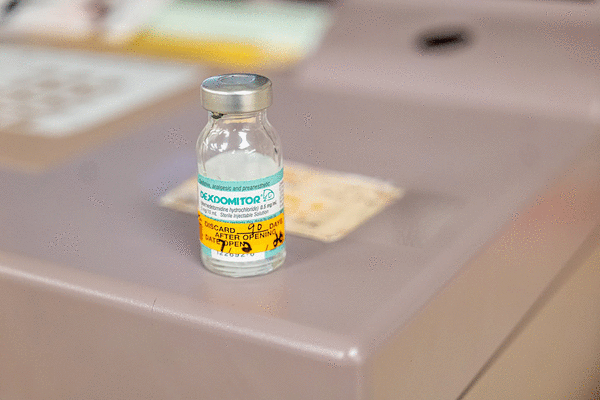
MINNEAPOLIS — A powerful animal sedative is slowly making its way into Minnesota’s illicit fentanyl supply, creating the potential to complicate overdose treatment and prompting warnings from health and drug officials.
The drug, medetomidine, sometimes referred to as “rhino tranq,” “mede,” or “dex,” is not approved for human use and has an ability to put users in a prolonged sedative state. The drug can drop a user’s breathing and heart rate to dangerous levels and cause severe withdrawals that require hospitalization.
Medetomidine, which is intended for use as an animal sedative, has been linked to a wave of overdoses across the U.S. and withdrawal symptoms among patients that have placed significant strain on emergency rooms, particularly in Philadelphia.
In the past 15 months, federal drug enforcers in Minnesota have seized nearly 250 grams of medetomidine mixed with fentanyl. The seizures have primarily taken place in Minneapolis, with one seizure of pure medetomidine in St. Louis County, according to the sheriff’s office there.
Though medetomidine’s presence in Minnesota’s illegal drug world is not nearly as widespread as other pockets of the country, its emergence has prompted warnings from local, state and federal officials.
“Our concern is if it does start to explode and get more readily available in the fentanyl supply,” said Rafael Mattei, assistant special agent in charge of the DEA’s Minneapolis and St. Paul office.
Lethal drug supply becomes more unpredictable
The drug market across the United States has likely evolved in response to surging resources across the country to combat deadly overdoses from fentanyl, which peaked in 2022.
Drug traffickers, motivated by profits, looked to bulk up their fentanyl supply with cheap additives that still packed similar effects. First came xylazine, another veterinary sedative that cause severe skin wounds. More substances followed.
Staff at Red Door Exchange, a Minneapolis program that offers harm-reduction supplies for drug users, said they first heard about medetomidine a few years ago when the drug cropped up in the illegal opioid supply on the American coasts. Then, as drug trends typically go, it worked its way from the coasts into Minnesota.
“We were not surprised by medetomidine,” said Megan Thomas, the Hennepin County Opioid Response Team’s coordinator for naloxone, the drug used to reverse the effects of opioid overdose.
Dr. Alonso Guedes, associate dean of research for the University of Minnesota’s College of Veterinary Medicine, said medetomidine serves as sedative in veterinary hospitals for a range of animals. It can be used on pets, but is also strong enough to sedate large, exotic animals like lions or bears. It’s almost never seen outside of surgical settings.
“It is powerful,” Guedes said.
Medetomidine can be 100 to 200 times more potent than xylazine and is most often found in fentanyl powder. But unlike fentanyl, medetomidine does not respond to naloxone, commonly referred to by its brand name, Narcan. The combination can complicate overdose response and treatment since naloxone will reverse fentanyl’s effects in a user but have no effect on medetomidine.
“The naloxone is going to have them start breathing again but the medetomidine, they might still be sedated,” Thomas said.
Experts still urge the public to use naloxone in cases of a suspected overdose, even as more non-opioid substances continue to be added to the illegal opioid supply. They also emphasized calling 911.
“You just don’t know what they took,” Mattei said.
A revolving door of substances
Medetomidine’s crawl into Minnesota comes as the rate of overdose deaths in the state have ticked up compared to 2024.
Overdose deaths last year reached 1,025 in 2025, according to preliminary data from the Minnesota Department of Health. That’s a 3% increase compared with the number of deaths in 2024, when 994 drug deaths were reported. The figures are still a drop from the state’s peak at 1,392 overdose deaths in 2022.
Mattei said it’s impossible to predict whether medetomidine will surge in Minnesota’s drug supply as heavily as seen on the coasts, saying the agency remains focused on public awareness about the drug that’s often laced in fentanyl without the user knowing. Staff at the Red Door Exchange echoed a similar sentiment, emphasizing that a revolving door of substances are continuously being added to the opioid supply.
“We’re on medetomidine now; it will change,” said Julie Bauch, senior strategist for Hennepin County’s opioid response. “There will be something new. We will learn about it. We have not heard about it yet. We will do education again. We will get up to speed. The cycle doesn’t end for public health and medical professionals.”
©2026 The Minnesota Star Tribune. Visit startribune.com. Distributed by Tribune Content Agency, LLC






Comments