Iran-backed Houthis strike Saudi Arabia in major escalation
Published in News & Features
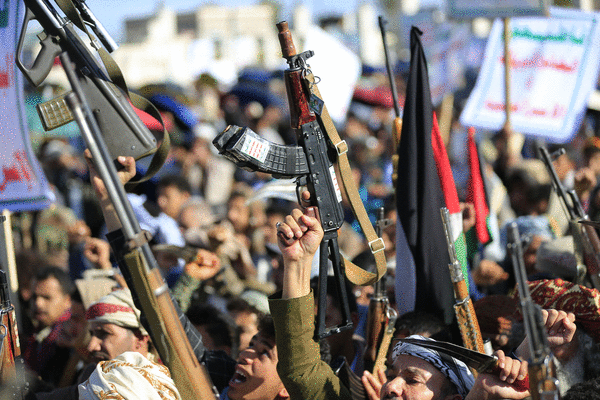
The Iran-backed Houthi group in Yemen fired ballistic missiles and drones on Saudi Arabia, the worst attack in several years that threatens to draw the rebels into the wider regional conflict between Tehran and Washington.
The Houthis claimed they targeted Abha Airport in Saudi Arabia’s southwestern region Monday and warned aviation companies to avoid Saudi airspace until what they called a Saudi siege of the Yemeni capital, Sanaa, is lifted.
State-run Al Ekhbariya TV reported that Saudi Arabia defense systems dealt with Houthi missiles, without saying whether Riyadh would retaliate.
The Houthi strike came hours after the group accused Saudi jets of bombing Sanaa International Airport to prevent a plane carrying the group’s delegation from returning from the funeral of the late Iranian Supreme Leader Ali Khamenei in Tehran.
Yemen’s internationally-recognized government, which is based in Riyadh, claimed the attack on Sanaa, saying Iran had violated Yemen’s sovereignty by landing the plane there.
The attacks mark the first major escalation between Houthi rebels and the Saudi-backed government since the two agreed to a ceasefire in 2022. Saudi Arabia intervened in the Yemeni civil war that erupted around 2015 on its border to prop up the government after Houthis overthrew it.
The Houthis have become an integral part of Iran’s network of proxy militia groups spread across the Middle East. It includes Lebanon-based Hezbollah, which has fought two wars with Israel in the past three years and coordinated attacks with Tehran against the Jewish state.
The Houthis though have largely avoided embroiling themselves in the Israeli-U.S. war on Iran and limited their role to a few symbolic missile attacks on Israel.
They also refrained from disrupting international shipping in the Red Sea as they did a few years ago following the outbreak of Israel’s war in Gaza. A large number of ships were affected traffic through the waterway collapsed.
That hasn’t happened this year despite Iran threatening to close the Bab Al-Mandab Strait in the Red Sea like it did with the Strait of Hormuz in response to U.S. attacks on its soil.
Renewed attacks in the Red Sea could jeopardize Saudi Arabia’s oil exports through its East-West Pipeline, which allows crude to bypass Hormuz and reach the Red Sea to Europe and other markets. Saudi Arabia also sees Yemen as a national security matter given its close proximity to the kingdom.
The Houthi delegation returning from Iran was later allowed to land at Hodeidah, a port controlled by the group. That showed “there was still an effort to avoid broader regional escalation,” said Mohammed al-Basha, a U.S.-based Yemen analyst.
Still, he added, that could change and “we could be inching toward a full-scale war” between Saudi Arabia and the Houthis.
©2026 Bloomberg L.P. Visit bloomberg.com. Distributed by Tribune Content Agency, LLC.






Comments