'It looked like an apocalypse': Miami rescuers describe their efforts in Venezuela
Published in News & Features
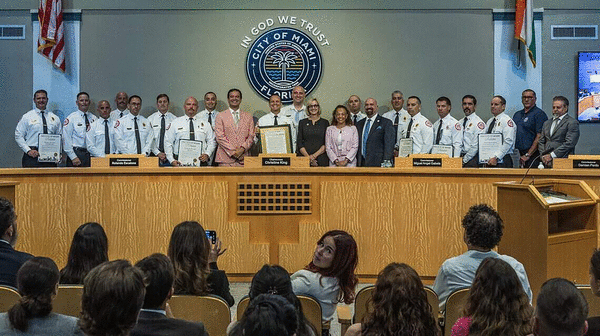
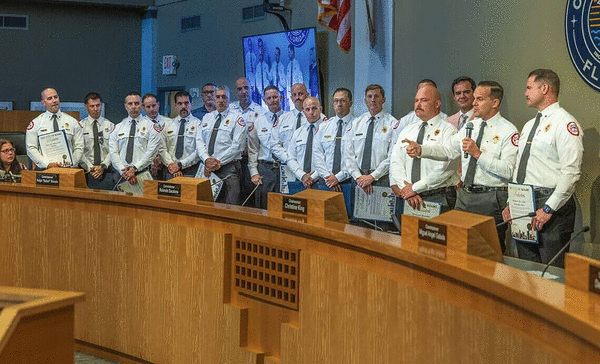
On the evening of June 26, city of Miami Assistant Fire Chiefs Christopher Diaz and Gerardo Rodriguez received a call. Within four hours, they and 77 other Miami-based first responders were ready to deploy to Venezuela, where they would spend the next eight days searching for survivors among the rubble.
“Everyone was there for one purpose: to save a life,” Diaz said.
Around 15 members of the rescue team from the Miami Fire-Rescue Department were honored by Miami Mayor Eileen Higgins at Thursday morning’s City Commission meeting. The first responders received two separate standing ovations as Higgins detailed their efforts and the significance of their work in giving people hope.
They arrived June 27 to total devastation. Rodriguez — who has served on disaster task forces for over a decade — said it was as if the country had been hit by multiple nuclear bombs, reducing it to rubble.
“It looked like an apocalypse,” Rodriguez said.
But the city of Miami team, led by Diaz and Rodriguez, hit the ground running. Receiving directions from the U.S. Department of State, the rescuers were assigned a radius of collapsed and leaning buildings to search.
The Miami Fire-Rescue Department members were deployed to Venezuela as part of Florida Task Force 2, which also included Miami-Dade Search and Rescue, to join a broader American rescue response known as USA-11. The United States also sent teams from Fairfax, Virginia, and Los Angeles as part of the response.
“They represented not only our fire department, every elected official here, the city administration, all the department directors behind us, every resident of Miami — they represented the United States of America,” Miami Fire Chief Robert Hevia said.
Using seismic and acoustic listening devices and dogs, the teams searched with teams from Venezuela, Chile, Costa Rica, El Salvador and Mexico, alongside local Venezuelans, to locate victims trapped alive under the rubble.
The dogs helped alert to victims; cameras and audio equipment helped the team confirm if they were alive. Then, they put a plan into action.
“We don’t stop until we get that person out,” Diaz said.
They worked for eight straight days, taking 24-hour shifts with no breaks. While one team spent 12 hours gathering information on potential victims in the area, the other worked actively on-site. The work was difficult, as the rescuers contended with unstable buildings and structures that could collapse at any moment.
There were also logistical challenges, as only a limited amount of equipment could be transported by plane, and vehicles were hard to navigate through the destruction.
For Diaz and Rodriguez, despite the difficulties, the mission came first. But a rescue didn’t come until July 2 — five days after they’d arrived.
Led by Miami Fire Rescue, international groups rescued Hernán Alberto Flores Gil, a 44-year-old man who had been trapped under tons of rubble for eight days. The teams worked nonstop for 53 hours to rescue him, navigating their way through a collapsed nine-story structure that was extremely unstable.
“We were working hand in hand with the Venezuelan team, the Chilean team, Costa Rica, El Salvador, Mexico, and at a certain point, you can look left and right: different uniforms, same mission,” Diaz said.
He said that Gil was communicative and in relatively good health, despite the condition and the environment he was trapped in.
“To know that one human being is alive today makes it all worth it,” Diaz said. “That’s our mission, that’s our purpose.”
The rescue teams received international praise for their efforts. Rodriguez described the moment of saving someone as “by far the absolute best feeling in the world,” a joy and emotional high that’s at times indescribable.
The two crews from the Miami-area returned Sunday night. Both Diaz and Rodriguez expressed mixed feelings at the order to leave, knowing there was the possibility of other victims who could be saved. A website tracking those missing has listed over 44,000 people as yet to be found.
Typically, the city of Miami search-and-rescue team prepares for a minimum of two weeks for work in disaster zones. During the Surfside condominium collapse, Rodriguez and others searched for over 14 days — and that was half of a building, not 500 buildings of total devastation, he said.
“No one in this team will leave voluntarily,” Diaz said, a sentiment that Rodriguez echoed. “We have to be ordered to leave.”
Although the U.S. teams have departed, John Barrett, the U.S. chargé d’affaires for Venezuela, said that aid will continue. According to Barrett, U.S. humanitarian assistance has exceeded $310 million as of Tuesday. Last week, he said that the U.S.’s focus was “100% on saving lives.”
Even when dozens of countries had teams deployed, families of the missing and dead told the Herald that there had not been enough manpower or machinery to save those buried alive under the rubble. Several outlets also reported that the Venezuelan government had been blocking rescue teams while they were deployed.
With international teams leaving, families and volunteers continue to look through the rubble, some with just their bare hands, to find their loved ones.
Diaz found working beside the Venezuelans in rescues meaningful. Despite the awful situation, Diaz said he saw a lot of “Venezuelan pride.”
What was impressive was “all of the Venezuelan citizens out there working hand in hand with the rescue teams, with anything that they have, with limited resources, trying to help us, trying to help themselves, trying to help their family,” Diaz said.
Barrett said in a Tuesday press conference in Caracas that the U.S.-based teams saved six lives. Higgins emphasized Thursday morning that the rescues would not have been possible without the courage and “competence” the rescuers displayed.
The Miami team has since returned to serve the city. After Thursday’s ceremony finished, several firefighters went straight to the station.
_____
©2026 Miami Herald. Visit miamiherald.com. Distributed by Tribune Content Agency, LLC.






Comments