UC San Diego develops way to forecast when coastal landslides are imminent
Published in News & Features
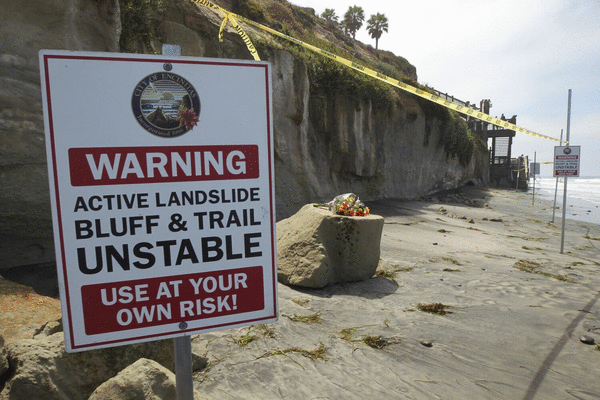
SAN DIEGO — The University of California, San Diego has developed a rudimentary way to detect when and where coastal landslides are likely to occur, which could lead to an early warning system for a phenomenon that has killed 19 people in greater San Diego since the 1940s.
Scientists say in a study released Thursday they were able to predict five landslides within hours and days of when they occurred at spots from Encinitas to Torrey Pines State Beach. The discoveries happened over a four-year period ending last year.
The most notable forecast came in April 2024 when scientists gave authorities two days’ notice that a landslide would occur on the Del Mar Bluffs, along the railroad corridor. A collapse did happen, dumping roughly 200 tons of material onto the beach. The incident happened around 5 a.m., when few people were around.
Such events are not unusual in Del Mar, which experienced six bluff failures from August 2018 to February 2019, interrupting passenger rail service. The slides occurred in areas where the beach is fairly narrow, which can make it harder for people to run to safety.
The situation was more dire in August 2019 when an unexpected mid-afternoon landslide at Grandview Beach in Leucadia killed three people. The tragedy helped lead to the UCSD study, which was conducted by the school’s Scripps Institution of Oceanography.
The next step, the study says, is to formally find a way to turn such information into an actionable warning system.
“When we started the project, we didn’t even know that we would get any data,” said geomorphologist Adam Young, who led the study. “We could have had these sensors out and not had any landslides. I was surprised we did get signals.”
Young was referring to the in-ground sensors that were placed at Beacon’s Beach and San Elijo State Beach in Encinitas, and in the railway corridor in Del Mar. The proof-of-concept project also involved the use of tiltmeters and LiDAR to help measure and monitor shifting soil.
“You can’t see this kind of movement with the naked eye,” said Mark Zumberge, a Scripps geophysicist who collaborated with Young on the study.
The study recommends that such research be expanded in San Diego County and introduced in other coastal areas of California, including Orange, Sonoma and Santa Barbara counties, Santa Cruz and Big Sur, where a mudslide in 2017 closed state Route 1 for 14 months.
That proposal is strongly supported by Assemblymember Tasha Boerner of Encinitas, who obtained $2.5 million from the state for the Scripps study.
“I teared up when I heard the great results they got,” Boerner told the Union-Tribune. “This was the right idea at the right time with the right team. What they’ve done is fantastic.”
She added that when the data is refined and more actionable, she could see it becoming part of ALERTCalifornia, the highly praised public safety project that uses a network of high-resolution, live cameras to rapidly spot the outbreak of wildfires and monitor their growth. The system, which was developed by UC San Diego, is widely used to fight fire and announce evacuations.
The release of the new study comes at an uneasy moment for scientists and first responders. NOAA says there is a nearly 70% chance that a large El Niño will develop this year — one that could bring heavy rain to Southern California, increasing the threat of coastal landslides.
Such rain preceded the April 2024 landslide at the Del Mar Bluffs near Ninth Street. Earlier in the year, rain caused a cliff collapse that reached the Point Loma Wastewater Treatment Plant, triggering a 5,800-gallon sewage spill and temporarily closing the tidepools at Cabrillo National Monument.
El Niño also generates huge surf that eats away at the base of cliffs, making them more unstable, and it can raise sea level, which has a similar effect.
Scientists are optimistic that they’ll eventually develop a way to accurately and widely forecast when and where landslides will occur, creating a reliable early warning system.
“Unlike earthquakes, which so far have not revealed telltale signals prior to their occurrence,” the Scripps study says, “landslides behave in a way that invites monitoring, enabling prediction … In all five cases, it was clear days before the actual collapse that the failure was imminent.”
Young is eager for progress, saying, “A landslide can occur anytime — on a sunny day or in the middle of the night. We need to be able to predict when it’ll happen.”
_____
©2026 The San Diego Union-Tribune. Visit sandiegouniontribune.com. Distributed by Tribune Content Agency, LLC.






Comments