California wolves are eating much more cattle than wild prey, study finds
Published in News & Features
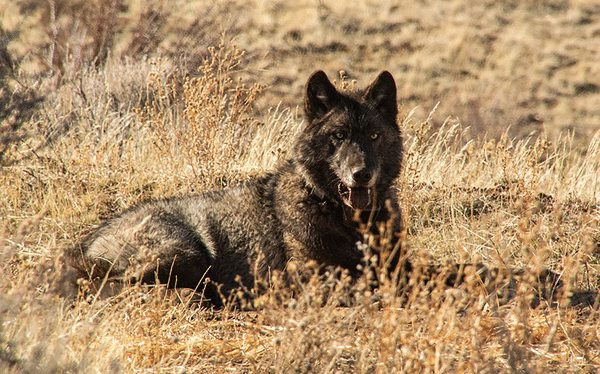
LOS ANGELES — The return of the wolf in California has been met with joy by conservationists, who delight in the improbable population rebound, and with fury by ranchers who bemoan the toll on their cattle.
Now, a new study on the diet of gray wolves suggests that the population regrowth is a result of the animals feasting on cattle, as their natural prey sources remain comparatively scarce.
Researchers at UC Davis found cattle DNA in 72% of wolf scat samples collected in the summers of 2022 and 2023.
By comparison mule deer, the primary natural prey for wolves in California, appeared in 45% of samples, and small mammals appeared in 51% of samples.
"Whether it's through scavenging or whether it's through depredation, [cattle are] a huge component of the wolves' diet," said Tina Saitone, lead study author and professor in the UC Davis Agricultural and Resource Economics Department. "Their conservation success is because of livestock producers in the state."
The study reaffirms fears that many wolves are becoming dependent on cattle as a primary food source as it is easier to feed on slow-moving, fatty cows than stalk the state's dwindling deer population. Some irregular food items such as chicken and pig were also detected in the samples, suggesting that wolves are also scavenging from human waste disposal sites.
The results of the study, though limited to the Lassen and Harvey wolf packs during a several-month period, underscore the challenges of people coexisting with wolves.
There were 267 investigations opened by California wildlife officials into wolf-livestock predation in 2025, up from 74 the previous year. Of the investigations opened last year, there were 198 livestock losses confirmed likely due to wolves — generating outrage from Sierra Valley ranchers.
The high rate of kills prompted the California Department of Fish and Wildlife to take the unprecedented step of euthanizing four gray wolves from the Beyem Seyo pack that were responsible for 70 livestock deaths in less than six months.
Wildlife officials have warned of the dangers of wolves becoming overly accustomed to feeding on cattle as opposed to their natural prey of elk or deer.
"This shift not only undermines recovery efforts for the species in California but also risks altering generational feeding patterns and broader ecological dynamics," Fish and Wildlife said in a statement. "Moreover, habituation to livestock inadvertently draws wolves closer to human communities, increasing the potential for conflict despite their natural avoidance of people."
The cattle-kill crisis is also costly, with each animal lost setting ranchers back several thousand dollars. The state has established a program to compensate ranchers for each head of cattle lost, and last week the Department of Fish and Wildlife allocated $2 million to continue compensation efforts and fund nonlethal methods to deter wolves from attacking cattle.
Another recent study by UC Davis researchers indicates that wolves are increasing stress levels among the herds of cattle they prey on, which could have further economic consequences for ranchers.
By analyzing tail hair samples, researchers found that herds living among wolves had cortisol levels 58% higher than those living in areas without wolves.
"What this really confirms is that death or depredation is not the only impact here," Saitone said in a statement. "Living among wolves for cattle is a chronically stressful experience, and that could ultimately have production-related impacts in both the short and the long term."
The presence of wolves in California poses a fresh and complex challenge for state wildlife authorities after hunters and trappers pushed the population to extinction around a century ago.
The lupines have reappeared within the last 15 years, migrating from Oregon and forming new packs, largely clustered in the northeastern portion of California. There were 55 wolves confirmed alive and nine wolf packs by the end of 2025, according to Fish and Wildlife's annual wolf report.
Despite the challenges posed to ranchers, wolves play an important role in managing the balance of an ecosystem. As apex predators, they keep the population of midlevel predators in check, allowing vegetation and other wildlife species lower on the food chain to thrive.
©2026 Los Angeles Times. Visit latimes.com. Distributed by Tribune Content Agency, LLC.






Comments