Venezuela quake death toll reaches 3,811 two weeks after disaster
Published in News & Features
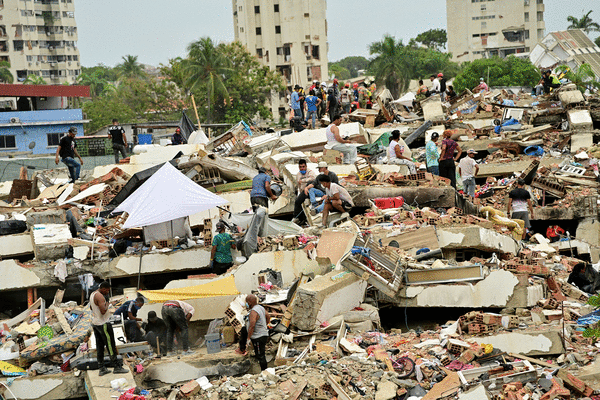
Two weeks after Venezuela’s devastating twin earthquakes, the country is entering a new and increasingly painful phase of the disaster. While hopes of finding additional survivors have all but vanished, tens of thousands of families remain waiting for answers about relatives whose whereabouts are still unknown.
Government officials said Wednesday night that the official death toll has climbed to 3,811, with 16,740 people injured, as authorities continue shifting their focus from emergency rescue operations toward reconstruction and humanitarian assistance.
The updated figures, presented during a government briefing, show 6,462 people have been rescued alive since the 7.2- and 7.5-magnitude earthquakes struck north-central Venezuela on June 24, just 39 seconds apart, making them among the deadliest natural disasters in the country’s modern history.
Authorities said 17,907 people remain homeless after losing their residences, while 190 buildings collapsed completely and another 856 suffered significant damage.
Officials also reported that nearly 9,603 metric tons of food have been distributed, more than 27,300 patients have received medical treatment through Venezuelan and international hospitals, and 4,388 international rescue workers have participated in the response alongside more than 30,000 Venezuelan military, police, firefighters and emergency personnel. Nearly 29,000 volunteers have also registered to assist relief operations.
Yet even as official rescue operations wind down, one of the disaster’s biggest unanswered questions remains the fate of thousands of people who have yet to be accounted for.
Although Venezuelan authorities have not released an official nationwide tally of people whose whereabouts remain unknown, the United Nations and several humanitarian organizations estimate that roughly 50,000 people remain unaccounted for following the earthquakes.
Independent online registries created by volunteers and relatives contain between 43,000 and 51,000 names, reflecting the enormous uncertainty that continues to surround the disaster.
Aid agencies caution that the figure should not be interpreted as the number of people believed to be trapped beneath the rubble. Instead, it includes a combination of people who may still be buried inside collapsed buildings and thousands of others who remain out of contact because telecommunications networks, electricity and transportation infrastructure were severely damaged across some of the hardest-hit regions.
In many communities along Venezuela’s Caribbean coast, damaged cellphone towers and prolonged communications outages have prevented families from confirming whether loved ones survived or simply relocated after the earthquakes.
Even so, rescue crews acknowledge that the possibility of finding additional survivors has become increasingly remote 15 days after the disaster. The shift reflects the harsh reality of major earthquakes, where the overwhelming majority of rescues occur during the first several days after a collapse.
For many families, however, the absence of definitive answers has made it impossible to move from hope to mourning.
Volunteer organizations continue updating online databases as relatives upload photographs, medical information and last known locations in the hope that someone may recognize a missing family member or provide new information.
Meanwhile, the government’s attention is increasingly turning toward the longer-term challenge of recovery.
Officials said nearly 86,800 families have received government assistance, while temporary camps continue housing thousands of displaced residents. Engineers remain deployed across La Guaira, Caracas, Miranda and other affected states inspecting damaged apartment buildings, bridges, schools and public infrastructure to determine which structures can safely be repaired and which must be demolished.
The reconstruction effort is expected to become one of the largest in Venezuela’s modern history. A preliminary assessment prepared for the United Nations Office for Disaster Risk Reduction estimates the earthquakes caused approximately $37 billion in direct physical damage to buildings and infrastructure, although researchers caution the estimate excludes indirect economic losses and the full cost of rebuilding.
International assistance also continues to expand.
Government officials said 4,388 foreign rescue specialists remain involved in the response alongside Venezuelan emergency personnel and humanitarian organizations distributing food, medical supplies, drinking water and shelter assistance.
The United States has committed more than $386 million in humanitarian assistance for earthquake victims, making Washington the largest single contributor to the international relief effort, according to the U.S. State Department.
The funding has supported emergency medical care, food assistance, clean drinking water, sanitation, temporary shelters, protection services and logistics through organizations including the International Federation of Red Cross and Red Crescent Societies, UNICEF and the World Food Program.
The State Department said the United States has delivered more than 400 metric tons of emergency supplies — including shelter kits, hygiene kits, tarps, buckets and cooking equipment — which it estimates have reached approximately 70,000 people affected by the earthquakes.
As the emergency enters its third week, Washington also announced the creation of a humanitarian air bridge between the United States and Venezuela. Coordinated by the State Department in partnership with humanitarian logistics organization Airlink and Amazon, the initiative will transport relief supplies weekly from Miami International Airport to Maiquetía International Airport at no cost to participating humanitarian organizations.
Although U.S. urban search-and-rescue teams deployed from Virginia, California and Florida have completed their missions and returned home, the State Department said American personnel remain in Venezuela to oversee humanitarian assistance and coordinate the continuing relief effort. More than 2,400 rescuers from 60 international teams representing 29 countries, assisted by nearly 200 specialized search dogs, participated in rescue operations following the June 24 earthquakes.
Senior State Department officials also traveled to Venezuela in recent days to assess damage and review ongoing relief operations, underscoring Washington’s continuing role as the country transitions from emergency response to long-term recovery.
_____
©2026 Miami Herald. Visit miamiherald.com. Distributed by Tribune Content Agency, LLC.






Comments