Trump disputes Iran's Hormuz control, touching on sticking point
Published in News & Features

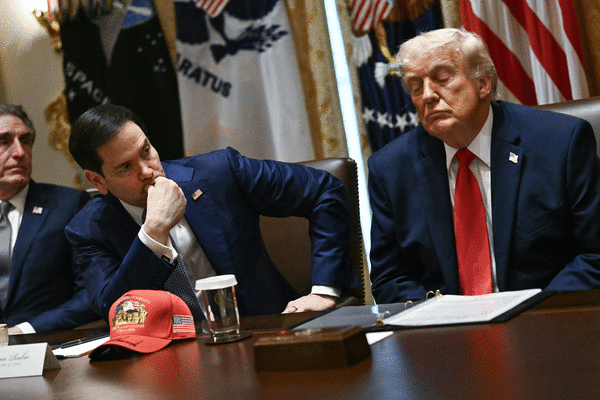

WASHINGTON — President Donald Trump asserted that no one nation would control the vital Strait of Hormuz waterway, highlighting a key sticking point in resolving the war with Iran.
Trump was asked during a meeting of his Cabinet officials if he was comfortable with a short-term deal that would open the strait but under Iranian control.
“Nobody’s going to control it. It’s international waters,” Trump said Wednesday at the White House. “The strait’s going to be open to everybody” and the U.S. will “watch over it.”
Trump didn’t indicate what steps the U.S. would take to ensure free passage of vessels. Iran has effectively choked off traffic along the energy waterway, triggering a chain reaction of price spikes for crude oil and gasoline that have shaken the global economy since the U.S. and Israel’s Feb. 28 attack.
The U.S. president has by turns instituted his own blockade of Iranian ports along the strait, called for allies to assist with the effort to pry it open so that commercial ships and tankers could resume safe passage and threatened to resume major airstrikes against the country — all to little avail.
Oil remained lower on the day as traders stayed optimistic that a deal was in sight, even after Trump said he was “not satisfied” with the negotiations.
Trump’s remarks followed an Iranian state television report on a draft interim peace deal, which said maritime traffic through the Strait of Hormuz could return to normal within a month of it coming into effect.
The White House cast the report and the draft memorandum of understanding as “a complete fabrication,” adding in a social media post that “nobody should believe what Iranian state media is putting out.”
Trump also downplayed the possibility of Iranian sanctions relief, saying “we’re not talking about any easing of sanctions, no money, no nothing.”
Other key points in negotiations reported by Iran’s IRIB News included the U.S. lifting its naval blockade on Iranian ports and the American navy leaving waters surrounding Iran.
The draft also said Iran and Oman will have a mechanism in place to oversee shipping in the strait. That’s one of the most contentious issues holding up a deal, with the U.S. saying vessels must be allowed free passage. Oman has not commented in recent weeks on Iran, saying the two are in discussions about managing the strait.
Trump on Wednesday asserted that “Oman will behave just like everybody else,” threatening that otherwise “we’ll have to blow them up. They understand that.”
He also amplified his call for more countries to join the Abraham Accords and recognize Israel alongside an agreement with Iran.
Trump threatened that “I’m not sure we should make the deal if they don’t sign” and asserted that countries like Saudi Arabia, the United Arab Emirates and Qatar “owe that to” the U.S.
Both Iran and the U.S. in the past week have said their talks, via mediators such as Pakistan and Qatar, are making headway. U.S. Secretary of State Marco Rubio reiterated on Wednesday that “there’s been some progress and some interest, and we’ll see over the next few hours and days.”
Ali Bagheri-Kani, deputy secretary of Iran’s Supreme National Security Council, said that “until we have agreed on all issues, we consider that we have agreed on nothing.”
Bagheri-Kani in Russia on Wednesday added that “a completely different procedure will be introduced” for Hormuz passage and that Iran and Oman are holding talks to determine that mechanism.
An Iranian delegation recently returned to Tehran following intense talks in Doha that yielded good progress, according to a diplomat with knowledge of the visit.
The negotiations, in coordination with the U.S., focused on the Strait of Hormuz and Iran’s highly enriched uranium, while the issue of Tehran’s frozen funds was also discussed as part of a potential final agreement, said the diplomat, who asked not to be identified speaking of private discussions.
Facing domestic pressure to end a conflict that’s driven up inflation and gas prices and imperiled his party’s prospects in November midterm elections, Trump has maintained that he won’t be rushed on a deal. He said Wednesday that Iranians thought they could force his hand in negotiations.
“They thought they were going to out-wait me,” Trump said. “‘We’ll out-wait him, he’s got the midterms.’ I don’t care about the midterms. Look what happened last night,” he added, referring to victories for candidates he backed in primary races.
The warring sides, since notching a fragile ceasefire in early April, also need to agree on what portion of Iranian financial assets will be unfrozen and how quickly. On Tuesday, Iranian state media said Tehran wants $12 billion unfrozen once an interim deal is agreed.
Another potential obstacle is a parallel war in Lebanon between Israel and Tehran-backed Hezbollah militants, who are classified as terrorists by the U.S. Israel has stepped up attacks in recent days and said its ground forces are moving further into its northern neighbor’s territory.
Iran insists the ceasefire has to cover “all fronts,” including Lebanon.
Here’s more on the Iran war:
—Several explosive drones fell in Israeli territory near the border with Lebanon on Wednesday, the Israel Defense Forces said.
—Commercial shipping through the Strait of Hormuz gained modest momentum as at least two non-Iranian supertankers exited the Persian Gulf, the latest mini-flurry in energy flows transiting the vital waterway.
—An oil tanker named Olympic Life reported an explosion off the coast of Oman on Tuesday, according to the Joint Maritime Information Center.
_____
(With assistance from John Bowker, Josh Wingrove, Fiona MacDonald, Will Kubzansky, Jennifer A. Dlouhy and Skylar Woodhouse.)
_____
©2026 Bloomberg L.P. Visit bloomberg.com. Distributed by Tribune Content Agency, LLC.




Comments