Why some Pittsburgh-area school districts are considering changes to their uniform policies
Published in News & Features
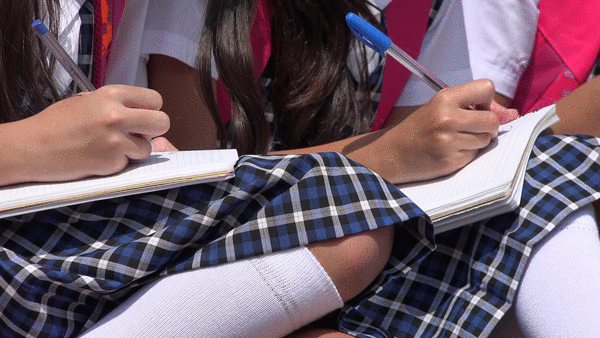
PITTSBURGH — When some Pittsburgh-area students walk into school this fall, they’ll be showing off their new blue jeans, T-shirts and hoodies rather than the monochromatic colors of school uniforms they used to wear.
Two districts in the region — Sto-Rox and Wilkinsburg — last week considered changes to their uniform policies, the result of student and parent surveys that found that families sometimes struggle to buy uniforms, and students wanted to be allowed to express themselves more.
Sto-Rox high schoolers starting next school year will no longer be required to wear uniforms, but students in K-8 will still follow the policy, which mandates solid-colored tops and bottoms, prohibits fingertip-length skirts, and regulates hats and other headwear.
The change will allow older students to determine what’s appropriate to wear to class before they head off to college.
Wilkinsburg, a K-6 district, is recommending the removal of uniforms districtwide based on student wishes for self-expression and concerns that uniform policies are unfairly applied to students of color.
But directors disagreed last week about how to move forward. Administrators have explained systems where students are penalized and removed “from classes when they are not compliant,” Superintendent Jocelyn Artinger said Thursday.
A nationwide movement
Ohio’s Cleveland and Akron school districts in 2021 nixed school uniforms. Cleveland, at the time, adopted a gender-neutral dress code designed to help students develop a body-positive self-image.
Akron’s decision stemmed from parent feedback that indicated families were incurring additional costs to purchase uniforms. Uniforms can cost up to $500 per child per year in some cases, Uniform Market found.
Erie Public Schools, on the other hand, are tightening dress codes.
The district next school year will enforce a policy not used since the onset of the COVID-19 pandemic, requiring students to wear solid-colored collared shirts and prohibiting denim.
Schools often enforce dress codes and require uniforms to cut down on gang-related clothing and prevent students from using clothing as a status symbol, said Richard Thompson Ford, a Stanford University law professor and author of “Dress Codes: How the Laws of Fashion Made History.”
“You cut all that off at the knees if everyone has to wear a uniform,” Ford said. “Social leveling of a lot of different kinds, but also this kind of social uplift, dress-for-success idea.”
That’s supported by a 2013 University of Nevada, Reno, study, which found that 90% of middle school students surveyed did not like wearing uniforms. But the study noted several benefits, including decreases in discipline, gang involvement and bullying; and increases in safety, ease of going to school, confidence and self-esteem.
A 2022 study by Arya Ansari, an assistant professor of human sciences at Ohio State University, countered that idea, instead finding that school uniforms did not impact young students’ attendance or behavior — including anxiety and social withdrawal; aggression or destruction of property; and social skills.
And students who had to wear uniforms reported lower levels of feeling like they belonged in schools compared to students who didn’t wear uniforms.
Tom Ralston, University of Pittsburgh assistant professor and former Avonworth superintendent, said Western Pennsylvania districts reconsidering uniforms are listening to families.
“Each community has to decide what is best for them,” Ralston said. “Things work in one community really well, and you go to another school, and it doesn't work.”
Local decisions
At Sto-Rox, the district’s 930 students, 98% of whom are economically disadvantaged, have been wearing uniforms since the 2024-25 school year.
At the time, district leaders saw students coming to school in inappropriate outfits, said board President Cameron Culliver. Officials also wanted to alleviate bullying spurred by kids comparing clothing brands, while helping families save money by purchasing fewer clothes.
The policy was largely successful, Culliver said, aside from a few students initially saying they wouldn’t wear uniforms. But recent surveys found that families want the district to ensure students are college-ready, including through clothing.
On Thursday, the school board eliminated uniforms for ninth through 12th graders and instead implemented a new dress code. That will permit high schoolers to wear jeans and hoodies — as long as the hood stays down. And it includes rules about the lengths of dresses and skirts, as well as what types of leggings can be worn. Pajamas are prohibited.
Uniforms will likely remain in place for students in kindergarten through eighth grade, although the board tabled a vote on that after students said they wanted to add normal shirts to the uniform, in addition to shirts with collars.
At Wilkinsburg, a district of 480 students, 94% of whom are economically disadvantaged, school directors debated Thursday about how to move forward with uniforms. They have been required since 2012 to promote equity, reduce distractions and build school identity, the district has said.
But concerns recently arose over cost and access for families, and students indicating a desire for self-expression, concerns that uniforms were implemented in districts predominately of color; and worries that students were missing class when being disciplined for not following the policy.
District leaders polled families about their uniform preferences to account for some of the concerns that had been raised. Asked if the district should continue requiring uniforms, 50% of respondents said “yes” and 38% said “no.” Twenty-nine percent said students would see positive impacts if uniforms were removed, while 45% said there would be negative consequences.
Artinger, Wilkinsburg’s superintendent, said that if the board chooses to keep uniforms, parent complaints will likely rise as their children are sent home or to the office over policy violations. Officials have been lax on upholding uniforms this school year.
For Artinger, the problem with uniforms is that they are often seen in districts where students are predominantly Black. Nearly 80% of Wilkinsburg students are Black.
Nearly three-quarters of predominantly Black and more than half of predominantly Hispanic schools require uniforms, compared to 2% of majority white schools, a 2022 National Education Association report found. Districts often say dress codes are aimed at keeping students safe, according to the report, but they can foster a less equitable environment for those adversely affected.
“Mt. Lebanon doesn’t wear uniforms. South Park doesn’t wear uniforms,” Artinger said, pointing to predominantly white districts. “Their school environments are not jacked up. ... We only make Black children in public schools wear uniforms. That’s a problem for me.”
Director Sharmaine Gamble countered, saying that Wilkinsburg does not need to follow those districts. The Wilkinsburg board will make a final decision at a meeting on Thursday.
“At the end of the day, we’re not traditionally white students,” Gamble said. “We can set our own culture. We don’t have to be like them. We can be like us.
“As far as having uniforms, I do believe that they set a precedent for how you behave when you’re in school, just the same as when you’re training someone to go off to work.”
©2026 PG Publishing Co. Visit at post-gazette.com. Distributed by Tribune Content Agency, LLC.




Comments