Mayor Brandon Johnson touts faster Chicago police responses post-ShotSpotter
Published in News & Features
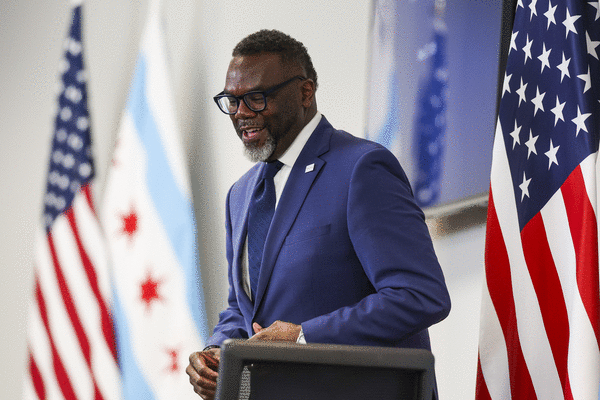
CHCIAGO — Mayor Brandon Johnson argued Wednesday that Chicago police are doing a better job without gunshot detection technology like the controversial ShotSpotter system he got rid of, even as his administration is considering bids from other companies to take over installing such tools citywide.
Johnson pointed to a study from the Justice Project at the University of Chicago that determined response times where the technology operated have improved 4.2 minutes on average since he ended the ShotSpotter deal in September 2024. That’s proof, the mayor argued, that critics’ “consternation” about his decision was unfounded.
He panned “fearmongering” around his move away from an “ineffective” technology that he previously accused of slowing police down by overloading them with alerts.
“(To) those who were obviously promoting fear and casting doubt on our effort to improve safety, this is clear evidence that we are clearly moving in the right direction,” he said.
The mayor, also grappling with thorny public safety questions tied to several large youth gatherings that ended in violence over the Memorial Day weekend, did not answer directly about the status of the city’s plans to purchase a new gunshot detection system when asked if the Justice Project analysis would lead him to halt that process.
“I’ve never been opposed to technology, I’ve only been opposed to technology that is proven to be ineffective,” Johnson said.
The city’s procurement process is ongoing, said Emmanuel Andre, deputy mayor for community safety.
Aldermen impatient with the process stretching back two years pressured Johnson to pick a replacement system earlier this month, arguing during a hearing that ShotSpotter saved the lives of gunshot victims by prompting police to respond even when Chicagoans did not call police.
“Where’s the urgency? We need to expedite this. We need a system functioning today in the city,” Ald. Silvana Tabares told Johnson’s procurement chief, Sharla Roberts, at the City Council committee hearing on the ongoing situation.
For her part, Roberts would not say when a contract would be signed or a new system implemented, citing a need for confidentiality. Nine companies proposed systems to the city, she said.
“We’re working diligently to get this (process) across the finish line,” Roberts said. “I don’t want to understate it: This size and complexity takes a longer time.”
Ald. Pat Dowell appeared unimpressed with the lack of specifics at the hearing.
“If I had a dollar for the word diligent, I could go buy a nice lunch today,” she said.
It was only the latest outcropping in the battle between the council and Johnson over the technology designed to alert public safety personnel to the locations of suspected shootings. The technology decommissioned by Johnson has been a key point of City Hall tension in recent years.
Johnson campaigned on a promise to remove the system implemented by former Mayor Rahm Emanuel. He has weathered repeated efforts from its City Council backers trying to force him to keep it. Thirty-four aldermen voted to take away the mayor’s power to decide the contract’s fate, but Johnson ignored the vote, arguing it made “no sense” because only he has the needed power over city contracts.
During the yearslong fight, the mayor panned the tech as a “walkie-talkie on a pole” while arguing it was too expensive, not sufficiently reliable in detecting gunshots and misdirected sparse Chicago Police Department resources by sparking unnecessary emergency responses.
Media coverage of his decision to remove the technology invoked unwarranted fear in the public, Johnson told reporters Wednesday.
“I’m not saying that you all should not have covered it. I’m saying that, as much as I offered empirical evidence otherwise, that part of the story did not get illuminated as much,” he said.
The mayor also responded to the “teen trend” events and other large gatherings that ended in violence in recent days.
The events captured in widely shared social media videos included a Hyde Park gathering where three people were shot and a Near West Side gathering where a man drove a car into five police officers before being arrested and charged with attempted murder.
Still, it was the first Chicago Memorial Day weekend in a decade that ended without a homicide, “meaningful progress” addressing “an intolerable level of violence,” Johnson said.
“Any incident of violence leaves in its wake lasting harm, trauma, and destabilizing conditions, which weigh on too many families in our city. We cannot, and we will not downplay or ignore that reality,” he said. “We are continuing to lead with what the data shows.”
Pressed on the gatherings, Johnson called on teens to leave the “dangerous and reckless” events and parents to know where their kids are. The city snuffed out other planned gatherings and made some necessary arrests using the city’s preexisting 10 p.m. teen curfew, he added.
But Johnson said he opposes a push by Ald. Brian Hopkins to give police superintendents the power to declare a teen curfew anywhere, anytime with a 12-hour minimum notice. He cited the spread of such youth gatherings across the country and likened the call for stricter curfews to the push for the ShotSpotter system.
“I just think that we should just think critically in this moment around how we can prevent the harm from happening. And look, I know how scary and overwhelming this is for Chicagoans,” he said. “We want to make sure that what we do, that it actually works. Asking the city of Chicago to embrace something that has not demonstrated effectiveness, I believe that’s a step backward.”
He instead pointed to his expansion of the city’s youth summer jobs program and efforts to host events for teens across neighborhoods, crediting them for contributing to the sharp reduction in murders and shootings the city experienced last year.
Hopkins said Tuesday he would only bring the ordinance up for a vote if Johnson pledged to not veto it. The mayor previously vetoed a Hopkins-sponsored ordinance passed by the City Council that would have created such curfew powers with only 30 minutes notice.
Reported shootings and murders remain far below the levels Chicago experienced in 2024, but are slightly up compared this year compared with the same point last year, according to police data.
_____
©2026 Chicago Tribune. Visit chicagotribune.com. Distributed by Tribune Content Agency, LLC.




Comments