Matthew Perry's trusted assistant gets more than 3 years in prison for the actor's death
Published in News & Features
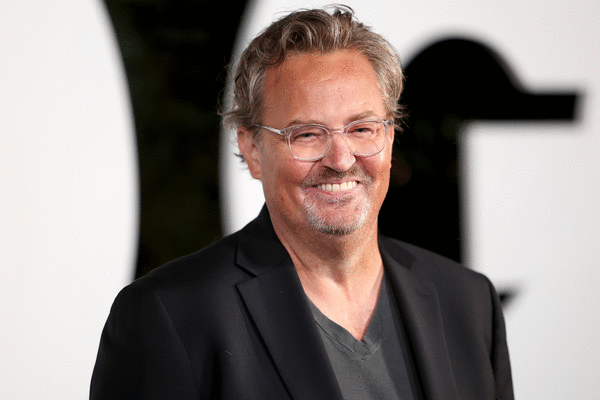
LOS ANGELES — A former live-in assistant to Matthew Perry was sentenced Wednesday to three years and five months in prison for distributing the ketamine that caused the actor’s death.
Kenneth Iwamasa, who previously made $150,000 a year working for Perry, pleaded guilty in August 2024 to conspiracy to distribute ketamine causing death. He admitted to repeatedly injecting Perry, 54, with ketamine without medical training, including multiple injections on Oct. 28, 2023 — the day of Perry’s death.
Perry, who had a history of drug abuse and addiction, was found dead in the hot tub of his Pacific Palisades home from acute effects of the drug. Iwamasa was among five people charged in connection with Perry’s death and is the final one to be sentenced.
The judge ordered Iwamasa to self surrender by July 17.
“Your conduct was reckless, not just on the day of his death, but leading up to his death,” U.S. District Judge Sherilyn Peace Garnett told Iwamasa, as she handed down her sentence.
While prosecutors noted in their sentencing memo that Iwamasa was the first defendant to cooperate against the others, they asked the judge to sentence him to more than three years in prison. They cited the former assistant’s responsibility for Perry’s medical care, knowledge of the actor’s addiction struggles and steps to remove and destroy evidence following Perry’s death.
“As defendant watched Perry spiral into darkness, he could have taken steps at any point to pull Perry back into the light,” prosecutors wrote in their sentencing memo.
“Defendant could have contacted Mr. Perry’s family members or sought professional help to address Perry’s drug relapse, or he could have simply said ‘no’ when Perry asked for another ketamine injection. But he chose not to help, and instead concealed the ongoing danger to Mr. Perry, which ultimately resulted in his death.”
It’s unclear what sentence Iwamasa’s attorneys are requesting.
In a reply to the government’s sentencing memo, Alan Eisner and Dmitry Gorin cited Iwamasa’s “particular vulnerability to the relationship dynamic which he fell into with the victim.”
“In short, he could not ‘simply say no,’” Iwamasa’s defense attorneys wrote. “That inability had tragic consequences.”
In letters to the judge ahead of sentencing, Perry’s loved ones said the actor had considered Iwamasa “family.” Suzanne Morrison, Perry’s mother, said Iwamasa’s No. 1 responsibility “was to be my son’s companion and guardian in his fight against addiction.”
After Perry’s death, Morrison wrote, Iwamasa insisted on speaking at the funeral and clung to the family, “as if he was somehow the good guy who tried to save Matthew.” She accused Iwamasa of threatening legal action “to pry a settlement from workman’s comp.”
“We trusted a man without a conscience, and my son paid the price,” Morrison wrote.
Iwamasa had known Perry since around 1992 and became his live-in assistant in 2022, according to prosecutors. His responsibilities included coordinating medical appointments and helping ensure Perry took medication that he was lawfully prescribed.
According to Iwamasa’s plea agreement, around September 2023, Perry requested Iwamasa’s help procuring illegal drugs. At that point, prosecutors said, rather than help Perry maintain sobriety, Iwamasa “became his enabler and drug supplier.”
Throughout October 2023, prosecutors said, Iwamasa repeatedly injected Perry “with doses of ketamine without proper medical training or the equipment necessary to ensure the drug was being safely administered.” They cited the fact that Iwamasa saw “clear warning signs that Mr. Perry was in danger.”
At least twice in October, Iwamasa found Perry unconscious in his home and also saw Perry “freeze up,” unable to speak after a large ketamine injection, according to the government’s sentencing memo. Despite that, prosecutors said, between Oct. 24 and 27, Iwamasa injected Perry with six to eight shots per day.
Iwamasa admitted that on the day of Perry’s death, at the actor’s direction, he injected Perry with a shot of ketamine in the morning and again while he watched a movie around midday. Less than an hour later, Perry asked Iwamasa to prepare the jacuzzi and “shoot me up with a big one.”
According to the plea agreement, Iwamasa filled a syringe with ketamine and administered it to Perry while the actor was in or near the jacuzzi. Soon after, Iwamasa left to run errands for Perry. When he returned, he found Perry’s body.
While being questioned by police officers, prosecutors said Iwamasa concealed the injections he’d administered and “also took steps to remove and destroy evidence related to Mr. Perry’s use of ketamine in the days leading up to his death.”
Prosecutors said Iwamasa later provided “significant and credible information related to the drug conspiracy.”
This month, a judge sentenced Erik Fleming, a former producer and drug counselor, to two years in prison for distributing the ketamine that killed Perry. Jasveen Sangha, known as the “Ketamine queen,” was sentenced last month to 15 years in prison.
Salvador Plasencia, a former physician who supplied ketamine to Perry in the weeks leading up to his death, previously was sentenced to 30 months in prison. Mark Chavez, another former doctor who played a role in providing the actor ketamine, was sentenced to eight months of house arrest.
In Morrison’s letter to the judge, she thanked the investigators for discovering the truth about Iwamasa and the judge for her “calm and careful deliberation.”
“And I have to say this: the word ‘closure.’ Such a thing doesn’t exist,” she wrote. “Ask any mother whose child has been torn away so mercilessly. Nothing takes this pain away, nor will it, I am sure, for as long as I live.”
©2026 Los Angeles Times. Visit at latimes.com. Distributed by Tribune Content Agency, LLC.





Comments