Garden Grove crisis exposes Southern California's hidden industrial risks
Published in News & Features
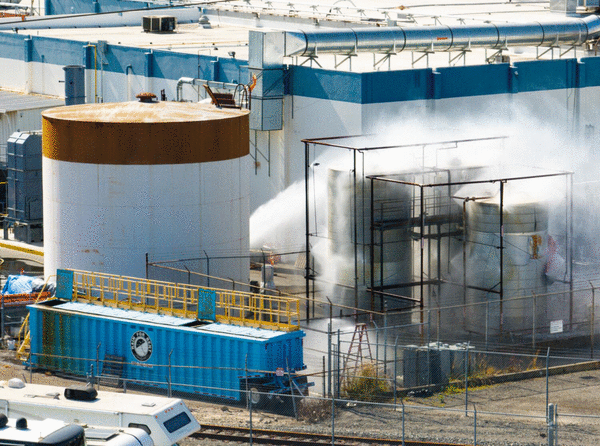
LOS ANGELES — The days-long threat of a catastrophic chemical explosion in Garden Grove has exposed the pervasive yet often ignored industrial risks hidden amid daily life in Southern California, where aerospace plants and petrochemical facilities are interwoven amid homes, schools and parks.
Now, experts say this aging infrastructure is converging with population growth and regulatory rollbacks that are increasing the likelihood that similar incidents will happen again.
The greater Los Angeles area became a global hub for aerospace and defense manufacturing around the start of World War II, with companies here producing military aircraft, electronics, plastics, petroleum products and other specialized materials that helped transform the region into a dense manufacturing zone even as its suburban footprint was expanding.
Many of those operations used petrochemical products and solvents such as resins, adhesives and acrylic compounds like methyl methacrylate, the chemical at the center of the Orange County crisis. While some of that work has slowed since the end of the Cold War, many industrial sites remain active and tucked among communities.
That makes the possibility of another Garden Grove incident a matter of “if,” not when, said Seth Shonkoff, executive director at the science research institute PSE Healthy Energy.
“It’s not really whether industrial accidents are possible in the L.A. Basin — they are,” he said. “The important question is whether regulatory systems, emergency preparedness and land use decisions are keeping pace with changing industrial hazards and growing urban densities.”
While the Garden Grove incident was in some ways an outlier driven by specific system failures, there are several factors that make it likely to now occur more often, said Shonkoff, who is also an associate researcher at the UC Berkeley School of Public Health.
They include global warming, which is increasing the average number of extreme heat days in Southern California, putting more strain on storage tanks and industrial processes that rely on the need to keep production materials cool.
At the same time, a lot of the region’s industrial infrastructure is aging, which also heightens their risk of leaks, cracks or failure.
But perhaps most critical is the push to build more housing in places where housing has not typically been constructed. Sometimes that means more people are moving into undeveloped areas along the wildland-urban interface, which can put them at greater risk for wildfires, but other times, it means they are moving closer and closer to industrial zones.
“When you increase the population density around these types of facilities, you are increasing the hazard that if something goes mechanically wrong, more people are going to be at risk,” Shonkoff said.
Many of these areas are home to low-income communities and communities of color that already experience disproportionate harms from pollution and other environmental hazards, said Deja McCauley, land use and health program manager with the nonprofit Physicians for Social Responsibility Los Angeles.
This has already been evidenced by previous environmental disasters, such as the decades of lead contaminants that spewed from the Exide battery plant in Vernon, or toxic dust and explosions from the Atlas Metals recycling plant in Watts.
Just last week, while emergency crews responded to the chemical crisis at GKN Aerospace facility in Garden Grove, 2,400 gallons of crude spilled into the Los Angels River near East Los Angeles, and a fire burned at a tire recycling center in South Gate, prompting a shelter-in-place order.
But while some communities are moving closer to existing industrial facilities, there are also regulatory changes that are making it easier for industrial facilities to be built closer to communities, McCauly said.
Last year, Gov. Gavin Newsom passed two controversial bills that overhauled the California Environmental Quality Act, or CEQA. The legislation exempted a broad array of housing development and infrastructure from environmental review in an effort to streamline construction and help address housing scarcity in California.
While some hailed it as a necessary cutting of red tape, critics said the move will expose more vulnerable communities to potential harms: The legislation included an exemption for advanced manufacturing facilities, such as semiconductor plants, nuclear facilities, industrial factories and other places that handle high-risk hazardous material, to be permitted in some communities without any environmental review.
At the same time, the Trump administration has taken steps to roll back regulations on emissions from industrial facilities, such as mercury and other toxics emitted from coal plants. Earlier this year, the administration said it will loosen limits on emissions of ethylene oxide, a cancer-causing chemical often used in the sterilization of medical devices, including at multiple facilities in Los Angeles.
“What’s happening at Garden Grove — we’re going to see a lot more of that due to these environmental rollbacks,” McCauly said.
A new state bill, SB 954, is now advancing through the legislature and would restore some of the CEQA protections that were removed last year, including narrowing the types of facilities that can bypass environmental review and providing more guidelines for siting sensitive places such as schools, homes and daycares, among other changes.
But part of the reason communities here remain vulnerable to incidents like Garden Grove is that many people aren’t aware of the region’s long history of industrial manufacturing, said Peter Westwick, an adjunct history professor at USC and director of the Aerospace History Project.
“Its association with Hollywood, which is what most people probably think of as ‘the industry’ in L.A., has probably obscured the manufacturing presence, along with L.A.’s suburban image,” Westwick said.
Even before the manufacturing and aerospace boom, L.A.’s industrialization started with natural resource extraction driven by the oil industry, he said — a legacy that also continues to pose threats such as the Chevron refinery explosion in El Segundo last year.
From the 1940s to the 1960s, L.A. also had a thriving auto industry that was second only to Detroit, producing half a million cars at its peak.
“All this manufacturing provided a lot of jobs and drove L.A.’s remarkable growth in the early and mid 20th century, but it had a major legacy in air pollution, groundwater contamination and so on,” Westwick said.
He added that “the current emergency is Garden Grove is just an example of this longer embedding of industry around L.A.”
For now, much of the responsibility for managing the risk falls to individuals. Tools such as CalEnviroScreen or PSE’s methane risk map can help people locate pollution sources, toxic facilities and other threats in their area.
State agencies such as the California Air Resources Board, the California Environmental Protection Agency and the Office of Environmental Health Hazard Assessment also offer various guidelines or enforcement mechanisms, but their jurisdictions are fractured and disjointed, said Shonkoff, of PSE Health Energy.
He said the biggest factor that will determine when the next Garden Grove happens is not individual actions, but how industry and regulators approach the safety of these facilities, including where they should be sited.
“The onus should be put on the facilities to manage their risk,” he said, “and also on regulators to make the important decisions of when ‘close’ is too close.”
©2026 Los Angeles Times. Visit at latimes.com. Distributed by Tribune Content Agency, LLC.





Comments