How Epstein tried to amass money, power and women in Africa, records show
Published in News & Features
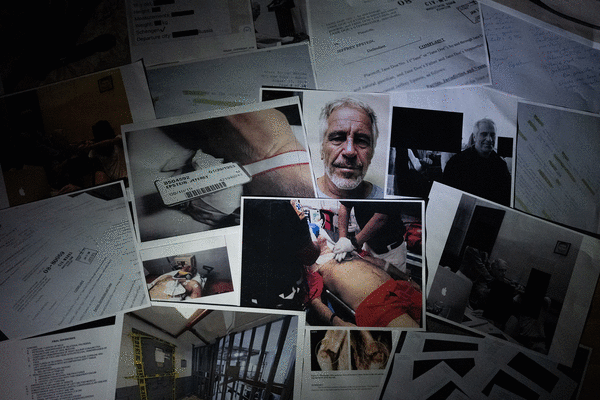
In the years before he was found dead in a Manhattan jail cell in 2019, Jeffrey Epstein cultivated elite circles across the length and breadth of Africa.
When Senegal was investigating the son of a former president for corruption, Epstein offered him his Palm Beach, Florida, mansion and spent hundreds of thousands on his legal fees, including hiring a top law firm to lobby Congress and the State Department to apply pressure on Senegal to release him.
“(V)ery glad to have you back,” Epstein wrote to him shortly after he was released from prison. “(W)e can skype when you like ... we can share incarceration stories.”
Epstein also did not shy away from military or political minefields.
He attempted to cultivate a relationship with Moammar Gadhafi, the strongman who ruled over oil-rich Libya in North Africa in late 2010. But when Gadhafi’s hold over Libya started weakening a few months later, Epstein turned his attention to the leaders of the anti-regime rebels, one of whom now lives in West Palm Beach.
In a meeting at his Palm Beach mansion in 2018, he offered advice to a Nigerian-born businessman who the following year would become CEO of a high-end New York fashion house. The investor was trying to make a deal with the Swiss company operating lucrative mines in Central Africa. The U.S. had imposed sanctions on the company due to its ties with a Russian oligarch.
“(I)f you had a meeting with the appropriate division of (T)reasury, im sure you can structure around it,” Epstein wrote.
Epstein wasn’t merely trying to ingratiate himself to amass money and power. On at least two occasions, he was on the prowl for women who could be sent to him, preferably younger and white, the files show.
“I prefer under 25,” he emailed a woman referred to him by a model he had known in New York, the niece of the Ivory Coast president. He was asking about the woman’s sister.
In another email to European modeling scout Daniel Siad, who had contacts in South Africa, Epstein explicitly said he was willing to cover the travel expenses of South African women to be brought to him, but “not the dark one.”
The Miami Herald sent a series of questions to Siad through his attorney but didn’t receive a response.
The Herald’s reporting on this story is based on the millions of pages of records released by the U.S. Justice Department earlier this year to comply with the Epstein Files Transparency Act passed by Congress in 2025.
A president’s son in trouble; Epstein hires top law firm
In 2010, Epstein’s longtime friend, Emirati businessman Sultan Ahmed bin Sulayem, introduced him to Karim Wade, the son of the then-president of Senegal in West Africa.
At the time, Wade was so powerful and held so many key government portfolios in his country that he was nicknamed the “Minister of Heaven and Earth.”
Epstein and Wade, who was born in Paris and studied at the Sorbonne, struck up a relationship that lasted several years and corresponded regularly, the records show.
Epstein introduced him to a network of global financiers and economic experts, including former U.S. Treasury Secretary Larry Summers, J.P. Morgan’s Jes Staley and Chinese property tycoon Desmond Shum, the records show. Epstein hosted him in his properties and also gave Wade custom sweatshirts with the Senegalese flag and Wade’s initials.
Roughly two years after Epstein and Wade struck up their friendship, the Senegalese politician was in trouble. Wade and his father lost the elections in 2012 and the new government accused them of illicitly enriching themselves while they had held office.
While Senegal’s investigators scrutinized the Wade family’s assets and pressure on Karim Wade grew, Epstein offered him and his family his Palm Beach mansion.
“(Y)ou and your family are welcome to use my house in Palm Beach, staff is there, pool etc (sic),” Epstein wrote to him that year. “(Y)ou will not suffer.”
Wade declined. Senegal charged Wade with illegally amassing roughly $1.4 billion and arrested him the next year. He was convicted and sentenced to six years in prison in 2015.
Over the next few years, Epstein corresponded regularly with Wade’s attorneys in Senegal, met at least one of them in Paris and helped mutual friends meet Wade in prison, the records show.
He paid at least $500,000 to one of the Senegalese attorneys representing Wade. On Wade’s request, Epstein also paid an additional $100,000 to Nelson Mullins Riley & Scarborough in 2015, a large law firm with a Washington office that counts among its alumni Secretary of State Marco Rubio and former Education Secretary Richard Riley.
The firm, the records show, lobbied the U.S. Congress and State Department, saying Wade’s imprisonment was politically motivated and pressured the Senegalese government to release him.
“I want my friend back,” Epstein wrote in a January 2016 email.
Nelson Mullins did not respond to the Herald’s request for comment.
Senegalese President Macky Stall granted Wade a pardon on June 24, 2016. He served three years of his six-year sentence and flew to Qatar that same night.
The Herald sent a list of detailed questions to Wade’s attorney about Wade’s relationship with Epstein. He did not respond.
Asks ex-model to find him women
Among the many people Epstein contacted in his efforts to free Wade from prison was Nina Keita, the niece of Alassane Ouattara, the Ivory Coast president. Epstein had introduced her to Wade, telling him that she had “a long crush” on him. She also visited Wade while he was imprisoned at least once, according to the released files.
Epstein got acquainted with Keita when she was a model in New York in the early 2000s. Flight logs show she had been a passenger on Epstein’s private Boeing 727 airplane, dubbed the “Lolita Express.”
Keita introduced Epstein to her uncle, the Ivory Coast president, and the two met at the Waldorf Astoria in New York in September 2011. The next year, she organized a trip for Epstein to travel to the Ivory Coast where he met with Outtara again and the country’s ministers of economy and the interior.
But Epstein’s entreaties to Keita were not limited to business. Epstein, the records show, often asked Keita to introduce him to other women she knew.
“I hope you have a very cute friend in ny (sic) for next week,” he wrote in a June 2011 missive to her, a week before he traveled to New York.
“(H)ave you found me a new girlfriend?” Epstein wrote in another email a few months later.
In one instance, after Epstein met one of the women whom Keita had introduced him to, he instructed Keita to ask the woman to send him pictures of her 18-year-old sister.
“I prefer under 25,” he wrote to the woman, who later sent Epstein her sister’s contact information and told him she was expecting his call.
The siblings’ fate is unclear.
Keita, now an executive at Ivory Coast’s state oil company, did not respond to the Herald’s detailed questions about her relationship with Epstein. Her attorney instead threatened litigation and said the Herald’s reporting was based on “unfounded assumptions.”
He did not respond when the Herald asked him to specify which parts were inaccurate and shared with him the correspondence between Keita and Epstein.
Prince Andrew connection
In 2010, the same year Epstein first made Wade’s acquaintance, he was seeking to become Libyan dictator Moammar Gadhafi’s financial adviser.
He reached out to Prince Andrew of Great Britain, who, Reuters reported, had a relationship with the strongman’s son, to help arrange a meeting in Tripoli, the Libyan capital. King Charles III stripped Prince Andrew of his royal titles last year due to his Epstein connections; he now goes by Andrew Mountbatten-Windsor.
“(H)e (Gadhafi) does not know where to put his money,” Epstein wrote in an October 2010 email to the prince’s aide.
Epstein heard back from then-Prince Andrew roughly a month later: “Libya fixed.”
It is unclear whether Epstein traveled to Tripoli and met with the Libyan strongman. Mountbatten-Windsor did not respond to the Herald’s request for comment.
Around six months after the prince’s email, Epstein started exploring potential business ventures with the anti-Gadhafi rebel forces, who ousted and killed the dictator in 2011.
Western governments and banks had frozen billions of dollars of Libyan assets since the beginning of the civil war that year. Gregory Brown, the founder of a Beverly Hills company called GlobalCast Partners, LLC, contacted Epstein and sought his help in freeing those funds for the rebels, who later formed the provisional government after Gadhafi’s fall.
In exchange, the two would keep a share as their cut or get access to the country’s crude oil at discounted rates, making, in Brown’s words, “hundreds of millions if not billions.” Brown described it as the “largest treasure hunt opportunity in the world” and claimed to have friends in British and Israeli intelligence who could help them.
But Epstein first wanted to meet Ali Tarhouni, a former Seattle-based economist, who led the provisional government’s financial and commercial committee.
“He (Tarhouni) should be talking to me, re: setting up financial institutions over the next couple of months,” Epstein wrote in an Aug. 26, 2011, email to Brown. It was the same day Tripoli fell to rebel forces after a week-long battle.
It is unclear from the records whether such a meeting took place.
Tarhouni, who now lives in West Palm Beach, did not respond to the Herald’s requests for comment.
Brown did not respond to the Herald’s multiple requests for comment. The Herald also contacted two other individuals who were listed as company executives in the now-defunct website of Brown’s GlobalCast Partners. They did not respond either.
A British lord, Epstein and banking project in Congo
In January 2011, Britain’s Lord Peter Mandelson, who had just left the Labour government and had opened a consulting firm, emailed Epstein for his thoughts on a Congolese banking project.
The project, codenamed “COLIBRI”, was the brainchild of Rigobert Andely, a former central banker and ex-finance minister of the Republic of Congo, also known as Congo-Brazzaville.
Andely’s aim was to create a bank that would finance the country’s oil and mining industries, offer advisory services to public and private entities, and participate in government debt transactions, the records show. He contacted Mandelson for help with connecting him with potential investors.
Mandelson, in turn, sent Epstein details of the project and asked for an assessment on Jan. 14, 2011. He also arranged a meeting between Epstein and Andely in Paris roughly two weeks later.
“(He) is a good friend and totally trustworthy,” Mandelson wrote to Andely. “You can be open with him.”
But Andely was called away that day to Brussels on government business. The records do not show what discussions Epstein and Andaly had later.
Andely could not be reached for comment.
Mandelson, a former British ambassador to the United States who was fired in September amid his ties to Epstein, did not respond to the Herald’s queries. British authorities arrested him earlier this year for allegedly passing sensitive government information to Epstein while in office. He has not been charged and is out on bail.
This was not the only time Epstein was associated with dealings in the Congo Basin.
Advises ex-CEO of New York fashion house
In 2021, Jide Zeitlin, the Nigerian-born former CEO of Tapestry, the New York fashion house that owns Coach and Kate Spade, had his eyes set on the Democratic Republic of Congo’s vast reserves of minerals and metals.
Swiss commodities giant, Glencore, which owned the mines, was at the time the subject of a U.S. Justice Department probe into bribery allegations. Zeitlin was lobbying Congress to ensure that any settlement the U.S. reached with Glencore should involve the sale of the company’s Congo mines to his investor consortium, according to federal lobbying records reviewed by the Herald and a 2021 New York Times report.
Zeitlin’s involvement with Glencore started years before 2021.
Among the people he used as a sounding board: Jeffrey Epstein.
Steve Bannon, the right wing politico with ties to President Donald Trump, introduced Zeitlin to Epstein in 2018. At the time, Zeitlin was chair of Nigeria’s sovereign wealth fund.
The same year Zeitlin met Bannon, the U.S. Treasury imposed sanctions on two companies Glencore partially owned. The Treasury targeted those companies because they were controlled by Russian oligarch Oleg Deripaska.
Epstein and Zeitlin discussed the sanctions issue at the financier’s house in Palm Beach on May 4, 2018, the records show. The next day, Zeitlin wrote to him and thanked him for his thoughts.
Epstein understood that his discussions with Zeitlin were sensitive and asked to talk further in-person in Palm Beach.
“This channel is NOT secure,” he wrote to Zeitlin on May 21, 2018, three days after the Financial Times reported that British authorities were also investigating Glencore over its dealings in Congo.
Through the next year, Glencore restructured its holdings to comply with U.S. regulations; the U.S. lifted sanctions on the two companies in 2019.
Zeitlin’s maneuvers in Congress did not work out. Glencore agreed to pay the Justice Department $1.1 billion in 2022 to resolve the investigations. The firm still operates the Congolese mines.
The released records suggest Zeitlin started to distance himself from Epstein after the Miami Herald published its investigation into the financier in late 2018.
Zeitlin declined to comment. He resigned as Tapestry’s CEO in 2020 after its board investigated allegations by a woman who accused him of “posing as a photographer under an alias to lure her into a romantic relationship more than a decade ago,” according to the Wall Street Journal.
The FBI arrested Epstein in July 2019 on sex-trafficking charges. He was found dead in federal custody a month later on Aug. 10, 2019.
_____
(Miami Herald staff writer Grethel Aguila contributed reporting.)
©2026 Miami Herald. Visit at miamiherald.com. Distributed by Tribune Content Agency, LLC.




Comments