The Flores twins built a drug empire with El Chapo -- then betrayed him
Published in News & Features
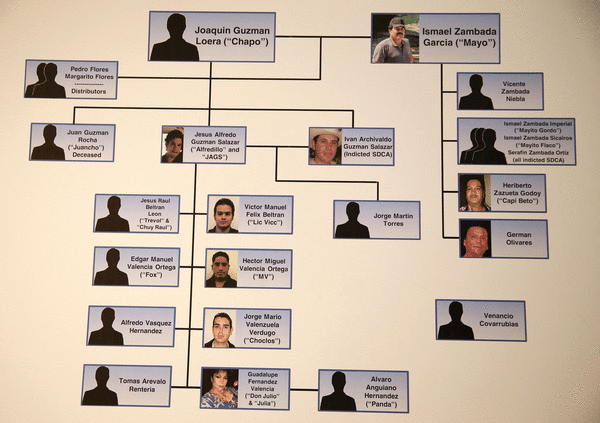


To build their billion-dollar drug empire, the Flores brothers worked together as a perfect machine.
Identical twins born in Chicago to Mexican immigrant parents, they could communicate without speaking — just a raised eyebrow or grunt would do.
Pedro, who went by Pete, had the smarts and discipline to manage a sprawling bi-national business. Margarito, known as Jay, brought the charm and deal-making savvy.
By their early 20s, they were doing business with the world’s most powerful drug lords, including Sinaloa cartel chief Joaquín “El Chapo” Guzmán.
The twins were born into the drug trade and had grown up on gangster flicks like “Scarface,” but several brushes with death convinced them they didn’t want to end up like the film’s protagonist, Tony Montana, a cocaine smuggler killed in a hail of gunfire.
So they made a dramatic choice that put a target on their backs forever:
They snitched.
Their spying helped bring down El Chapo and marked the starting point of a trend of high-profile drug lords cooperating with federal authorities that continues to this day. But it came with a price — the twins were convicted of drug trafficking and sentenced to prison.
Today they are free men living thousands of miles apart, each pursuing a very different path toward what they hope is redemption.
One has adopted an assumed identity, reinventing himself as a suburban dad with a job that has nothing to do with the drug trade. The other lives a very public life as a media cartel expert and a consultant to law enforcement, cashing in on his unusual expertise. Their separation is for the best, Pete says: “We make too much noise when we’re together.”
But he worries about Jay, whose appearances on Fox News, meetings with members of Congress and training sessions with cops, he fears, put the whole family at risk.
They all remember the judge’s warning at their sentencing hearing in 2015.
“You and your family will always have to look over your shoulder,” he told the brothers, who sat side by side in the courtroom in matching prison uniforms, anxiously tapping their feet. “Any time you start your car, you’re going to be wondering: Is that car going to start, or is it going to explode?”
It was not an exaggeration.
Their father, after all, had already paid the ultimate price.
_____
From the outside, Margarito Flores Sr. was a model immigrant. He drove a forklift at a candy factory and parked a station wagon in front of his tidy home in Little Village, a Mexican American enclave on the South Side of Chicago. But he had a secret.
Margarito Sr., who hailed from Zacatecas state, was smuggling people and drugs. In 1981, he sold 11 pounds of heroin to an undercover federal agent and was arrested in front of his children and his wife, who was pregnant with the twins. He was in prison when Pete and Jay were born three months later.
For the precocious, bright-eyed twins, childhood ended the day their father came home from prison when they were 7 years old. He didn’t smoke, didn’t drink and told them only weak people used drugs. He assigned them grueling chores and taught them that respect between men was everything. “Every other word was a swear word, even when he was happy,” Jay said.
It wasn’t long before Margarito Sr. went back to the family business and introduced his sons to the rhythms of life as a cartel mule. Some of their earliest memories are of road trips to Mexico, where their father put them to work picking and packaging marijuana.
He relied on their small hands to remove gas canisters from vehicles, revealing cavities that he then packed with drugs. Later, the family would drive together across the border, the novelty of identical twins helping distract federal agents tasked with inspecting cars.
After Margarito Sr. faced more legal troubles in the U.S., he and his wife fled to Mexico with the twins. Eventually the boys returned to Chicago to live with their older brother Armando, a rising figure in the Latin Kings street gang. They slept in the basement while Armando sold drugs upstairs.
Around then, another older brother, Hector, died of a heroin overdose. Their father told the family to move on. “We mourned him, did the rosary and got back to business,” Jay said.
A few years later, Armando went to jail and the twins lived on their own, with bills piling up on the dining room table. They were 17.
When an associate of Armando’s asked if they could move some cocaine, they agreed. Within weeks, they had hundreds of thousands of dollars stashed under their beds.
Life became a blur of drug deliveries and cash that needed counting. They acquired a fleet of cars and a cache of burner phones and began renting stash houses around the city that they filled with cocaine and money.
They weren’t yet of drinking age, but they were well on their way to paving what a Chicago judge would later describe as “a highway of drugs into this city.”
_____
The brothers bickered at times. Jay, a born optimist, found Pete too negative. Pete thought Jay was gullible. But when it came to business, they shared a clear vision.
Bilingual and comfortable on both sides of the border, they were consummate middlemen, interfacing between Mexican suppliers and dealers on inner-city streets.
They received shipments of thousands of kilos of cocaine, transported in cars, tractor-trailers and trains, which they distributed in Chicago and nearly a dozen cities, including Los Angeles, New York, Minneapolis and Louisville, Kentucky.
Armando had encouraged the brothers to work at McDonald’s when they were teens to learn the ins and outs of a successful business. They applied those lessons to the drug trade, striving for consistency with their product and making sure each of their workers had a role that was clearly defined. They employed a team of mechanics that fitted cars with stash compartments to hide cocaine, and a paralegal whose job was to monitor ongoing drug cases.
The twins scoured criminal complaints, and kept a copy of federal sentencing guidelines at hand — a template for what not to do.
They splurged on jewelry, clothes and motorcycles and partied at the hottest clubs and fanciest restaurants. Pete, who enrolled in college despite his father’s insistence that it was a waste of time, pulled up to school in a brand-new Range Rover.
But their flashy lifestyle began attracting the attention of rivals. And the feds.
In 2003, another gangster kidnapped Pete. Jay paid his ransom in cocaine. Soon after, a grand jury indicted the brothers on drug charges.
They did what other relatives had done when facing legal troubles: They fled south.
Jay and Pete brought their soon-to-be wives: Valerie and Viviana. Both were daughters of Chicago police officers.
_____
Life in Jalpa, Zacatecas, was more peaceful than in Chicago. Days dawned with the crowing of roosters and ended with blazing sunsets. The brothers often hiked up a hill to a famed 19th-century sanctuary honoring the Virgin of Guadalupe. Sometimes the power went out and there was nothing to do but talk and play board games by candlelight.
But the twins continued to run their business, using multiple phones to oversee dozens of employees back in Chicago. The money poured in, and they spent it, buying up ranches and beach homes across Mexico. They bet tens of thousands of dollars at local horse tracks and splurged on diamond-encrusted watches.
Once again their flamboyant habits drew attention.
In 2005, a business deal with a drug supplier named Guadalupe Ledesma went awry. He sent goons after Pete, who was handcuffed, blindfolded and stuffed in a trunk.
Ledesma held Pete at a safe house for weeks while Jay desperately sought his release.
That is how Jay found himself on a private plane soaring through the skies of Sinaloa state to a rugged mountain hideout to meet Ledesma’s boss: El Chapo.
The notorious kingpin was known for his wealth and for his wiles, including a daring escape several years earlier from the most secure prison in Mexico. He was known, too, to be ruthless.
Jay’s palms sweat as El Chapo sized him up, his lazy eye unmoving. Despite the cold reception, Jay says, the drug lord eventually ordered that Pete be freed. He also made an offer.
“We can do business,” Jay said El Chapo told him. “We can keep making money together.”
Soon after, Pete was released — and Ledesma turned up dead.
Guzman told the twins he’d had one of his workers suffocate Ledesma with a plastic bag.
_____
Once they began doing deals with El Chapo and other top Sinaloa leaders, including Ismael “El Mayo” Zambada and Arturo Beltrán Leyva, the drugs really started flowing.
U.S. authorities say that by 2008, the twins each month were trafficking up to 4,400 pounds of cocaine — with a street value of more than $100 million.
But more money meant more problems. During a night out at a Puerto Vallarta strip club with Chinese suppliers of the precursor chemicals used to cook meth, the twins and their wives were kidnapped by crooked cops.
They were released only after the intervention of Beltrán and the local plaza boss, Nemesio Rubén Oseguera Cervantes, known as “El Mencho.” He would go on to form the powerful Jalisco New Generation Cartel before being killed by Mexican authorities in February.
It started to feel as though the world was closing in on the twins, who both now had families of their own to think about. Pete’s wife, Viviana, had just had a baby.
Jay, who had two daughters with his first partner back in Chicago, now had a son with Valerie, who was pregnant with his fourth child.
Valerie begged Jay to leave the drug trade. Her first husband had been imprisoned for selling drugs and her second husband had been shot and killed. “I don’t want that for us,” she pleaded.
The U.S. investigation into the twins was widening. And rifts were forming in the Sinaloa gang, pitting Beltrán against El Chapo. The twins, who prosecutors said always eschewed violence, weren’t sure they would survive a looming cartel war.
One night in 2007, Jay was watching a documentary about the mobster John Gotti, who was betrayed by an underling who testified against his former boss.
What if the twins did the same?
“We just wanted to stop running,” Pete recalled. “We wanted to do the right thing for once and change our lives.” They were 26 at the time.
“It’s gonna hurt,” Pete remembers thinking. “But one day we’ll look back and hopefully say it was worth it.”
_____
Pete arranged a secret meeting with U.S. drug agents in Mexico and began negotiating a deal.
Officials said the twins could plead guilty and probably receive a reduced sentence if they produced dirt on El Chapo and his associates. But they needed to provide hard proof.
For months, the brothers lived as double agents, continuing to run their drug business while secretly taping dozens of conversations with their partners. In 2008, they even recorded phone calls with El Chapo in which they discussed a heroin deal.
Shortly thereafter, the U.S. government pulled the twins and their families out of Mexico. The brothers were held in protective custody and spent months being interviewed by authorities.
The twins’ information helped the U.S. seize hundreds of kilos of cocaine and heroin and millions in drug profits.
It “led directly to the charging of approximately 54 defendants in 2009,” according to their sentencing memorandum. That included El Chapo, who was recaptured by Mexican authorities, escaped again from prison, was captured again and eventually extradited to the U.S. and convicted on murder, drug and weapons charges.
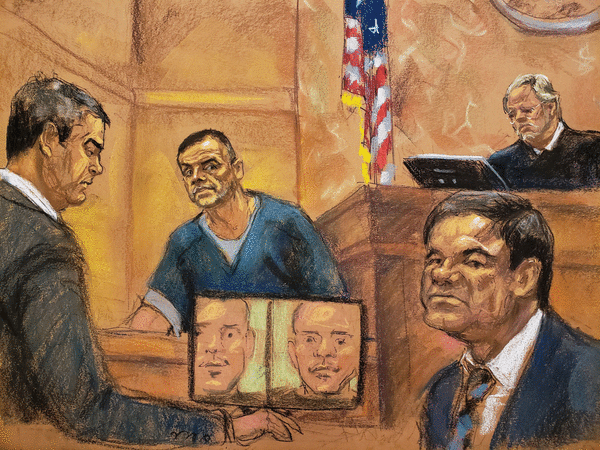
Pete would serve as a star witness at the kingpin’s 2019 trial, describing drug deals with the capo and the circumstances surrounded Ledesma’s death.
But the twins’ father was livid when he learned his sons had turned on cartel leaders.
“You don’t know what they’re capable of,” Margarito Sr. told the twins. “They’re going to kill all of us.” He disowned his sons, whom he dismissed as “cowards.”
In 2009, he crossed the border back into Mexico despite U.S. government warnings. Soon after, he went missing. His burned-out car contained an expletive-laden message, warning the twins to “shut up.” His body was never found.
From prison, the twins were guilt-ridden. But they also blamed their father.
“He chose that life,” Jay said. “And that’s the life that ruined our family.”
Prison is hard for anybody. The worst part for Pete and Jay was that they were separated, shuffled around to different penitentiaries across the country.
They had spent their entire lives together. Now they had to learn how to live behind bars and on their own.
Jay mastered chess, studied the law and became an evangelical Christian. Pete, also drawn to Christianity, started leading Bible study.
They had ample time for reflection. Both thought at times about Hector, the brother who overdosed. The twins hadn’t just supplied drugs; they had seen, in their own family, their corrosive impact.
They were reunited in 2015 for their sentencing in Chicago after both pleading guilty to drug trafficking charges. Jay cried as he told the judge: “I’m ashamed. I’m embarrassed. I’m regretful.” He apologized for putting his family in harm’s way.
Pete asked for forgiveness, too, saying he was ready to take “full responsibility” for his life.
The government credited the Flores brothers with helping the U.S. understand the inner workings of the Sinaloa cartel, including details of killings, kidnapping and the 747s El Chapo used to move drugs from Central America
The judge sentenced them each to 14 years, including the seven they had served while waiting for their trial. He warned that they were “going to leave here with a life sentence” regardless because their cooperation imperiled them and their families.
He added that he didn’t believe they had turned over all of their drug proceeds to authorities. “Everyone in this city thinks that you have money,” he said.
Months after the twins were released from prison in 2020, their wives and three other relatives were indicted, accused of burying millions of drug profits under the porch of a home in Texas. Valerie and Viviana served time in jail.
The twins, finally free and still only in their early 40s, had to figure out what they wanted to do with the rest of their lives.
“We got out and started at zero,” Pete said.
“I think it was negative zero,” countered Jay.
_____
Pete got a regular job, in an industry he does not want to name. The day he received his first paycheck — for $2,200 — was one of the happiest of his life. “It felt like my first 2 million,” he said. “I feel rich in ways I can’t explain.”
Pete is eager to leave the past behind. He spends his days taking his kids to soccer practice, cooking dinner and watching Netflix with his wife. None of his friends or neighbors know his true name or story.
“I’m a new person,” Pete said. “I just want to live my life quietly and move on.”
Pete is traumatized by the anguished nights he spent in captivity in Mexico, wondering whether he would be killed. He is still haunted by what happened to his father.
He hopes he’s setting an example for his children, whom he’s pushing to go to college. “We used to think about leaving them a fortune, but all that would have done is put them in danger,” he said.
When Jay left prison, his wife urged him to take Pete’s path. “We have a clean slate to just restart,” she pleaded. “Let’s act like this never happened.”
But Jay felt a calling.
He had seen a former police officer on TikTok talking about how smugglers hide drugs in cars. Jay realized he knew more than this so-called expert, so he launched a business, Kingpin to Educator, offering services as a kind of all-around cartel savant. “Who better than somebody who did it and got away with it?” he said.
He consults on film and television projects, coaches defendants who have decided to cooperate with prosecutors and travels the U.S. for law enforcement training. He dreams of having the opportunity to shape the nation’s drug policy — and of advising President Donald Trump.
When he appears on television, as he did often in the wake of El Mencho’s killing, he wears a face mask in an effort to conceal his identity.
That doesn’t stop the wrath that comes his way. Jay often receives hate mail from people calling him a snitch or warning that he’s a “dead man walking.” At the same time, some of the police whom he consults with have slammed him for not serving more time in prison.
On a chilly morning this winter, Jay strode in a conference room filled with detectives, drug agents and prosecutors from across the East Coast. He was freshly shaved and wore a collared shirt beneath his Tommy Hilfiger sweater. Most of the cops sported work boots, jeans and beards.
When Jay appears in public or on TV, he wears a mask to hide his identity, but when he meets behind closed doors with police he does not.
He had been speaking for only a couple of minutes — criticizing the U.S. drug war for failing to reduce the quantity of drugs available on American streets — when a hand shot up.
“How long were you with the cartel?” a man asked.
For Jay, the question smacked with naivete. The drug trade, he said, depends on the work of many independent contractors, from the farmer who grows the coca plant to the mechanic who installs the trap compartment to the dealer who sells cocaine on the street.
“This is not a war, it’s a business,” he said. “We need to treat it that way. We need to make it so unprofitable that no one wants to go into the business to begin with.”
In his years as a trafficker, Jay said, law enforcement had intercepted many of his drug loads, but never once the piles of cash he sent south.
The U.S., he said, needs to stop obsessing over catching bogeymen like El Chapo and focus on targeting cartel financial operators, the guns that pour from the U.S. into Mexico and addiction among Americans.
_____
Pete and Jay are 45 and live on opposite sides of the country. Their meetings are rarer now — and feel different. They can still communicate without saying much, but their points of view have shifted.
Pete thinks it’s odd that some of Jay’s best friends are law enforcement officers and lawyers, his phone ringing daily with calls from interdiction officers asking advice.
Pete is still bitter that the government went after their wives, and that he and his brother didn’t get lighter sentences considering all they did. “We risked everything,” he said.
Jay regrets that he can’t share his current chapter with Pete.
“It’s a little bit sad that I feel like I don’t know my brother as well,” Jay said, “and that he doesn’t know me.”
His brother might not understand his mission, but he hopes that it will help clear their name. “I want to take something negative and make it positive,” he said. His new dream: having a southbound border checkpoint named after him and his twin.
©2026 Los Angeles Times. Visit at latimes.com. Distributed by Tribune Content Agency, LLC.






Comments