California announces new $3,500 rebates for electric vehicles. Here's how to get one
Published in Business News
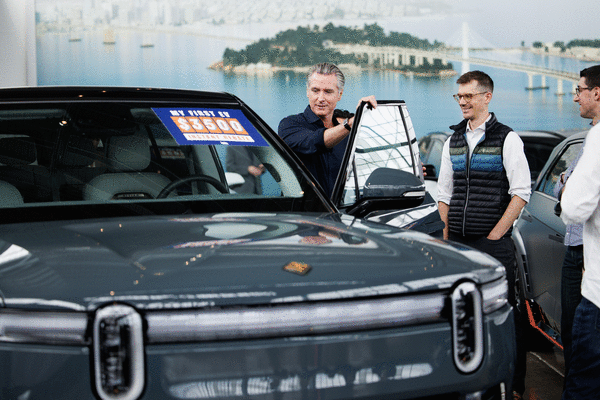
A new program to provide incentives for people who are buying their first electric vehicle in California is up and running, Gov. Gavin Newsom announced Friday.
The program, approved by lawmakers in Sacramento last month, is aimed at offsetting the loss of federal EV incentives that were eliminated last year by President Trump and Republicans in Congress.
Under California’s new initiative, called “My First EV,” first-time EV buyers who purchase a new electric vehicle with a sticker price under $50,000 will be provided a $3,500 rebate. And First-time EV buyers who buy a used electric vehicle for less than $25,000 through manufacturers’ pre-owned vehicle programs will receive a $1,750 rebate.
Plug-in hybrids aren’t eligible. And the price caps don’t apply to EV companies with headquarters in California, so all Lucid and Rivian vehicles qualify.
The rebates are given at dealerships and deducted from the car’s purchase price on the day of sale. The state program will pay half of each rebate, and 13 automakers have agreed to match it. The first three to have their programs up and running Friday were Tesla, Hyundai and Lucid.
By the end of August, Ford, Chevrolet, Rivian and Kia will join the program. In September, Toyota, Lexus, Honda and Subaru also will join, followed by Mitsubishi in November. Nissan and Volvo haven’t yet announced their launch timelines.
“While Donald Trump is hellbent on burning more expensive fossil fuels and raising costs for Americans, California is proving there’s a better way,” Newsom said.
He noted that China is “flooding the zone” worldwide with low-cost EVs, and the United States is at risk of losing out on a booming world market. According to the International Energy Agency, 25% of all new car sales globally last year were electric. Americans bought 1.2 million. Europeans bought 5 million. Chinese residents purchased 14.3 million.
“California is showing the world what real economic security looks like,” Newsom added. “It’s one that can’t be held hostage by foreign conflicts and Big Oil. The Golden State is leading the charge on building a reliable, affordable clean future.”
There are now 216,000 public EV charging stations in California, in addition to hundreds of thousands of home charging stations, Newsom noted, far more than the 120,000 gasoline pumps statewide.
Cars, trucks and other forms of transportation emit 60% of the smog in California and 40% of the state’s greenhouse gas emissions.
California has reduced air pollution dramatically over the past 50 years. That’s due to tougher rules on factories, power plants and vehicles that began when Ronald Reagan was governor, along with smog-check requirements for motorists, cleaner-burning diesel and gasoline blends and incentives for electric vehicles. But because of the state’s large population, hot summers and geography that can trap smog in valleys, many areas, including the Central Valley and Los Angeles, still do not meet federal health standards under the Clean Air Act, and have rates of childhood asthma and other pollution-related ailments higher than the national average.
The California Air Resources Board estimates the $135 million lawmakers provided to fund the EV rebate program, along with automakers’ matching funds, will cover 73,000 vehicle sales. At California’s current rate —132,624 EVs sold through June 30, or about 22,000 a month — the rebate funds are likely to run out by the end of this year.
On Friday, at a news conference in Oakland with Newsom, Laura Renger, president of the California Electric Transportation Coalition, a coalition of automakers and electric utilities, said EVs have lower operating costs than gasoline-burning vehicles.
“We have found that when drivers go electric they don’t go back,” she said. “That’s because all of the benefits of an electric vehicle. They are quiet. They are responsive. They are easy to maintain. They are increasingly affordable, and they are enjoyable to drive. But people cannot access cars if they are not able to afford them.”
EV prices vary widely. The cheapest 2026 models, like the Chevrolet Bolt with a sticker price of $28,995 or the Nissan Leaf at $31,535, are comparable to many new gasoline-powered cars, like the Toyota Camry at $29,600 or the Honda CR-V at $30,920.
Other EVs like the Hyundai Ioniq 5, at $36,600, the Tesla Model 3 at $38,380 or the Ford Mustang Mach-E at $39,840 are comparable to higher-end gasoline cars. And others like the Tesla Model X luxury SUV, which costs $91,380, are more expensive than most gasoline vehicles.
Electric vehicles have faced major headwinds over the past year. Trump has reversed or blocked many of the federal incentives put in place by former President Joe Biden.
Last September, Trump and Republicans in Congress eliminated the federal tax credit of up to $7,500 for the purchase of new electric vehicles and $4,000 for used EVs. They let a law expire that allowed states to permit solo EV drivers to use carpool lanes on federally funded highways, ending that perk nationwide.
Trump also signed a resolution blocking California’s first-in-the-nation regulations banning the sale of new gasoline-powered passenger vehicles by 2035, which Newsom put in place in 2020. California has filed a lawsuit over that issue, which is still pending.
Trump held a White House ceremony last year, saying California’s rules limited consumer choice. He revoked federal permission for the ban, called a “waiver,” that the U.S. Environmental Protection Agency had given to the state when Biden was in office.
“We officially rescue the U.S. auto industry from destruction by terminating the California electric vehicle mandate once and for all,” Trump said. “They said it couldn’t be done. It’s had us tied in knots for years. They passed these crazy rules.”
California has more electric vehicles than any other state.
In 2012, there were about 30,000 electric vehicles on the road in California. Since then, 2.7 million EVs have been sold in California, according to data from the California Energy Commission. The top-selling model of any passenger vehicle, gas or electric, statewide this year is the Tesla Model Y.
As battery technology has improved in recent years, with many models now able to travel more than 300 miles when fully charged, EVs made up 22.9% of all new car sales in California in 2025. Santa Clara County had the highest rate in the state, with 41.1% of all new vehicles sold being electric last year.
But after the federal incentives went away, sales dropped.
So far this year, EVs have made up 17.5% of all new car sales in California. After Trump ordered military attacks on Iran, oil prices rose globally, sending gasoline prices higher. As a result, EV sales began to rebound. In the second quarter of this year, 19.5% of new car sales in California were EVs.
Not all of Newsom’s EV efforts are popular.
Overall, 65% of likely voters said they oppose Newsom’s executive order banning the sale of all new gasoline-powered vehicles by 2035, according to a poll released last month by the non-partisan Public Policy Institute of California. That’s up 17 points since 2021. Xavier Becerra, the Democratic nominee for governor, has said he may delay or overturn that order if elected.
©2026 MediaNews Group, Inc. Visit at mercurynews.com. Distributed by Tribune Content Agency, LLC.




Comments