Auto review: Everything you need to know about Jeep's new hybrid SUV
Published in Business News
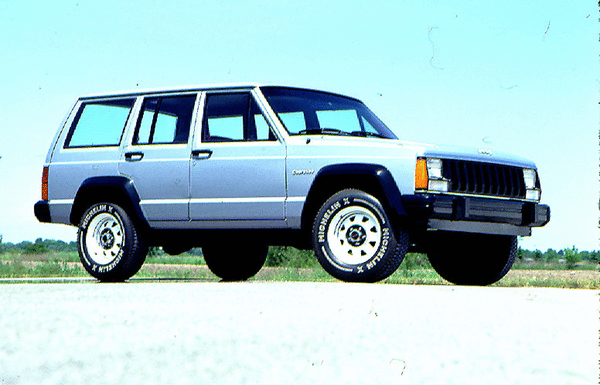
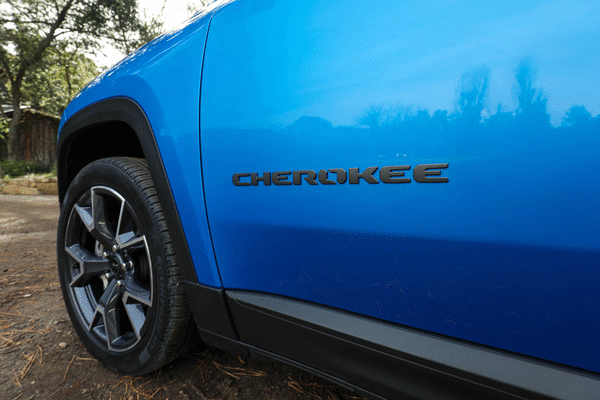
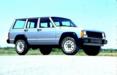
The Jeep Cherokee has been around since 1974, having survived disco, malaise-era Detroit, Japanese imports, German accountants, two fuel crises, the SUV boom, the crossover SUV plague, and several corporate mergers whose chief product appeared to be PowerPoint presentations. If the Cherokee were a person, it would own several windbreakers, complain about property taxes, and have a coffee mug older than most TikTok influencers.
It’s also lived several very different lives. There was the big SJ, built when America measured fuel economy in gallons per mile. The XJ arrived in 1983 and accidentally became one of the greatest utility vehicles ever built because engineers were still allowed to win arguments against marketing departments. Then things became complicated. In 2001 came softer successors, culminating in the infamous 2014 KL model, whose front end looked like its styling had been outsourced to a committee of tropical fish and anime illustrators. It spent most of its career explaining why it looked the way it did, despite actually being a competent SUV. It eventually succumbed to the sort of corporate indecision usually associated with governments.
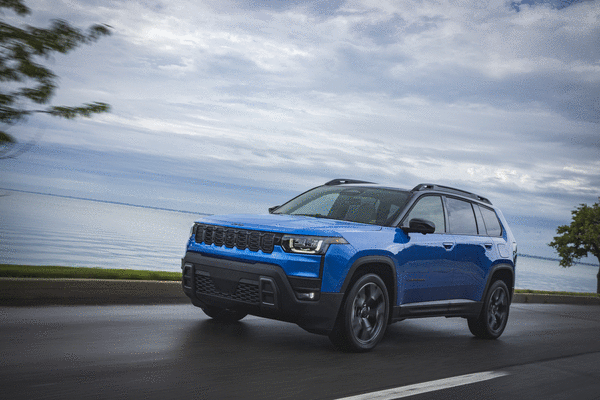
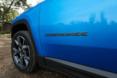
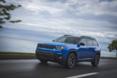
After a three-year hiatus, the Jeep Cherokee is back, and thankfully, nobody will need therapy after looking at it. Its face resembles a Jeep. Its proportions resemble an SUV. Its styling that won't cause neighborhood associations to schedule emergency meetings. Mercifully, it isn't trying to be revolutionary. Instead, Jeep has chosen the far more difficult ambition of building something people might actually buy.
Under the hood, the modern world makes its obligatory appearance in the form of a turbocharged 1.6-liter four-cylinder working alongside two electric motors through an electronically controlled continuously variable transmission (or CVT). The result is 210 horsepower and 230 pound-feet of torque, standard all-wheel drive, and 37 mpg in combined driving while drinking 87-octane fuel. It's a conventional hybrid, which is another way of saying it doesn't expect you to remember to plug it in every evening before wandering inside to argue with your smart thermostat.
The surprise isn't that it's efficient. The surprise is that it's pleasant.
Putter around town and you’ll find the Cherokee glides away from traffic lights with enough electric smoothness to make ordinary gasoline engines feel like they're starting with a hand crank. The transition between battery power and internal combustion is nearly invisible. Floor the accelerator while driving uphill and the gas engine reminds you that physics still has veto power. Like most hybrid CVTs, it develops the familiar soundtrack of an enthusiastic kitchen appliance. Fortunately, this happens only when you insist on driving as though your inheritance depends on arriving twelve seconds sooner.
The steering is very light, accurate, and about as emotionally expressive as a bank manager. Brake pedal feel is equally feather-light. That's perfectly acceptable. Nobody buying a compact family SUV expects it to channel a Lotus or, for that matter, fun-to-drive. They expect it to haul the family and their junk while providing an existential sense of suburban responsibility. The Cherokee pleasantly performs it all with impressive competence.
Ride quality lands in the sweet spot between marshmallow softness and chiropractor referral. It doesn't encourage heroics on winding roads, but neither does it punish the occasional enthusiastic mistake. It simply goes about its business with the calm efficiency of an accountant who secretly owns a fishing boat.
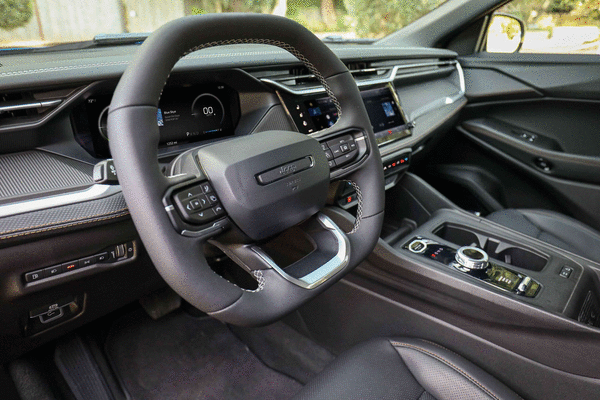
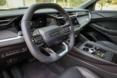
Inside, the Cherokee offers good room for four, comfy seats, a mostly quiet cabin and a design that’s refreshingly modern, particularly when accented in white leatherette. But its materials don’t suggest that Jeep paid too much for them.
Technology also deserves applause because it largely refrains from showing off. A 10.25-inch digital instrument cluster joins a 12.3-inch touchscreen running the latest Uconnect system. Wireless Apple CarPlay and Android Auto are standard, responses are quick, graphics are crisp, and changing the radio station doesn't require consulting an online forum populated by software engineers and insomniacs.
The safety systems are equally comprehensive. Automatic emergency braking, blind-spot monitoring, rear cross-traffic alert, reverse emergency braking, and driver-attention monitoring all come standard. They intervene when necessary without behaving like the nervous passenger who believes every yellow light represents the opening moments of a disaster documentary.
The new Cherokee doesn't spend much time trying to resurrect its ancestors. That's probably wise. The XJ has achieved the sort of mythical status usually reserved for discontinued bourbon. Nothing wearing the Cherokee badge was ever going to satisfy people who believe the automotive golden age ended sometime around cassette tapes.
Instead, Jeep has built a thoroughly modern compact hybrid SUV that competes honestly with the Honda CR-V, Toyota RAV4, and Subaru Forester instead of relying on nostalgia and seven-slot grilles to carry the argument. It won't become an off-road legend. Nor will it inspire grown adults to write sentimental essays on internet forums two decades from now. Instead, it might quietly become the sort of vehicle people are genuinely happy to own. That's not automotive romance. It's competence. And competence has become surprisingly exotic.
2026 Jeep Cherokee
Base price: $36,995
Powertrain: Turbocharged 1.6-liter hybrid
Horsepower/Torque: 210/230 pound-feet
EPA rating (combined city/highway): 37 mpg
Fuel required: 87 octane
Length/Width/Height: 188/75/68 inches
Ground clearance: 8 inches
Cargo capacity: 34 cubic feet
Towing capacity: 3,500 pounds
©2026 Tribune Content Agency, LLC










Comments