Exploding windows land Minnesota company in court
Published in Business News
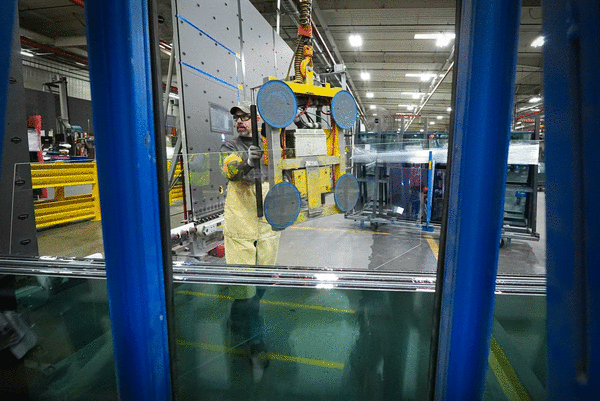
Philadelphia’s glass-faced Riverwalk apartment towers offer an infinity pool, hardwood floors and an on-site Starbucks. One unadvertised feature surprised residents: windows that can spontaneously explode.
Now the buildings’ owner is suing its Bloomington, Minnesota-based window provider, Apogee Enterprises. The lawsuit says the windows were under warranty, but Apogee orchestrated “a coordinated corporate shell game designed to avoid liability for the dangerous defective glass.”
In its Oct. 27 federal complaint, Philadelphia’s PMC Property Group says Apogee used two of its subsidiaries to create confusion about what companies provided which products and services — all to avoid fulfilling the warranty on the windows, which cost $50 million to install in 2021 and 2022 in the Riverwalk buildings, as well as a third property.
“No one will accept responsibility for the defective glass, and no one will even say where it came from,” PMC says in the complaint.
Apogee and its subsidiaries — glassmaker Viracon and window-unit maker Wausau Window and Wall Systems — declined to comment for this story, as did PMC.
The Apogee companies’ window systems are widely used in new construction. Viracon’s glass has landed in more than 100,000 buildings since 1970, its website said. That includes U.S. Bank Stadium in Minneapolis.
Apogee reported profit of nearly $109 million in the 2025 fiscal year on an adjusted basis.
Local media call PMC the largest apartment owner in Philadelphia. Window systems make up “nearly the entire exterior of” the Riverwalk apartments.
One resident of the apartments declined to comment, citing a non-disclosure agreement.
Peter Oh, a business law professor at the University of Pittsburgh School of Law, said companies can use complex structures to take advantage of the fact that their various entities have limited liability. But a legal strategy known as “piercing the corporate veil” can help plaintiffs, he said.
“The law carves out an exception that in certain circumstances, it’s possible for a plaintiff who has been harmed to be able to reach past the veil of limited liability” and into the assets of a parent company, Oh said.
To do this, plaintiffs typically show evidence of wrongdoing and demonstrate that a shareholder of the complex corporation has control over a subsidiary, Oh said.
PMC’s complaint alleges the property owner paid Apogee subsidiary Wausau about $50 million to supply the window systems for the Riverwalk buildings and a third property. Viracon, also owned by Apogee, made at least some of the glass units that went into these systems.
This glass was contaminated with nickel sulfide during the manufacturing process, the lawsuit claims. That caused the formation of “tiny particles” within it that can expand when the temperature changes, causing spontaneous breakage.
Since the beginning of 2024, these breakages have started happening more often, garnering the attention of city inspectors and media.
In a Fox 29 segment, a third-floor resident said he came home one day to find a glass panel had plummeted more than 20 stories to shatter on his balcony. “Eventually it’s going to fall on someone,” he said.
The glass has fallen onto sidewalks, balconies, patios and other areas. PMC said in the lawsuit it had to hire outside experts, create emergency protocols and erect scaffolding to protect residents. It expects the total expenses related to the breakages to cost millions of dollars.
But when the landlord sought relief from the company, it instead encountered a “carefully orchestrated strategy of deflection,” according to the lawsuit.
“When PMC first demanded that Wausau honor its express warranties — which warranted against ‘premature failure of the window [or] glass’ — Wausau refused,” the apartment owner said.
Wausau claimed it didn’t manufacture the glass and “had no way of knowing that information.”
Eventually it became clear to PMC that Viracon manufactured at least some of the glass, the lawsuit said. Yet Viracon said it could not “conclusively identify” the source of the glass.
PMC said the warranty demands it sent to Wausau and Viracon ultimately reached Apogee, which “ignored each and every one.”
“These related companies have obfuscated responsibility to such an extent that there are now different lawsuits in different courts against each company,” PMC said.
The plaintiff is asking the court to declare that Wausau’s and “Viracon’s corporate veil can be pierced in order to hold Apogee responsible” for the subsidiaries’ actions.
The dispute is also being litigated in the Philadelphia County Court of Common Pleas and federal district court in Pennsylvania.
A district judge removed Apogee from the federal lawsuit on “personal jurisdiction grounds.” That suit proceeds against Wausau and Viracon.
After the removal, PMC sued Apogee in Minnesota to pierce its subsidiaries’ veil.
“Apogee’s, Wausau’s and Viracon’s corporate shell game, designed to avoid legal responsibility, has unnecessarily burdened multiple courts’ time and resources, and it should be countenanced no further,” the Minnesota federal complaint said.
Apogee has not yet responded to the complaint in court.
©2026 The Minnesota Star Tribune. Visit at startribune.com. Distributed by Tribune Content Agency, LLC.










Comments