Runway taxi times at O'Hare airport among worst in nation
Published in Business News
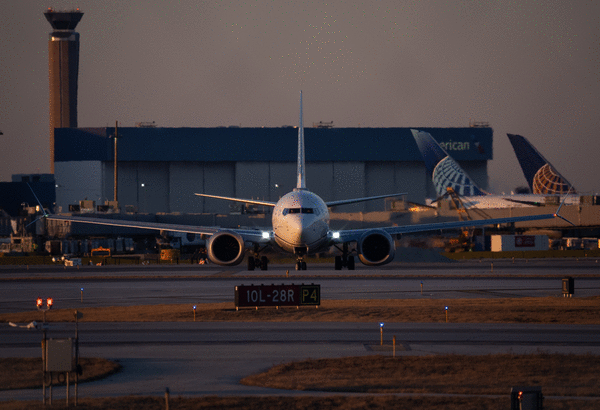
Chicago can look tantalizing from the window of an airplane on its descent into O’Hare International Airport.
But much to the chagrin of air travelers who might glimpse the city’s skyline rising over Lake Michigan on their way in, touching down at O’Hare isn’t exactly the same as arriving. That’s because taxi times at the airport are longer, on average, than those at almost every other major airport in the country.
“It’s kind of like driving up into your garage, or driving up into your driveway at home, and then they don’t let you out of the car,” said Dennis Tajer, an O’Hare-based American Airlines pilot and spokesperson for its pilots union.
From January through the end of August this year — the most recent month for which Federal Aviation Administration data is available — planes landing at O’Hare averaged 20 minutes to taxi to their gates once their wheels hit the ground. No other major U.S. airport reported in-coming taxi times that long. The next-longest taxi-in times were at Charlotte Douglas International in North Carolina, where planes averaged just under 14 minutes to reach their gates.
O’Hare also has some of the longest taxi-out times in the country, with planes taking an average of more than 28 minutes to leave the ground once they push back from their gates. So far this year, only New York’s John F. Kennedy International has a longer average taxi-out time, just under 29 minutes.
Across town at Chicago’s Midway International Airport, things are comparatively speedy. Planes take an average of just over 15 minutes to take off after they push back from the gate at the Southwest Side airport. And Midway’s taxi-in times are, so far this year, among the shortest at the nation’s large airports — just under five minutes on average.
Airlines build expected taxi times into their schedules, so long taxi times don’t necessarily mean delays or missed connections. But even if passengers end up arriving on time, airline officials and industry experts acknowledge the wait can be torturous.
“To the customer, it feels like, ‘I landed, and I had to taxi forever,’” said Omar Idris, United Airlines’ vice president of O’Hare.
“You’re sitting there in a tube waiting to go somewhere,” said Brett Snyder of the industry website Cranky Flier.
Experts say there are a number of reasons why taxi times at O’Hare are so long, including ongoing construction, the distance of the runways from the terminals and the airport’s sheer busyness.
O’Hare last year had the busiest airfield in the world, according to the Airports Council International World. And the airport is getting even busier, owing in part to an arms race between United and American Airlines. Both airlines have been scrambling to add flights out of the airport, where gate space is allocated by how much an airline flew the previous year.
Even though the FAA stepped in and instituted limits on the number of daily flights at O’Hare earlier this year — a move it said at the time was intended to help prevent widespread delays — the airport still saw 6% more flights during the busy summer season compared with last summer, according to the city.
More than 25 million people traveled through O’Hare between June and August. The FAA flight caps are now scheduled to remain in effect for nearly another year.
Julie Rath, American’s senior vice president of global airports and business partners, said taxi times would “absolutely” be longer had the FAA not stepped in at O’Hare.
At the same time, the airport is in the midst of an $8.8 billion terminal modernization project that has necessitated extensive construction at the airport.
Kevin Bargnes, a spokesperson for the Chicago Department of Aviation, which manages the city’s two airports, said the massive modernization project — which will add 19 new gates to the airport by the end of 2028 and more in 2030 and beyond — will ultimately help “ease gate-related congestion.”
Bargnes acknowledged that at the moment, some planes must taxi around the construction site for what will become the airport’s Concourse D. “That additional taxi time is limited,” he said.
Bargnes also said all taxiway and runway construction work that had “the potential to significantly affect taxi times” at O’Hare has been completed. All taxiways and runways that are typically used by passenger aircraft are open and have been since mid-August, according to the city.
The Aviation Department pointed to other factors that influence taxi times, including “airline schedules, air traffic control staffing, gate availability, weather, and the runways in use and their distance from assigned gates.”
Airlines are taking steps to try to address taxi times at O’Hare.
A newsletter for American Airlines pilots reviewed by the Tribune pointed to several efforts the airline said helped reduce taxi-in times at O’Hare last month, including using the airport’s international terminal for domestic arrivals in evenings and prioritizing arrivals over departures during certain congested periods.
Those efforts, the newsletter said, helped contribute to a more than 50% decrease in extra-long taxi-in times — those that take more than 40 minutes — in the first couple of weeks of October.
United pointed to an effort it took alongside the city this spring to add new pavement near the airport’s E and F gates to help reduce congestion there, and a second phase of the project that involved creating a new connector between taxiways to help the flow of traffic.
United said O’Hare was seeing the lowest taxi-out average in more than a year and that the airline’s taxi-in times there were trending the lowest they’ve been since March.
Taxi times at O’Hare have been among the longest of major U.S. airports for years, but from January to August, they had gotten longer when compared with last year: Average taxi times grew by about two minutes on the way in and almost four minutes on the way out compared with the same time period in 2025.
Through August this year, 14% of flights arriving into O’Hare took half an hour or more to reach their gates.
Outside O’Hare last week, C’Aira Shields remembered a time earlier this year when she was on a flight returning from Florida that spent 35 to 40 minutes taxiing to the gate.
This time, Shields, 29, was returning to Chicago from a work trip to Atlanta. When she landed in the Southern city — whose airport was the second-busiest in the world by plane traffic last year, after O’Hare — she taxied for about a dozen minutes. But on the way home to Chicago, her plane took an O’Hare-average of 20 minutes to make it to the gate.
Still, that felt like a bit of an improvement.
“This one felt like the fastest I’ve had in a while,” Shields said.
©2026 Chicago Tribune. Visit at chicagotribune.com. Distributed by Tribune Content Agency, LLC.










Comments