UnitedHealth mistakenly declared eight doctors dead
Published in Business News
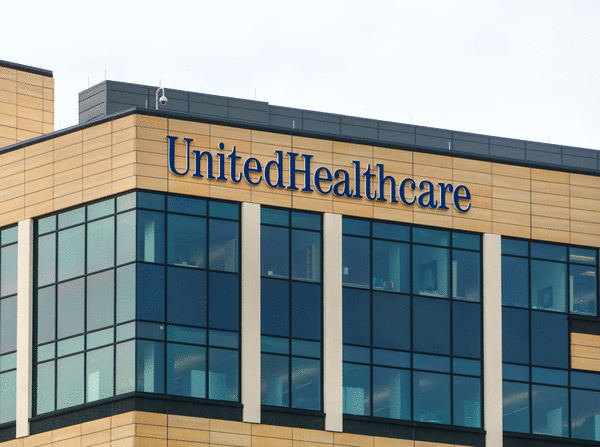
Eight U.S. doctors, including two Minnesota physicians, were mistakenly identified as dead in letters sent to patients last month by health insurer UnitedHealthcare.
A UHC spokesman confirmed the total this week after the Minnesota Star Tribune received a copy of a letter that incorrectly notified some patients of the death of Dr. Geoffrey Fasen, a Fairview Health Services surgeon. The wording of the letter was largely identical to one sent last month to patients of Dr. Richard Johnston, an Edina, Minnesota, ophthalmologist.
Both letters were dated Sept. 11. Two weeks later, the patients received a second UHC letter acknowledging the mistake, and stressing that the doctors were still in-network providers — and presumably alive.
“You may continue to see them at network costs,” the correction letters stated.
UHC apologized in a written statement for the initial, erroneous letters, adding, “we have updated our processes to help prevent this type of error from occurring in the future.” A spokesperson did not elaborate on the breakdown that caused the problem in the first place.
The letters were sent from a UHC division responsible for meeting state and federal laws and keeping patients informed when doctors or other providers leave UnitedHealthcare’s network. Death is just one possible reason for leaving the network.
The process isn’t as foolproof as it sounds, especially for large insurers with thousands of doctors and other practitioners in their networks, said Adam Wilson, a general manager of the Berwyn Group, a consulting firm that helps companies with death audits to update their contact lists and directories.
The “death master file” maintained by the Social Security Administration theoretically would offer an easy resource for insurers to check against their provider lists, but Wilson said the file can be months or even years out of date.
That means insurers need to find other ways to track deaths. But checking provider directories against obituaries and other sources of information can lead to these types of errors, said Wilson, who previously worked for 17 years at UHC.
Insurers are under increasing pressure to update their directories and remove so-called “ghost providers” who are no longer accepting patients or in their networks. The federal No Surprises law, for example, requires insurers to collect cost-sharing payments from patients at lower in-network rates if outdated directories steer patients inadvertently to out-of-network providers.
Wilson said data-sharing among insurers and providers can cause errors to spread if any of their directories incorrectly list doctors as dead.
Johnston, the Edina ophthalmologist, was briefly removed from UHC’s provider network when the health insurer listed him as dead. Blue Cross and Blue Shield of Minnesota and HealthPartners were taking steps to remove him from their networks as well until his office notified them that the doctor was alive and still providing care.
Johnston said the errors were corrected, but the experience was unnerving for patients who had already been anxious about upcoming surgeries before being told incorrectly that their doctor had died and they would need to find another one.
©2026 The Minnesota Star Tribune. Visit at startribune.com. Distributed by Tribune Content Agency, LLC.
Comments