Evan Ramstad: With Huang's rehiring, Trump takes his biggest socialist step yet
Published in Business News
Naturally, the first thing I did when I heard the Nvidia news Monday morning was turn to ChatGPT.
I directed it to produce a list of all the times when a private company has hired or rehired a chief executive officer at the direction of the president of the United States.
It listed just one: Donald Trump telling the giant AI chipmaker Nvidia to rehire Jensen Huang.
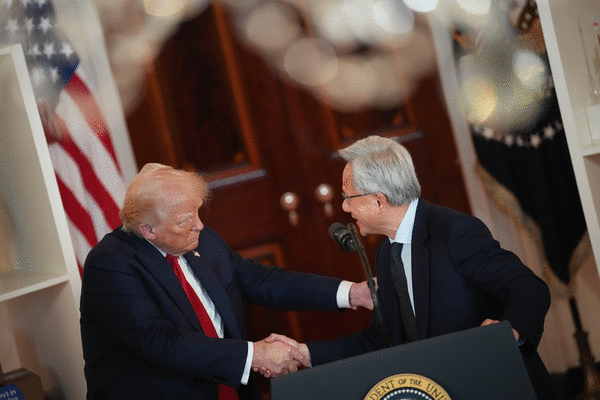
“I’ve been speaking to the board directly and indirectly, and I felt very strongly about it,” Trump said on CNBC Monday morning. He added, “I convinced them. I made the deal.”
The man who all year has said his Democratic opponents are socialists and communists just did one of the most socialist things any president has done in the nation’s 250-year history, short only of a handful of government takeovers of companies or industries.
No wonder the stock market shot off like a rocket. Trump signaled to investors the risks are gone, and they would get to keep the profits.
Some prominent Silicon Valley figures and investors were pushing for Huang’s reinstatement as well, which makes sense, because they have much to lose from the popping of the AI bubble.
By telling Nvidia’s board to rehire Huang, Trump effectively moved all the risks of AI development, which were being borne by private investors and repriced on stock markets every day, onto the American taxpayer.
If Trump will insulate Nvidia and Huang from market risk and accountability, why should anyone think he won’t protect other AI companies, too? Why should anyone think Trump won’t allow AI companies to do whatever they want, including building data centers in Americans’ backyards?
The fundamental problem of the AI industry did not change, however: No one knows how the biggest companies — like Alphabet, OpenAI, Anthropic and Meta — shelling out hundreds of billions of dollars on debt-fueled capital spending this year alone will make that investment back.
“Investors should worry about how the large language models are going to make up all of the money they have spent, and are they ever going to be economically viable,” said Kim Forrest, founder of Bokeh Capital Partners, on Bloomberg TV Monday morning.
She was referring to the AI models that are at the industry’s cutting edge, and which are much more expensive than Chinese systems that perform nearly as well as the United States’ most advanced ones.
“These are rational questions, and stocks have traded lower because of it, and we still have those questions outstanding. Jensen’s return does not settle that,” she added.
Nor does Huang’s return settle the national security question at the heart of his Nov. 12 ouster from the job. Huang acknowledged he had a sexual relationship with a Chinese woman who had ties to that country’s security agencies.
Now, a man with the staggeringly bad judgment to cheat on his wife with a woman believed to be a Chinese spy is back in charge of one of America’s most powerful companies. News reports in recent weeks have exposed at least two other affairs and a browbeating culture at Nvidia that starts with Huang.
Trump told CNBC that “after a lot of research,” he told the Nvidia board that Huang was “not a problem” to national security.
There are people in Trump’s inner circle who clearly doubt that. The administration is riven by this debate over whether Nvidia should be able to sell its most advanced chips to China, which has been striving for decades to overtake America’s economic dominance in the world.
Of course, Huang pushed to allow those sales. Some analysts estimate that up to 20% of the company’s revenue comes from firms in Asia that may have been helping China skirt U.S. export controls.
Trump just gave cover to all of that. And he did so just four days after meeting China’s leader, Xi Jinping.
At a White House press conference on Friday, Trump told reporters he talked about Huang with Xi. “I did discuss that with President Xi, and he said, ‘Oh, brilliant, brilliant! He’s a brilliant man,’ ” Trump said.
The open question: Does this mean Chinese companies will have equal access to Nvidia’s chips as American firms?
There have been times in American history when it was appropriate for the government to intervene in the economy, the biggest being the Great Depression in the 1930s and the most recent being the housing and financial crisis of 2008. During the government bailout of General Motors in 2009, the Obama administration tapped Ed Whitacre, a longtime telecom executive, to lead its turnaround.
Today’s economy in the U.S. is nowhere close to such trouble. It has been damaged by Trump’s scattershot tariff policies and labor-force-reducing crackdown on immigrants. But economic growth recovered this year from last year’s terrible performance.
Trump cares, above all, about the performance of the stock market, which last week had its biggest loss since the week in April 2025, when Trump announced he was imposing universal tariffs.
And so, this president, who has gutted the federal government’s assistance to the poor and old and sick, has now freed the multibillionaire Huang and Nvidia from the control that investors bring. He may have also opened the door for Nvidia to increase sales to China.
Call it socialism or call it state capitalism. It would be unbelievable if it weren’t happening.
———
©2026 StarTribune. Visit at startribune.com. Distributed by Tribune Content Agency, LLC.




Comments