Retail earnings show US consumers keep spending for the right price
Published in Business News
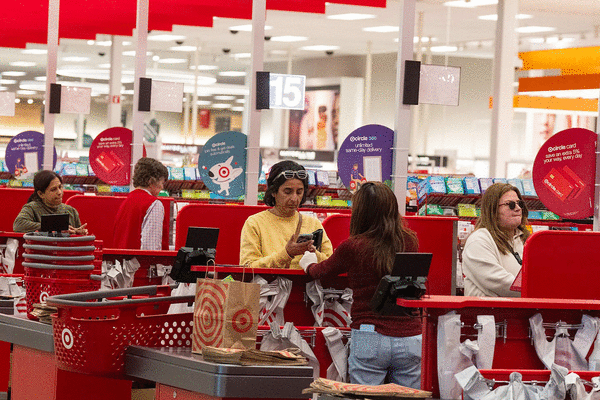
American consumers haven’t given up. But they’re feeling the pressure.
Walmart Inc., which posted its weakest sales growth in more than six years on Thursday primarily due to its pharmacy business, said consumer spending remains at consistent levels even as customers make tradeoffs to prioritize value. Target Corp. and Home Depot Inc. also reported sales gains this week, describing resilient shoppers who are still opening their wallets when they find the right product at the right price.
Faced with high prices, dwindling savings and slowing wage growth, Americans are searching for deals and unique merchandise while shying away from big purchases.
“We certainly see that choices are made,” Walmart Chief Financial Officer John David Rainey said in an interview, adding that people are buying fewer items per trip. “As fuel prices have increased, there’s been incremental pressure on the consumer versus the beginning of the year.”
Consumer spending is the mainstay of economic growth, accounting for nearly 70% of total U.S. output. Bigger-than-usual tax refunds in the spring, a stable job market through most of this year and stock market gains have allowed Americans to keep spending despite frustration with high prices.
Economists say U.S. spending may slow down in the coming months but it’s far from a retrenchment. The median forecast in an August Bloomberg survey of economists sees personal consumption expenditures advancing at a 2.1% annual pace in the third quarter, down from a more robust 3.2% in the second quarter.
“We do expect consumer spending to revert to a more moderate pace in in the second half of the year,” said Lydia Boussour, a senior economist at EY-Parthenon. She noted that consumers have been “relying on savings, relying on some of the wealth gains, and some are relying on credit to finance their spending. But that’s a situation that we think is not sustainable.”
As consumers become increasingly selective, it’s getting even more important, and harder, for retailers to find the right mix of products.
Lower prices
Walmart lowered prices on more than 11,000 items in the quarter to appeal to consumers carefully managing their budgets. That’s about double the adjustments the world’s largest retailer makes in a typical quarter. The company is putting the proceeds from its tariff refunds toward the effort.
Other retailers noted that while shoppers still aren’t shelling out big bucks for things that require financing like housing remodels, they’re buying plenty of protein snacks, pastel notebooks and portable power tools.
Target, which is seeking to reverse a multiyear slump, reported its second consecutive quarter of sales growth and saw demand improve across a variety of categories and demographics. Target’s back-to-school sales — a barometer for consumer spending ahead of the holidays — are up almost 20% compared with last year, executives said.
“We are seeing that our guests respond when we have the right combination of style, design and value for these really important seasons,” Chief Merchandising Officer Cara Sylvester said on a call with reporters this week.
Home Depot executives said shoppers are buying patio products, refrigerators and other big-ticket items that typically don’t need financing. They are also taking on gardening, painting and other small projects in place of big remodels.
Overall price pressures have eased in recent months but national average gasoline prices have held stubbornly above $4 a gallon in the wake of the Iran war. The cushion from tax refunds has faded. And importantly, average hourly earnings have grown slower than consumer inflation, diminishing purchasing power and stretching budgets. In June, the personal-saving rate was the lowest since 2022.
“U.S. consumers consistently find ways to spend money, which is shocking and a little worrisome,” Greg Portell, lead partner of global markets at consultancy Kearney, said in an interview.
Many consumers want to keep spending, even if there are some tough choices and difficult tradeoffs.
Geneva Harris this week visited a Walmart in Landover Hills, Maryland, to load up on supplies for ice cream floats. She had three grand-nephews piled into the back of her SUV and three grand-nieces planning to join them later in the week at her home in nearby Cheverly.
The retiree said rising prices mean she is spending more but buying less — cutting back on things like going to the Maryland State Fair while trying to make up for it by embracing small pleasures at home with her family.
“Everything is becoming less affordable. Everybody is just budgeting to pay for their rent, their mortgage, and the enjoyment of life is just slipping away,” Harris said.
Even so, she will make the occasional splurge. On Wednesday it was a small outfit her nephews wanted for their dog, on sale for $5. On Friday it will be the floats with the youngest members of her family during the last full week of summer break. School starts next week for the kids.
“You have to make the fun memories. That’s what they’re going to remember,” she said.
(With assistance from Ryan Beene and Dana Morgan.)
©2026 Bloomberg L.P. Visit bloomberg.com. Distributed by Tribune Content Agency, LLC.









Comments