Target shows signs of turnaround, but consumer anxiety poses next threat
Published in Business News
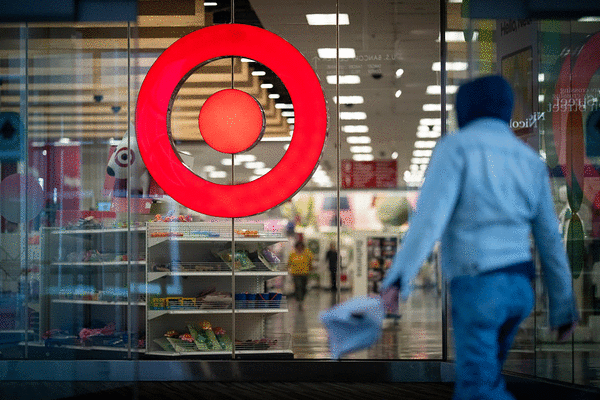
Target posted its strongest sales quarter since its pandemic surge, but analysts question whether persistent economic uncertainty will stall the company’s progress.
The retailer on Wednesday reported a 5.6% increase in comparable sales for the February-to-April period. The company also raised its full-year guidance to 4% net sales growth, up from 2%.
Target’s results will be closely watched because it reported earnings before other major retailers, including Walmart and Costco. The Minneapolis-based company is widely viewed as a key retail bellwether, offering an early read on U.S. consumer sentiment and the broader economy.
Target saw sales growth across all merchandising categories, with especially strong gains in baby, beauty and health and wellness, executives said. Apparel and home were positive but more muted.
“We will not confuse this progress with potential,” CEO Michael Fiddelke said on a media call. “Our focus is on delivering consistent growth, not just in 2026, but for decades to come.”
A year ago, Target reported a 4% decline in comparable sales as consumer sentiment fell to one of its lowest points on record, with shoppers pulling back amid uncertainty tied to President Donald Trump’s tariff policies. Executives said at the time consumers were still spending but making more trade-offs to prioritize essentials.
Analysts see stronger quarter, but caution ahead
Fiddelke said the company expects positive sales growth in each quarter this year — a notable shift after several years of guidance that projected flat or declining sales.
The company’s guidance, though, remains relatively cautious. Fiddelke said that reflects a “lesson learned” in how Target positions the business, avoiding what he described as “betting too big only to surprise the other direction.”
Fiddelke’s caution echoes that of some analysts, who say it could be difficult for Target to maintain its recent growth.
Target’s stock has climbed about 30% over the past year after steep declines in summer 2022 following an inventory glut and again in 2023 as its post-pandemic slowdown became more pronounced. Shares fell more than 3% by Wednesday’s market close.
Mizuho analyst David Bellinger said in a Wednesday note that Target’s share price was likely affected by investors being cautious about changes to consumer spending, particularly in the lower-income cohort.
In a note ahead of earnings, Seth Sigman of Barclays said Target’s sales rebound came faster than expected but cautioned that the first quarter may be its strongest of the year for the same reason. Larger tax refunds appeared to boost purchases among middle-income shoppers, one of Target’s core customer groups.
U.S. retail sales rose from February through April, though gains in the latter part of that period were driven in part by higher gas prices after the U.S.-Israeli war on Iran started at the end of February. Excluding gas, sales increased by less than 1% each month.
Analysts also pointed to outside risks, including higher mortgage rates that continue to keep some homebuyers on the sidelines.
Fiddelke said consumers are still selective, spending on essentials and some discretionary items while pulling back on larger purchases and making trade-offs around holidays and other key occasions.
Profits for the quarter fell more than 20%, mainly due to turnaround costs and a one-time credit card settlement from the prior-year quarter.
Retailers navigating uneven consumer demand
Target’s stronger quarter comes as major retailers start to report mixed consumer behavior.
Home Depot reported Tuesday sales growth in its latest quarter, but executives said homeowners are still delaying larger projects, especially in categories such as flooring, lighting and lumber. Lowe’s also topped expectations and posted sales growth Wednesday.
Walmart is scheduled to report earnings Thursday, followed by Best Buy and Costco on May 28.
Analysts on Target’s earnings call asked about the broader economy’s effects. UBS analyst Michael Lasser, for example, questioned how much of the first-quarter growth could be attributed to “action that Target has taken versus exogenous variables like tax refunds.”
In response, Fiddelke said Target will continue to monitor consumer behavior, but that the company was “encouraged” by customers’ response in key categories where it made improvements. Traffic was also up 4.4%.
Piper Sandler analyst Peter Keith said in a post-earnings note that “while longer-term sustainability of the turnaround remains in question, early signs are positive.”
Target continues to make changes
Target is continuing to invest in its supply chain as it works to speed up deliveries to stores amid shopper complaints about out-of-stock items.
The company recently opened a $265 million supply-chain facility in Houston that receives and stores merchandise from vendors until it is needed at distribution centers and stores. The 1.2 million-square-foot property will support seven regional hubs and is intended to ease overcrowding, particularly for seasonal, bulky or hard-to-forecast items.
On Tuesday, the company named Jeff England — a former Walmart executive — as its new head of supply chain. England most recently worked at QXO and will start at the end of May. Outgoing supply-chain chief Gretchen McCarthy will remain in an adviser role through August.
The retailer also launched two social creator programs aimed at generating more word-of-mouth-style recommendations between influencers and shoppers. Nonmerchandise sales rose nearly 25% in the first quarter, driven largely by growth in membership revenue and Target Plus, the company’s third-party marketplace.
Target released a collection with Parke, a viral clothing brand known for its embroidered crewnecks and matching sweatpants. On Parke’s website, crewnecks can cost more than $130. A similar version sold through Target was priced at $40. Executives said those collaborations, including others with Roller Rabbit and Pokémon, continue to draw lines of customers.
But some shoppers said they feel like the retailer is “ trying to be everything to all people” and haven’t yet noticed meaningful improvements in stores, though analysts say it will take time.
Several changes are expected in the second quarter, including a curated “Beauty Studio” concept that will replace its partnership with Ulta, as well as the continued rollout of its baby boutiques. The company also plans to overhaul about 75% of its home assortment by June.
©2026 The Minnesota Star Tribune. Visit at startribune.com. Distributed by Tribune Content Agency, LLC.








Comments