Welcome to the future: National Restaurant show features robot baristas and sushi-makers
Published in Business News
CHICAGO — Traffic has been down across the restaurant industry over the past few years, but you wouldn’t know it by the crowds at the annual National Restaurant Association show at McCormick Place this week.
The four-day event through Tuesday featured packed exhibition halls, overflowing parking garages and aisles jammed with some 53,000 attendees nibbling on everything from cheesesteaks to cheesecake while exploring the latest in foodservice technology.
Those innovations included a $100,000 robot barista, a $17,500 automated sushi-maker and a $1,000 AI-powered handheld device that listens in on the server-customer menu banter and places the food order without ever putting pen to pad.
Welcome to the restaurant of the future, where machines take your order, make your food and deliver it on robotic serving carts.
Chris Siefken, who heads point of sale for Atlanta-based Global Payments – the company behind the eavesdropping AI ordering device — said properly executed, the new technology can not only help the bottom line for increasingly stressed operators, but bring some “magic” to the table for restaurants and patrons alike by enhancing the human interaction of a shared meal out.
“The best technology is something that is almost so seamless in your life, and so fully integrated, that you don’t even notice it’s there,” Siefken said while displaying a prototype of the handheld Genius device at his booth Monday.
While technology turned heads, food remained the main draw for many attendees, with a smorgasbord of cuisines and beverage tastings at the show, along with demonstrations of the equipment needed to make them.
This was no free lunch, however, with vendors hoping to drive sales and provide restaurant operators large and small with new ways to build traffic and create efficiencies in an industry which has been stagnant for several years.
Sales at the top 500 chain restaurants grew by 3% to $451 billion in 2025 — essentially flat after inflation — representing the fourth consecutive year of decelerating growth, according to an annual study by Chicago-based food service research firm Technomic.
The restaurant industry is dealing with lower operating margins, rising costs, declining store traffic and a talent pool that is drying up among younger workers, according to Technomic. With soaring gas prices exacerbating affordability concerns, dining out is increasingly off the table for some consumers, keeping restaurant sales flat and margins tight in 2026.
“It’s harder than ever for restaurants and food service operators to be profitable in this environment,” said David Henkes, senior principal at Technomic. “There’s a big focus on labor savings and efficiencies. Reducing costs is such a primary driver right now for operators.”
Henkes said restaurants are increasingly looking at technology, such as robots and AI, to improve operating efficiency and solve labor problems. There were plenty of solutions on display at the restaurant show, including sushi robots.
AUTEC, a division of turntable maker Audio-Technica, opened up an automated sushi bar at the show featuring a series of machines that produce the rice sheets, create rice balls and cut rolls — essentially doing everything but shouting a greeting at customers when they enter.
Xiaokai Shang, sales manager of AUTEC Canada, said the sushi robots, which cost between $17,000 and $22,500 each, depending on their role in the process, are consistent, precise and fast.
“Every single piece, the thickness is going to be the same,” he said. “It looks beautiful and professional.”
The only thing the robots haven’t completely mastered is the art of rolling the sushi tightly enough, keeping human hands in the equation — at least for now, Shang said.
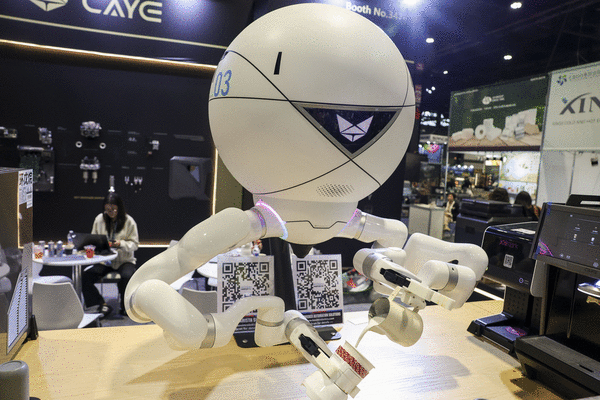
Another futuristic technological display was at the Kosim Robotics booth, which was offering up artful espresso drinks crafted by Orbista, an AI-powered robot barista.
The white robot features long multi-jointed arms and a giant orb-like head, looking something like an extra in a “Star Wars” movie. Orbista expertly assembles an order in minutes, working with adjacent espresso machines and topping the drink off with an array of intricate latte designs on its surface, including a self-portrait.
“You can print your logos with every coffee that you serve, so we can hard code that as a part of the program,” said Joy Guha, vice president of sales and marketing for Canada-based Kosim Robotics, which is marketing Orbista in North America. “We can also upload photographs of your friends, family, your pets, anything that you want to print, we print it.”
While the robot can do the work of a highly skilled human barista, it also comes with a pretty high price tag: $100,000 per unit. Guha said the novelty of the robot whipping up lattes attracts customers and is part of the value equation.
Three Orbistas are being deployed in the U.S., including one already in service at NYC Vegan Bistro in Brooklyn, with units also headed to Kansas City and San Jose. Guha said he is hoping the show will stir up sales of the robotic barista, which is built by China-based Panbotica Technology.
Meanwhile, restaurant servers can forget the guest check pad and pencil behind their ear. The Genius handheld by Global Payments is a forthcoming AI-powered handheld device that listens to conversations between the server and customer, quietly compiling the actual order in the background, turning menu perusing into science.
Looking like an iPhone, the device wades patiently through the back-and-forth descriptions of appetizers, main courses, drinks and daily specials, not only recognizing the final ordering decision, but which person at the table placed it.
At the end of the meal, a built-in payment reader completes the transaction.
Expected to launch in the fourth quarter, the Genius device will be priced upward of $1,000 each, but like many smartphone offers, the cost drops sharply as part of a promotional package.
“If you process payments with us, we’re giving these away for free,” said Siefken, whose company works with thousands of restaurants across the country, including a recent deal struck with the Carl’s Jr. fast-food chain.
While technology was on full display at the restaurant show, old school food exhibits still packed them in, especially those handing out free samples to a hungry lunchtime crowd Monday. One of the longest lines formed at Amoroso’s, a century-old Philadelphia bread company, which has been coming to the annual show for decades.
The primary draw is serving Philly cheesesteaks on Amoroso’s hearth-baked Italian rolls, a perennially popular offering in the land of Italian beef. The eight-inch rolls are cut into four pieces and served as two-inch samples. During the first two days of the show, Amoroso’s gave away 320 pounds of beef and 40 pounds of chicken in its free hoagies.
“As always, we are exhibiting our Philadelphia cheesesteak, and it seems like the crowd has been going bonkers for it and loving it,” said Jesse Amoroso, president and COO of the fifth-generation family business.
While Amoroso’s bread is sold in all 50 states through a network of distributors, the show is an opportunity to generate new leads and open up sales opportunities to expand that reach, he said.
Like many longtime exhibitors, Amoroso’s has found the best way to win a foodservice executive’s heart — and business — is through their stomach.
“We’re here for a reason,” Amoroso said. “We like to exhibit and demonstrate our product and give people a true impression and understanding of what the application of our product is most known for. We’re from Philadelphia. We make rolls for Philadelphia cheesesteaks.”
©2026 Chicago Tribune. Visit at chicagotribune.com. Distributed by Tribune Content Agency, LLC.










Comments