Living on $60K in Seattle comes with up to 7 roommates
Published in Business News





When Adriana Gomez-Weston first got the offer for her current job in Seattle, she was ecstatic.
Working for the catering company Compass, she estimated that she'd make around $60,000 a year before taxes. That sounded high compared with the average income in North Carolina, where Gomez-Weston, 33, grew up.
I thought that would be a lot of money," she said in a recent interview. "But it's not."
Gomez-Weston, like so many people in Seattle, is navigating an expensive city on a relatively tight budget.
She's a recent transplant to the city. Almost immediately upon moving, she discovered that it takes a lot just to get by.
This realization dawned on her when she saw how quickly each paycheck disappeared. She takes home about $3,500 a month, depending on how many hours she gets.
Gomez-Weston works primarily at offices around South Lake Union and the Eastside, where Compass is contracted to provide food at company events. She unloads food, serves it to clients and packs up dishes afterward. In these environments, Gomez-Weston became aware of just how much more many people in the Seattle area, especially those working in the tech sector, earn.
Her biggest expense is rent. Gomez-Weston pays $830 each month for a single room, including utilities, in a boardinghouse in the Green Lake neighborhood. She shares bathrooms and a kitchen with a rotating cast of up to seven other renters, typically students and traveling nurses. There's no common living area.
"The downside of the house is that every bit of space is used," she said. "It's just rooms and people sequestered in their own little rooms."
But the advantage of renting a single room is that it's affordable, said Gomez-Weston.
She spends most of the money she has left over on a number of different creative pursuits, including attending concerts across the city.
A step up
Gomez-Weston moved to Seattle from Los Angeles in July 2023 seeking a fresh start.
Specifically, she wanted a stable job and a new home.
In Los Angeles, Gomez-Weston worked primarily as a freelance writer and editor, earning around $2,000 a month. She lived in free housing that was provided as part of a work-exchange arrangement. Before that, she lived in Greenville, North Carolina, where she earned her bachelor's degree from East Carolina University.
Once in a while, Gomez-Weston's grandmother would send her some money to help her get by. But for the most part, she relied on her own to make ends meet.
Then, abruptly, the work-exchange fell apart. As it turned out, the building she'd been living in wasn't zoned for residential use. Around the same time, Gomez-Weston's freelance income began to dry up as clients turned to artificial intelligence technology to generate writing. Reading the tea leaves, she saved up some money and headed north.
For Gomez-Weston, one of the biggest draws for moving to Seattle was the city's arts and culture scene. She also wanted to escape the heat of Southern California and experience different seasons.
With a steady income, she can actually afford to enjoy the area's countless concerts and festivals.
Recently, she saw Brittany Davis, who performs regularly at the Rabbit Box Theatre in Pike Place. This week, she plans to attend an event with a secret headliner at Central Saloon with friends from out of town. This month, she's excited to go to a show by Paul Solger, a Seattle punk icon.
"As a music fan, I've been able to meet so many people and get immersed in things I really like and even have close encounters with some of my favorite musicians," she said.
Gomez-Weston doesn't have a strict budget for seeing shows. Rather, she tries to give herself the freedom to be spontaneous. A night out might mean getting dinner with friends, attending a performance, buying some drinks — for a total of around $80.
"Since I don't pay as much in rent, I like to leave at least enough to have leeway for other things," she said.
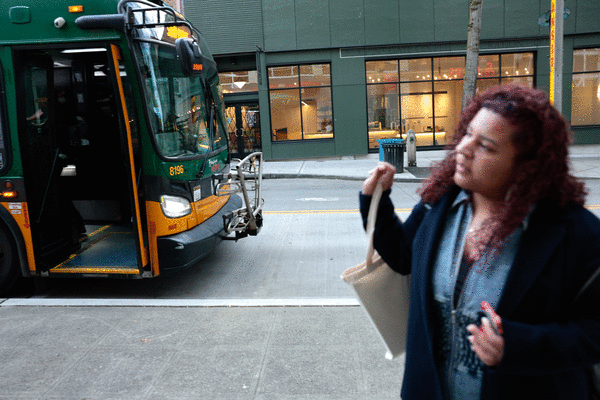
To get around, she mostly takes the bus, spending about two hours per day commuting. Though she'd like to have a car, she doesn't find it necessary and enjoys freedom from additional costs like gas, insurance and parking. Her job pays for her bus pass.
Sometimes, if she knows she'll have a lot of expenses coming up, she'll prepare by having a "vegetable weekend" — a few days where she stays at home doing chores and walking around the neighborhood, allowing her to conserve some money instead of going out.
In her spare time, she's also a volunteer host at Hollow Earth Radio, a station focused on music from Pacific Northwest artists. In addition to curating music, she conducts interviews with local musicians, writers, photographers and other DJs. Gomez-Weston also writes reviews for an independent publication she founded called Vinyl Apothecary. Though she loves the work, she wishes that it paid money.
"It's really hard to make a living doing what I actually enjoy doing and what I'm best at, which is writing," she said. She estimates that she spends between $150 and $200 a month on subscriptions for her radio work and writing, including audio editing, graphic design and web-hosting services.
The sense of creative potential she feels in Seattle has made the cost of living worth it.
"It seems like I found more of a place here," she said, comparing her time in Seattle with her stint in Los Angeles. "I really like the city in its specific quirks and arts community."
Moving on
Though she's content, Gomez-Weston is far from comfortable.
During the COVID-19 pandemic, she racked up around $8,000 of credit card debt that she's still paying off, setting aside $200 a month to do so. She also has student loans, but those are temporarily in forbearance, meaning she doesn't have to make payments on them.
In January, she lost her health coverage, so she's been uninsured since.
Compass provides insurance for employees working at least 30 hours a week on average. But her hours fell in January due to lower catering demand.
She makes too much to qualify for Medicaid, but didn't want to buy coverage off the individual market, which would have cost about $400 per month, she said.
Now, she takes extra care not to get sick or injured on the job. She hopes that she'll get insurance through work again soon as her hours ramp up in the spring.
Looking ahead, Gomez-Weston feels like she's beginning to outgrow her current housing arrangement.
"I'm just tired of living with people I don't choose to live with," she said. She wants a kitchen and bathroom that belong to just her.
Part of the reason Gomez-Weston initially moved into a boardinghouse is because she didn't have a formal rental history, making it difficult to apply for apartments on her own. By the end of summer, she thinks she'll be better situated.
She'll have built up three years of rental history at her current place. She'll be putting in longer shifts as catering work picks back up. And she'll also, she hopes, have more saved up if she pares down some of her fun spending.
Gomez-Weston has been setting aside about $400-$500 a month for moving costs, such as a security deposit, and first and last month's rent. She hopes to find an apartment for at most $1,600 a month, including all utilities, in South Seattle, where most of her favorite bars and music venues are located.
Her goal is to move out on her own by the end of the year.
"That's really important to me, especially with being creative," she said. "I'd feel a lot better in a place of my own to decorate and to do my own things and to invite people over.
Monthly budget
Adriana Gomez-Weston earns $3,500 a month after taxes/deductions, on average. Here’s a look at her budget:
$830: housing
$350: Groceries, a relatively low cost because she gets free food at work
$200: eating out or ordering in
$150-$300: entertainment
$200: credit card debt
$150-$200: creative pursuits, like web hosting for her writing, graphic design subscription to promote her DJ projects
$400-$500: saving to move out to her own place
$870: miscellaneous
$0: transit, thanks to a work-provided bus pass
©2026 The Seattle Times. Visit seattletimes.com. Distributed by Tribune Content Agency, LLC.










Comments