Miami unions want fair pay, conditions for World Cup workers: 'Promises are not enough'
Published in Business News
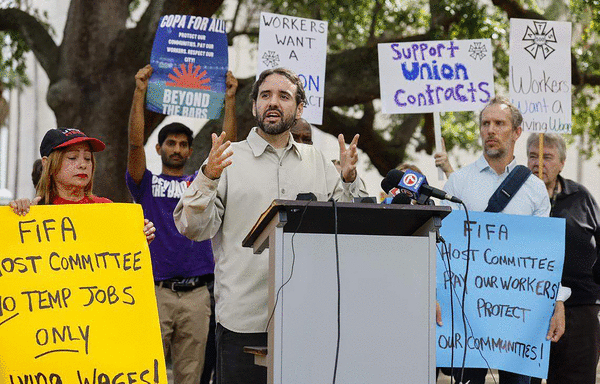
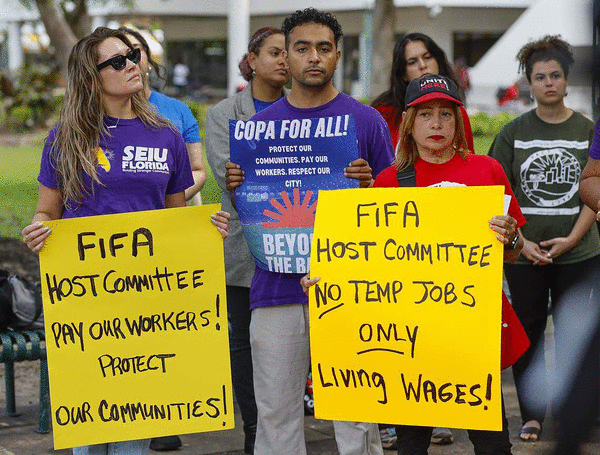

With the World Cup kickoff less than two months out, Miami-Dade labor leaders want to ensure that the benefits of hosting games reach the people who staff them.
At a press conference Tuesday, organizers presented a letter signed by 30 labor leaders and addressed to Alina Hudak, the president of Miami’s World Cup Host Committee. In it, they urged FIFA and the Miami World Cup Host Committee, the group overseeing local World Cup planning, to meaningfully enforce certain labor, worker protection and public safety standards.
“Promises are not enough,” read the letter.
Chief among the coalition’s asks are guaranteed livable wages for all local World Cup workers, along with accountability mechanisms to ensure that the contractors and subcontractors who hire those workers comply.
“The cost of living is very high in Miami,” said Elvia Montero, an employee at Miami International Airport and member of Local 355, a union that represents hotel, food service and gaming workers. “Thousands of people come here, and we’re the ones who give them their food, we’re the housekeeping. We deserve a fair wage.”
Other host cities, like Seattle, have clear agreements and enforcement mechanisms regarding hiring skilled labor, paying livable wages and ensuring safety standards, said Chris Beckford, vice president of South Florida’s AFL-CIO chapter, which represents workers across 60 local unions. Though he had hoped something similar would happen in Miami, Beckford said no enforced accord yet exists.
“The workers are not getting a say,” he remarked.
In a statement to the Miami Herald, FIFA said that host cities make their own labor rules, but, at minimum, they must follow the minimum standards laid out in FIFA’s Human Rights Framework.
Each host city is responsible for coming up with a human rights plan, which, FIFA said, should “translate these standards into locally relevant actions” that pertain to labor conditions, worker protections and safety.
Only four of the 16 cities hosting this year’s World Cup have submitted such plans, and Miami isn’t one of them.
The Miami World Cup Host Committee did not immediately respond to a request for comment.
In a statement, Miami-Dade County Mayor Daniella Levine Cava’s office affirmed its support for workers protections, living wages and rights and said that “labor should be a key partner at the table in all FIFA-related activities.” But Kenny Scott, president of a local construction union, said the mayor’s office had been “not that cooperative recently” in talks local organizers have been having with the host committee and FIFA.
Protections for workers, immigrants
Labor leaders called on the host committee to use Miami-Dade County’s prevailing wage — the standard wage for a given profession, as determined by the county — as a baseline and to require transparency from contractors about how much they’re paying their workers.
The coalition is also calling for the host committee to screen all vendors for prior labor violations before awarding contracts. If contracted, those companies need to provide safe working conditions, the coalition said, particularly given that World Cup matches and fan events will take place during the summer, potentially under extreme heat.
And at least 30% of workers at Miami-hosted World Cup events should be Miami-Dade residents, labor leaders urged — a provision they say would support long-term workforce development.
To enforce all of it, the coalition is advocating for an independent oversight structure to hold contractors accountable.
But beyond pay and working conditions, protections for non-citizen workers and fans was another common refrain among union representatives and community advocates.
Thomas Kennedy, a policy analyst at the Florida Immigrant Coalition, urged a pause on immigration enforcement actions at all World Cup venues and events.
The concern is not abstract, said Kennedy. During last year’s FIFA Club World Cup, an asylum seeker was detained during a game he attended with his two young children at MetLife Stadium in New Jersey. He was ultimately deported, according to Human Rights Watch.
“That could happen to any tourist who comes to the World Cup,” Kennedy said.
Those immigration requests are common-sense measures to ensure Miami is safe for the thousands of international visitors expected to descend on South Florida for the World Cup, he added.
This story was produced with financial support from supporters including The Green Family Foundation Trust and Ken O’Keefe, in partnership with Journalism Funding Partners. The Miami Herald maintains full editorial control of this work.
©2026 Miami Herald. Visit at miamiherald.com. Distributed by Tribune Content Agency, LLC.






Comments