Oil and Iran among cruise challenges as global passengers top 37 million
Published in Business News
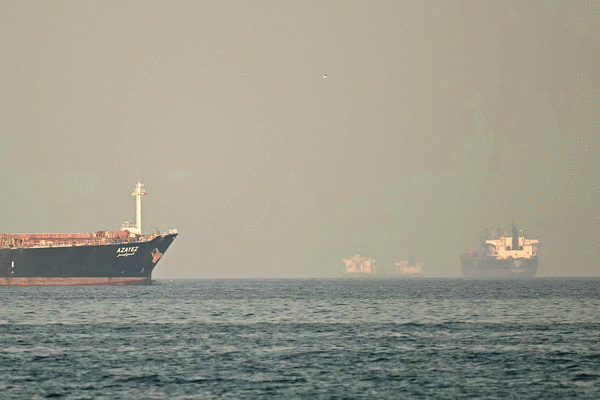
MIAMI BEACH — One cruise line has had a bigger challenge than others amid the war in Iran, but the leaders of four of the biggest cruise companies in the world all said the global oil situation is something they can’t ignore despite record numbers of people sailing.
The heads of the parent companies for Royal Caribbean, Carnival, Norwegian and MSC Cruises took the stage Tuesday for the State of the Global Cruise Industry keynote session at the Seatrade Cruise Global conference held at Miami Beach Convention Center. The representative of MSC, though, was in the hot seat.
“It’s very, very difficult to say. Obviously, we live it day by day,” said Pierfrancesco Vago, executive chairman at MSC Group’s Cruise Division.
While the line does sail out of Port Canaveral and PortMiami, it has more of a global customer base, including five ships that were affected in the Persian Gulf. MSC is also a massive shipping company that is among the 3,000 vessels such as tankers and container ships that are stuck either inside or outside the Strait of Hormuz.
But for the cruise ships, about 1,000 passengers were successfully evacuated along with most of the crew. It already has forced the line to cancel some planned European itineraries. Vago said the situation is very fluid.
“Morning is one thing, lunchtime is another, dinner is another game,” he said. “So there is a lot of announcements. So we need to stay cool and actually be ready to move out as soon as the possibility and opportunity comes.”
For the other lines, the rollercoaster of fuel prices has posed real economic challenges for some, but others noted that the industry has become more resilient than previous fuel emergencies.
“Fuel is something we need for our business. We’ve needed it for 50 years in some form or another. We’re going to need it for the next 50 years,” said Josh Weinstein, CEO at Carnival Corp. & PLC.
But advances in ship efficiency in the last few decades has shown dividends, including the industry’s pursuit of cleaner fuels such as liquefied natural gas and methanol.
“If we consume less fuel, we will save money, and it’s better for the planet,” Weinstein said. “So pretty much all of our effort and interest in the fuel space hasn’t been about reducing volatility. It’s been about reducing the need.”
Jason Liberty, chairman and CEO at Royal Caribbean Group said all of the lines have been making strides as the industry still has a zero carbon emissions goal by 2050.
“We’ve been advancing use of alternative fuels, biofuels, testing them in preparation for getting us closer and closer to our net zero goals,” he said. “One of the realities is that it’s not about what we want, it’s about what’s available.”
So that means reliance still on legacy fuel until those alternatives are “scalable and affordable, one to society, but also to our industry.'”
“I think today is a temporary moment in time,” he said. “That’s not going to change our pursuit of using alternative fuels.”
So for now, the price of oil will still hurt, but the cruise lines have a bigger safety net than they did in years past.
A record 37.2 million global cruise passengers traveled in 2025 according to new data from Cruise Lines International Association, the lobbying group for most of the world’s major cruise lines. That’s up from 34.6 million in 2024 and continuing an upward trend that’s expected to top 40 million before the end of the decade.
“The amount of mainstream demand that we have is, it’s night and day,” he said. “It is a mainstream consideration for the major markets of this world. We are not an alternative vacation. We are a vacation. And that sets us up very well for volatility.”
There were about 14 million global cruise passengers in 2009, for instance, the year the cruise industry was climbing out of a similar oil standoff between the U.S. and Iran.
“There’s always going to be volatility in the world, right? If you think about the last 20 years, it’s the financial crisis, it’s the Arab Spring, it’s the Ukrainian war, it’s COVID, Venezuela, and now the conflict in the Middle East,” Weinstein said. “The great thing about this industry is we adapt, we pivot, and we persevere. And I have no reason to believe that it’s going to be any different.”
CLIA President and CEO Bud Darr noted the order book among its member cruise lines for new ships has hit an all time high of $82 billion, with ships to be delivered through 2037. With more orders expected this spring, he said that value could break $100 billion soon.
“The new generation of cruisers have somewhat different values and also are willing to spend money on somewhat different experiences than in the past, the industry is evolving to satisfy that need, as well as the existing customer base,” he said.
Darr said among member cruise lines, which is about 320 ships this year, those vacations equate to $198 billion in global economic impact among 1.8 million jobs worldwide providing $60 billion in wages.
“That’s fantastic for an industry that has few hundred ships,” Darr said. “Lots of room to grow. We just scratched the surface of the potential market that’s out there.”
©2026 Orlando Sentinel. Visit at orlandosentinel.com. Distributed by Tribune Content Agency, LLC.








Comments