Will CA finally grant unions' bid for confidential conversations with workers?
Published in Business News
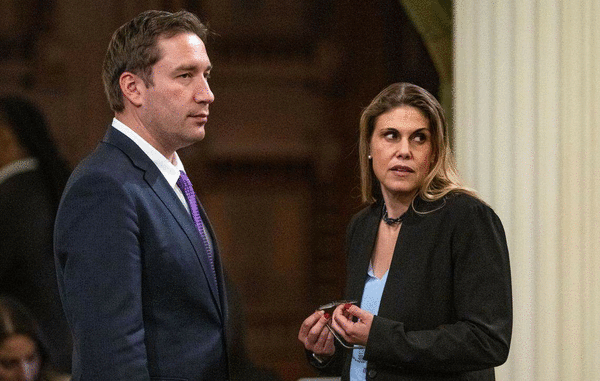
SACRAMENTO, Calif. -- In California, attorney-client privilege ensures that communication between an individual and their lawyer remains confidential. California labor groups are hoping 2026 will be the year that a similar, albeit lesser, privilege is extended to union representatives and their members.
A bill authored by Assemblymember Patrick Ahrens, D-Sunnyvale, would prohibit employers from asking peace officers, teachers and other public employees about their conversations with their labor representatives. Ahrens and other lawmakers have introduced similar bills in recent years, though none of those efforts made it as far as a piece of 2013 legislation that former Gov. Jerry Brown vetoed.
Opponents of this bill, and its previous iterations, said the legislation will create communication obstacles in critical public services areas and could make it more difficult to investigate wrongdoing by public employees.
Last week, the Assembly Public Employment and Retirement Committee approved the bill with a near unanimous vote. Assemblymember Tom Lackey, R-Palmdale, was the sole no-vote.
Sponsors of the legislation say that this bill essentially codifies existing rulings by the Public Employment Relations Board, which has previously issued decisions that employers infringed on union and employee rights by attempting to learn the content of their discussions. One of those decisions in 2018 found that a Southern California school district violated state law when officials interrogated a union steward about whether employees had complained to her.
Without this legislation, employers could compel union representatives to disclose information that could harm members, said David Mastagni, a labor lawyer who spoke on behalf of the Peace Officers Research Association of California during a hearing last week.
The lack of confidentiality “chills trust in the union,” Mastagni said in remarks captured by CalMatters’ Digital Democracy database.
He noted that the bill is written to ensure discussions related to criminal investigations are exempt, and the legislation does not supersede existing government code protecting public safety employees who are the subject of an investigation.
In a statement Ahrens said his legislation guarantees workers their basic right to due process by codifying PERB rulings on confidential communications between employees and their labor representatives.
“Employers have presented no compelling evidence that convinces me that employees shouldn’t have basic representation rights,” he said.
Opponents say bill would hamper investigations
Dorothy Johnson, a legislative advocate for the Association of California School Administrators, said this legislation would make it more difficult for employers to conduct administrative investigations into employees’ actions.
Creating protections for union-employee communications could prevent supervisors from seeking information about staff-student boundary issues that may not rise to the level of criminal investigations, such as texting a student or giving minors a ride home, but is still not permissible, Johnson said.
This would furthermore impede larger investigations into wrongdoing by public employees by making it more difficult to gather evidence, Johnson noted.
“There’s a difference between having an expectation of confidentiality versus having this privilege protected status,” she said.
Mastagni addressed those concerns in last week’s hearing by stating that school officials can still question witnesses about alleged assaults and employers can still ask about the facts of an incident. PORAC’s support letter for the bill noted that if an employee brought a sexual harassment lawsuit, a union representative could still be forced to testify about conversations under this law.
Opponents also noted that the bill could disrupt efficient communication between employers and their workers.
“You don’t really want your frontline service workers who are trying to work together as a team to be walking on eggshells every time they work on a project,” Kyle Packham, the spokesperson for California Special Districts Association, said in an interview.
Members of CSDA include water, sanitation and fire districts. Packham said those critical public services would be impeded by Ahrens’ bill because “seemingly innocent conversations” could be misinterpreted and become mired in adjudication with the Public Employment Relations Board.
The Legislature has considered similar bills in five previous sessions
Unions have long tried, and failed, to pass a similar measure to insulate communications between labor representatives and their members.
The legislature passed a version of this bill in 2013 only for former Gov. Jerry Brown to veto the legislation. In 2024 and 2025, assembly members advanced similar legislation. Both times the bills died in the Senate Appropriations Committee.
The state worker unions supporting this bill, which include the California Association Of Highway Patrolmen and the California Association Of Psychiatric Technicians, have provided significant financial support of lawmakers. In 2024, those two unions contributed over $1.1 million to legislators, according to CalMatter’s Digital Democracy database.
Other unions that voiced their support for the bill included SEIU California, the California Professional Firefighters and Teamsters California.
Those groups have made similar statements of support arguing for the need to protect communications between unions and represented employees. The bill’s sponsor, PORAC, said that these protections are not equal to attorney-client privilege.
In a supporting statement the law enforcement group said the legislation was a “modest and balanced” approach to ensure public agencies cannot interfere with union representation communications.
©2026 The Sacramento Bee. Visit at sacbee.com. Distributed by Tribune Content Agency, LLC.







Comments