Trump's wild, 5-minute rally sends clear message to Wall Street
Published in Business News
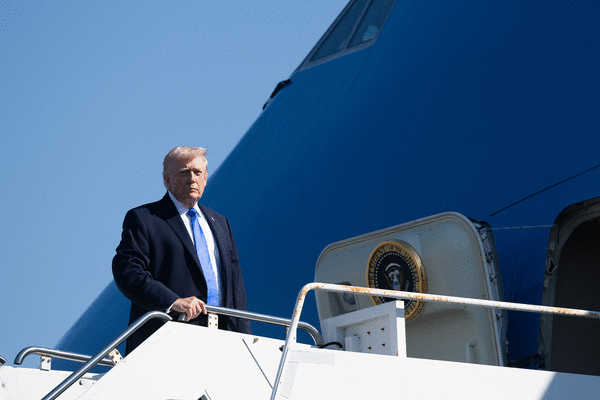
Just moments after Donald Trump backed down from his threat to bomb Iran’s energy infrastructure in a Truth Social post at 7:05 a.m., oil prices plunged over 13%, Treasury yields tumbled and traders signaled that U.S. stocks would surge at the opening bell.
It almost didn’t matter that less than an hour later Iran contradicted Trump’s claim that negotiations were underway. On Wall Street, the message was clear: Trump, at least, is eager to end a war that has sent the global economy careening toward a crisis since he started it a little over three weeks ago.
“If this doesn’t get resolved over the next seven to 10 days, we’re looking at a pandemic-style shut down of the global economy,” said Marko Papic, chief strategist at BCA Research. “Today’s announcement suggested Trump is aware the real economy could fall off the cliff.”
The president’s move set off a wild, five-minute rally that punctuated the most volatile trading day on Wall Street since the U.S.-Israeli war on Iran began. It also echoed the sharp reversals that traders endured last April, when Trump first pushed worldwide financial markets to the brink with his trade war before backpedaling.
Like then, his announcement was, in part, aimed at investors rattled by the fallout, according to people familiar with the matter, to head off another painful selloff just as the week began.
After U.S. markets opened on Monday, the S&P 500 jumped 2.2%, the biggest rally since May. Two-year Treasury yields at one point tumbled 0.22 percentage points from their highs to a low of 3.79%. Brent crude dropped below $100 a barrel, the dollar fell, and European stock and bond markets rebounded sharply from losses to end the day higher.
Yet beneath it all lurked doubts that Trump will be able to end the war as easily as he began it. And as that sentiment gained ground, the early gains faded across markets — underscoring the president’s limited ability to jawbone investors who are bracing for a period of potentially prolonged instability in the Middle East.
“I am worried that it’s not Trump’s decision anymore, not in the same way that tariffs could be called off,” said Brad Conger, chief investment officer at Hirtle Callaghan. “The people who are encouraged by Trump’s responsiveness to the market, their faith is misplaced.”
During his first year back in the White House, traders learned to expect that Trump would reverse course if the consequences of his policy shifts sent markets tumbling. It became widely known as the TACO trade, short for Trump always chickens out, and instilled a buy-the-dip mentality as he lobbed trade-war threats, talked up invading Greenland and attacked the Federal Reserve.
The war against Iran has undermined that belief. Hostilities have continued to escalate over the past few weeks, when Trump by turns claimed that he was winning the war and excoriated allies for failing to come to the U.S.’s aid. Iran’s leaders remain in control of the country. And by shuttering the Strait of Hormuz, they’ve chocked off energy supplies that are crucial for the rest of the world.
The fallout of that became increasingly apparent last week. As soaring energy prices deliver a potentially new inflationary shock, traders have started positioning for central banks around the world to ratchet up interest rates. That in turn has raised the risk of stagflation, or weak growth coupled with rising prices, and erased more than $2.5 trillion from the global bond market — putting it on pace for the biggest monthly loss in more than three years.
It also underscored how much the war is undermining the Trump administration’s other goals — of lowering mortgage rates, holding down oil prices and making the case that the economy is on a solid path ahead of this year’s congressional elections.
While Trump has repeatedly lashed out at Fed Chair Jerome Powell for not reducing borrowing costs, the two-year Treasury yield by Friday had jumped over a half-percentage point since the war began on concern inflation would tie the central bank’s hands.
“While President Trump has clearly been scrambling to find ways to keep a lid on oil prices, perhaps it was — once again — bond markets that forced his hand,” said Tom Garretson at RBC Wealth Management.
After stocks slumped Friday, sending the S&P 500 to its longest weekly losing streak in a year, Trump said on his social media feed that he was “getting very close” to meeting his objectives and considering winding down military efforts in the Middle East.
He later threatened to attack Iran’s electricity facilities if the country didn’t open Hormuz within 48 hours. Then on Monday, he said he would pause that for five days, citing progress in talks that Iran denied were taking place.
To many, the president’s shifting positions and well-established history of misstatements, exaggerations and lies has eroded his credibility in financial markets.
Jordan Rochester, a strategist at Mizuho Bank, said the White House’s messaging has sown havoc with positioning.
“The hardest part is not predicting the war but predicting the communication from the White House and how much markets will react to it,” he said in a note to clients. “We’re left with a market confused whether it’s credible sign of the endgame nearing or another ‘very complete, pretty much’ moment.”
Investors doubted whether his comments on Monday were much more than a short-term effort to prop up markets. By the time the market closed, the S&P 500 had pared its advance to about 1.2%. The Treasury market’s advance also ebbed.
“Truth is about perception, and Trump’s back and forth is creating uncertainty on top of uncertainty, which helps prevent market declines from otherwise confident bears,” said Michael Kantrowitz, chief investment strategist at Piper Sandler & Co. “All of this back and forth buys time and prevents overconfidence in markets — for better or for worse.”
____
—With assistance from Sydney Maki, Elena Popina and Kasia Klimasinska.
©2026 Bloomberg L.P. Visit bloomberg.com. Distributed by Tribune Content Agency, LLC.





Comments