Toyota adds $1 billion investment across Kentucky, Indiana plants
Published in Business News
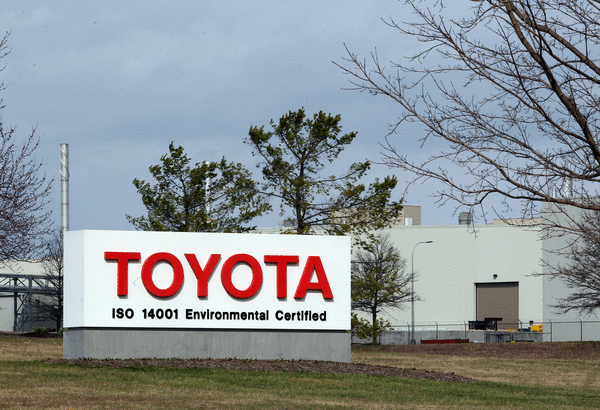
GEORGETOWN, Ky. — Toyota Motor Corp. is investing $1 billion between its Kentucky and Indiana plants as part of a broader $10 billion multiyear commitment to manufacturing in the United States, the company said Monday.
The move comes amid a push from President Donald Trump to both entice and coerce more companies to make their products within U.S. borders, though the Japanese auto giant has said that the investment decision is part of a long-running commitment to the country — regardless of who occupies the White House.
“Toyota’s investment in the U.S. is for the long-term, tied to our philosophy of building where we sell and buying where we build,” Mark Templin, Toyota Motor North America's executive vice president and chief operating officer, said in a statement.
“We have created a tremendous value chain for nearly 70 years. Our teams have contributed to world-class design, engineering, and assembly of more than thirty-five million cars and trucks for our customers in the U.S.,” he added.
Toyota will put $800 million into its Georgetown, Kentucky, plant — the automaker’s largest in the world — to modernize assembly lines as it prepares to ramp up production of the all-electric Highlander SUV, the company's first American-made fully electric vehicle, and a second yet-to-be announced EV. An additional $200 million will go to Toyota's plant in southern Indiana.
At least one of the three assembly lines at the Georgetown plant will produce the new three-row Highlander EV, scheduled for release in late 2026, as Toyota continues its purposefully slow embrace of fully electric powertrains after long being a leader in gas-electric hybrids.
The plant will also produce gas-powered Camry and RAV4 models as the company prioritizes flexibility in responding to evolving consumer demand for different powertrains and a back-and-forth regulatory environment in Washington.
Toyota affirms its Kentucky roots
Toyota, which ranked second to General Motors Co. in total U.S. light-duty vehicle sales in 2025, also used the Monday announcement in Georgetown to celebrate the 40th anniversary of the spring 1986 groundbreaking on its Kentucky factory, some 20 miles north of Lexington.
"Kentucky changed for the better 40 years ago when Toyota chose to make Georgetown its New Kentucky Home, and I am proud to say that partnership and success continues today as we celebrate this remarkable milestone together,” Kentucky Gov. Andy Beshear said in a statement.
The second-term Democratic governor and rumored 2028 presidential hopeful attended the event on Monday, delivering brief remarks and participating in a factory tour.
“Toyota Kentucky is Toyota’s largest vehicle manufacturing plant in the world, producing over 14 million vehicles since its doors opened and benefiting Kentuckians through good jobs and a strong economy," he added. "We are grateful to our great Toyota partners and look forward to building on years of success for generations to come.”
No members of President Donald Trump's administration attended the celebration, though the White House was briefed on the announcement ahead of time, according to Toyota.
“No president done more to revive American auto manufacturing than President Trump, and Americans continue to benefit from the President’s leadership," White House spokesperson Kush Desai said in a statement. "Toyota’s recent announcement builds on the tens of billions of dollars’ worth of investments that global automakers have poured in the United States thanks to the Trump administration’s tariffs, deregulation, and tax cuts.”
The $1 billion announcement between Kentucky and Indiana represents the first phase in a five-year, $10 billion investment commitment Toyota made in November 2025. The company made that commitment the same day it opened a $13.9 billion battery plant in Liberty, North Carolina, that houses battery production lines supporting gas-powered hybrid, full battery-electric and plug-in hybrid models across Toyota's lineup.
Toyota also recently completed a separate $1.3 billion effort launched in 2024 to prepare the Georgetown plant for production of a then-unnamed three-row battery-electric SUV — now known as the Highlander.
Kerry Creech, president of Toyota Motor Manufacturing Kentucky, said ahead of the Monday announcement and anniversary celebration that there is "a very big sense of pride for our team members," calling Georgetown a "generational plant."
"All our team members — mother, father, brother, sisters — work here. And they recommend other family members to come here," he added. "I think that there's 87 people that still work here since the inception of 1986."
Toyota, according to a company release, employs about 9,800 people in Kentucky.
Investments and write-downs from Detroit rivals
The Detroit Three automakers, top rivals of their Japanese counterpart, have similarly made sizable investments into U.S. vehicle manufacturing since the start of 2025. But they have also taken significant losses on more ambitious EV strategies.
Stellantis NV said in October 2025 that it plans to pump $13 billion into its U.S. operations over the next four years, a figure that also includes a roughly $5 billion investment announced shortly after Trump took office in January. The investment, according to the company, will support the introduction of five new vehicles, an all-new four-cylinder engine and more than 5,000 jobs at its facilities in Michigan, Ohio, Illinois and Indiana.
The Jeep maker, however, also took a "jaw-dropping" $26.5 billion investment charge last month on its electric vehicle investments as the struggling company looks to reverse course on an EV-minded strategy under former CEO Carlos Tavares that never materialized.
Ford Motor Co. made its own Kentucky commitment last summer when the company announced a $2 billion effort to "radically" overhaul the way it makes electric vehicles at its Louisville Assembly Plant. That effort is still ongoing, but Ford also announced $19.5 billion in special charges on its EV-focused Model e division in the fourth quarter of 2025.
GM made two separate major investment announcements in 2025, totalling about $4.9 billion, to shift some production to the United States — including the Orion Assembly plant in suburban Detroit — from Mexico and to bolster V-8 engine production at the company's Tonawanda Propulsion facility near Buffalo, New York.
But, like its crosstown competitors, GM also took writedowns on EV investments that did not pan out. The company announced those hits in two tranches: $1.6 billion in the third quarter of 2025 and another $6 billion in the fourth quarter.
Toyota has not filed any such writedowns or special charges on electric vehicle investments.
Tariff impacts on auto investments
On U.S. manufacturing investment more broadly, the Trump administration has repeatedly said that its tariff policies are a driving force behind automakers making multibillion-dollar commitments.
Desai said in an October 2025 statement that the $13 billion Stellantis investment shows how the Trump administration's push to restore American auto manufacturing "keeps bearing fruit," adding that it also shows confidence in Trump's agenda and "the coming Golden Age for American industry and workers."
The United Auto Workers union — which does not represent workers at any Toyota facilities — has also praised Trump's tariff policies as an investment driver.
“A year ago, Stellantis was on a fast-track to moving their U.S. operations out of the country," UAW President Shawn Fain said after the company's investment announcement last fall. "Their decision today proves that targeted auto tariffs can, in fact, bring back thousands of good union jobs to the U.S."
Others in the industry — including at Toyota — have been less eager to praise the administration's tariff policies. One company executive, asked to confirm whether the Japanese automaker's U.S. investment plans could shift as a result of import taxes, was noncommittal during a question-and-answer session with reporters in Washington, D.C., last week.
"Ten billion dollars is a commitment. But again, everything can change," said Leila Afas, Toyota's vice president of global public policy and strategy. She cited potential impacts of new technologies and other conditions within the company.
"So stay tuned," she said.
©2026 www.detroitnews.com. Visit at detroitnews.com. Distributed by Tribune Content Agency, LLC.







Comments