Florida still leads the way, but global spaceports could soon top 100
Published in Business News
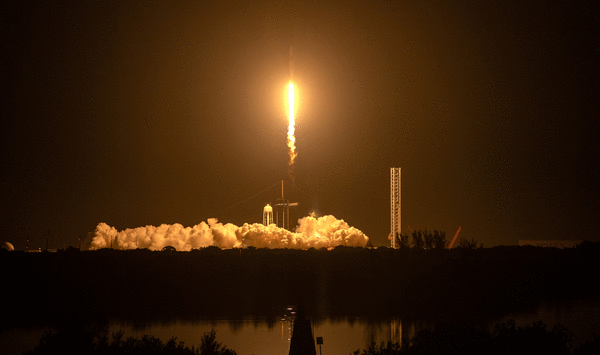
With Florida leading the world in launches again in 2025 and with no signs of slowing down, the state is ground zero for challenges for a growing industry as other spaceport players across the U.S. and world start to build momentum.
“We finally cracked triple digits. Got to 109 launches,” said Dale Ketchum, Space Florida’s vice president of government and community relations. “We’re continuing to grow rapidly. We’ve obviously got a lot of folks seeking to launch their vehicles at the Cape Canaveral spaceport.”
Ketchum was giving an update at the Global Spaceport Alliance’s annual summit on Tuesday that opened up four days of commercial space conferences this week at the Orange County Convention Center.
He noted that Kennedy Space Center and Cape Canaveral Space Force Station, along with California’s Vandenberg Space Force Base, have traditionally led the way for launches, and that’s not slowing down.
He expects between 96 and 125 launches from Florida in 2026, but recent talks with the Space Force could see the two states’ launch manifests swell in the next five years.
“Our friends in uniform were talking about a desire between Vandenberg and the Cape to get to 500 launches by 2030, so that’s going to continue to tax our capability,” he said. “But collectively, I think between NASA, Department of Defense and the state, primarily through the Florida Department of Transportation, we’re going to get that infrastructure in place.”
As Florida’s capacity grows, though, the need for the burgeoning space industry has prompted more cities to throw their hats into the ring and call themselves a spaceport.
The Federal Aviation Administration has 14 licensed spaceports in the U.S., but there are another 16 locations that have either already applied for a license or have announced intentions to do so, said GSA chair George Nield.
That number has grown to more than 100 around the world as more places look to cash in on what Nield says will be a lucrative future.
“It’s really changed from the early days of the space activity and the strong consensus now, across the board, (from) all the economists and financial experts is we’re well on our way to $1 trillion per year space economy, and we’ll see that in just the next few years.”
Already, according to the Space Foundation, the number is at $613 billion as of 2024.
“We believe that much of that economic growth can take place at or near spaceports. And the reason we say that is that we believe that spaceports are not just places from which you can launch rockets, but rather they can be focal points and technology hubs that can be part of an overarching economic ecosystem for space related activities,” he said.
Florida, in fact, is home to another two official spaceports, Cecil Spaceport in Jacksonville and the recently renamed Exploration Spaceport at Space Coast Regional Airport in Titusville.
The conference had representatives from existing and developing spaceport groups from around the U.S. including newcomers Montana and Washington state looking to figure out their place, while Florida’s spaceports look to enhance what they already have.
“We have benefited from 70 years of launching things into suborbital and orbital space. so those assets have been largely repurposed and reused,” said James Moffitt, Space Florida’s vice present of spaceport operations.
He said that Space Florida’s main challenge, has been to upgrade its infrastructure to keep up with modern demands.
“There’s been a lot of investment put into that aging infrastructure to get it to where it’s at today. And we’re not done yet,” Moffitt said.
The state has broken down its investment focus to support its spaceports into six infrastructure needs: Wastewater, wetlands, wharf space at Port Canaveral, bridges, power and gas.
“Some of the near term ones are like wastewater. Nothing sexy about wastewater, but it’s very, very important to the space industry. So that’s kind of at the top of our list. We’ve got to fix those things that allow the industry to grow and mature,” Moffitt said.
Ketchum said the the strain on Port Canaveral has perhaps the largest investment needs as more launch providers need to dock their recovery vessels.
“For a lot of the big boys who are launching and recovering vehicles, maritime operations is an absolutely essential component,” he said. “So we need to significantly expand Port Canaveral, and that ain’t cheap, but that’s a key part of our infrastructure.”
And with more launches comes more strain from all of the support needs, he said.
“They demand an awful lot of trucks that then beat the hell out of the roads and bridges you spend a lot of money on,” he said. “So these are great problems to have, and those of us who were around during the shuttle program and the retirement of the shuttle program, we worked our buts off to have these problems, and now we got them, and we got to solve them, but working collectively, I’m sure we will continue to do so.”
©2026 Orlando Sentinel. Visit at orlandosentinel.com. Distributed by Tribune Content Agency, LLC.








Comments