Stellantis might be off the hook in California amid EV pivot
Published in Business News
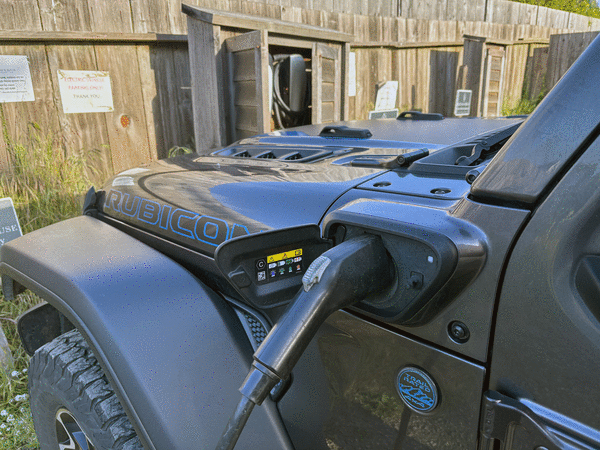
DETROIT — Chrysler parent company Stellantis NV might be off the hook from meeting steep electric vehicle sales requirements in California, recent developments indicate.
The Trump administration controversially halted EV requirements in the United States' largest auto market last year. But Stellantis — seemingly — remained bound through 2030 by a prior settlement agreement promising to comply with Golden State policies, regardless of any “judicial or federal action” preventing its latest rules from taking effect.
That might no longer be the case.
Stellantis dealers in California now have more flexibility in what vehicles they can sell, while state regulators are no longer projecting certainty over whether the company known for its gas-guzzling trucks will be held to account. Additionally, the automaker recently decided to kill plug-in hybrid Jeep and Chrysler models for the 2026 model year, making it all but impossible to meet a 35% "zero-emission vehicle" sales requirement.
That figure rises to 68% by 2030, the final year of Stellantis' settlement agreement with California. The 2024 deal, inked under embattled former CEO Carlos Tavares, was made in exchange for California forgiving past regulatory compliance shortfalls, and helped avoid potentially lengthy litigation between the two sides.
"Stellantis will continue to comply with applicable regulations," spokesperson Jodi Tinson said in a Jan. 16 statement. "We remain committed to freedom of choice for our customers in 2026 with the all-new, fully electric Jeep Recon and range-extended Grand Wagoneer."
Asked whether Stellantis still considered California's regulations "applicable" under its settlement agreement with the state, Tinson said the company is "not going to elaborate further."
The California Air Resources Board, which regulates vehicle emissions in the Golden State, declined to comment for this story. The agency previously told The Detroit News in June that the settlement agreement "remains in place, and we fully expect Stellantis to comply.”
Less plug-in, more V-8
Sean Hogan, vice president of Sierra Auto Group in Southern California and the chairman of Stellantis' national dealer council, said this week that Golden State retailers are confident that they now have flexibility in which models they can sell.
That includes, he said, a recent shift allowing California dealers to sell the company's popular gas-guzzling V-8 and supercharged V8-powered models.
Stellantis recently advertised that its Hemi V-8 Jeep Wrangler Moab 392, which gets just 14 miles per gallon, is "now available for order in all 50 states, including California, Massachusetts, New York, Oregon, Pennsylvania, Vermont and Washington." All are states that had adopted California's stricter emissions requirements before Trump halted them.
Many V8-powered Ram 1500 pickups and Dodge Durango SUVs are also currently listed for sale in California; the automaker previously was phasing out the larger engines on its trucks and SUVs due in part to the state's strict regulations. Under the Trump administration, the V-8 is back for the automaker, apparently even in California.
Stellantis isn't fully moving away from plug-in models. Despite killing the plug-in hybrid lineup, the automaker will soon sell an electric model called the Jeep Recon, and also plans to soon release range-extended hybrid Jeep and Ram models that have an option to run entirely on electricity.
But without its plug-in hybrid Jeeps and Chryslers — many of which were funneled to California in recent years to meet the stricter requirements — it's unclear how the automaker could meet the terms of its settlement with the state.
Daimler difficulties
Since issuing the statement in June that "we fully expect Stellantis to comply" with the settlement agreement, CARB has undergone a legal setback in a separate but related matter.
Truck makers Daimler North America LLC, International Motors LLC, Paccar Inc. and Volvo Group North America LLC sued California over attempts to enforce emissions regulations despite a Trump administration maneuver to cancel them. That maneuver, notably, is also being challenged in court by California and several other states with Democratic attorneys general.
Veteran environmental lawyer David Pettit of the Center for Biological Diversity said that an initial ruling in the Daimler case “did not go well” for CARB and could have implications for the Stellantis deal, too.
In the Daimler case — which the Trump administration joined as an intervenor on behalf of the plaintiffs — federal attorneys argued that a California agreement with truck-makers called the Clean Trucks Partnership is "a regulatory enforcement tool styled as a 'contract' with certain truck manufacturers."
A judge issued a preliminary injunction in October that effectively halted California from enforcing its rules via the partnership, though the case is still pending a final decision.
One factor in that decision: the question of whether California can do by contract what it is forbidden to do by regulation.
Pettit said in an interview that CARB has made missteps in its legal defense and is no longer in a strong position to enforce the previously agreed-upon EV targets for Stellantis.
“I've always thought as a lawyer — I've been a lawyer a long time — it's very bad karma to get too cocky about your case, especially in public,” the California-based attorney said, commenting on CARB’s projected confidence about Stellantis last year.
“History has shown that maybe being a little more nuanced would have been a good idea,” he added. “Now they don't seem confident about how they're moving in this area.”
©2026 www.detroitnews.com. Visit at detroitnews.com. Distributed by Tribune Content Agency, LLC.







Comments