Trump and tariffs dominated the top automotive stories of 2025
Published in Business News



The year 2025 was a pathbreaking one for the auto industry.
That was not wholly unexpected following the triumph of now-President Donald Trump in the 2024 election. But the speed and scale of changes were perhaps unlike anything Michigan's signature sector has seen in a generation.
Tariffs meant to onshore production prompted big domestic investment announcements but immediately hampered supply chains and slashed expected profits by billions of dollars. Federal policy reversals catalyzed a massive retreat on electric vehicles. Ram Trucks announced the return of its hefty Hemi V8 engine in a move that reflected both a desperation to win back customers and the broader state of Trump-driven U.S. auto policy.
The Republican leader and his allies were frequently the center of attention, but many of the biggest storylines were not driven by the feds. Ford Motor Co., for example, moved into its sterling new headquarters. China continued its dizzying growth. Turmoil deepened within the United Auto Workers union.
A lot happened in the past 12 months, and The Detroit News' team of auto writers and editors has gone back to put a bow on several of the most important and memorable developments.
The 'T' words
Tariffs and Trump dominated headlines in 2025. The president's moves to establish historically high import taxes altered all areas of the U.S. economy, especially the international-trade-reliant auto sector.
To begin the year, there were relatively few and small U.S. tariffs on automotive goods following a decades-long embrace of free trade and regional integration. Trump slammed the brakes on that trend.
He frequently and chaotically introduced, delayed, canceled and altered tariff policies throughout the year. Sudden moves left automakers and parts suppliers scrambling, though Trump's message has been consistent: "If you build in the United States, there is no tariff," he often said in 2025.
The president began the year threatening 25% tariffs on all imports from Canada and Mexico. Those taxes nearly took effect before eleventh-hour deals in early February led to a pause. A month later, executives from the Detroit Three automakers played a key role in negotiating an industry carveout.
Sector-wide pleas for Trump to take a light touch on tariffs continued but were ultimately unsuccessful. Trump soon announced 25% duties on steel and aluminum — which he later raised to 50% — and on March 26 unveiled 25% tariffs on all U.S. imports of vehicles and auto parts.
Trump deployed those duties using his authority under Section 232 of the Trade Expansion Act of 1962, which made those tariffs separate from the more legally dubious "Liberation Day" levies he announced a week later. (Michigan's auto industry nevertheless played a co-starring role that day.)
An April estimate from Michigan's Center for Automotive Research suggested that Trump's Section 232 tariffs would combine to cost manufacturers, distributors and customers about $108 billion across the U.S. auto industry and $42 billion for the Detroit Three automakers. That $42 billion amount is nearly triple the combined 2024 profits of Ford, General Motors Co. and Stellantis NV.
The magnitude of those potential costs diminished later in the year as Trump and his administration announced policies to mitigate the tariffs: Partial exemptions for Mexican and Canadian goods; bilateral trade deals with the likes of Japan, the European Union and Korea; and a 3.75% tariff rebate on U.S.-assembled vehicles announced during a visit to Michigan.
The auto sector has so far weathered the storm from Trump's tariffs, though there have been significant impacts and responses from around the industry.
For one, there have been new domestic investment announcements. Stellantis, for example, pledged $13 billion in U.S. investment in October. GM announced plans to invest $4 billion to move production from Mexico to three plants in the United States. Ford Motor Co. announced a $2 billion investment in its Louisville Assembly Plant.
The United Auto Workers union, which is frequently at odds with Trump, has mostly cheered the president's tariffs for influencing those kinds of investments. All three companies, however, also scaled back profit expectations due to the policies.
Automakers and suppliers, which tend to have tight operating margins, have had to collaborate and renegotiate as they try to share the burden of new tariff costs. Suppliers also faced a concerning scenario early in 2025 when China responded to U.S. tariffs by temporarily restricting exports of rare-earth minerals.
Vehicle prices for consumers — which did inch to record highs in 2025 — have not spiked as a result of tariffs, but industry experts worry that automakers and dealers will eventually have to cave to cost pressures in the supply chain.
Warren Browne, an auto supplier consultant and former GM executive who worked at the carmaker for 40 years, has projected total U.S. vehicle sales of 16.2 million units in 2025. That is a modest increase over the prior year, but his outlook for 2026 (15.6 million projected units) and 2027 (15.8 million) is less rosy.
EV retreat
Electric vehicle sales surged in September but collapsed after the end of the federal plug-in vehicle tax credit, a part of Trump’s campaign promises to end what he described as an “EV mandate.”
That also included efforts to repeal a legal finding that allowed the Environmental Protection Agency to regulate tailpipe greenhouse gas emissions, revoke California’s permission to set its own stricter regulations that nearly a dozen states had also adopted, and eliminate all federal fuel economy fines.
Even without those fines, the Republican leader unveiled a proposal for lenient new standards during a December event in the Oval Office featuring appearances by Ford CEO Jim Farley and Stellantis CEO Antonio Filosa.
In summary, Trump took actions in 2025 aimed at dismantling every major U.S. tailpipe emissions regulation.
The U.S. auto industry was previously racing to embrace a transition to electric vehicles, but the shift proved rocky. Automakers that set lofty EV goals at the start of the decade later urged regulatory relief after consumers were slow to adopt the new powertrain.
John Bozzella, head of the auto industry's top lobbying group in Washington, said in 2024 that Biden-era environmental regulations were at the "ragged edge of achievable." After the Trump administration ended the EV tax credit via the One Big Beautiful Bill Act, previous electrification goals became unequivocally impossible.
The Detroit Three acknowledged losses on EVs in 2025 and used the Trump-era regulatory holiday to announce major investments in continuing gas- and diesel-powered vehicles.
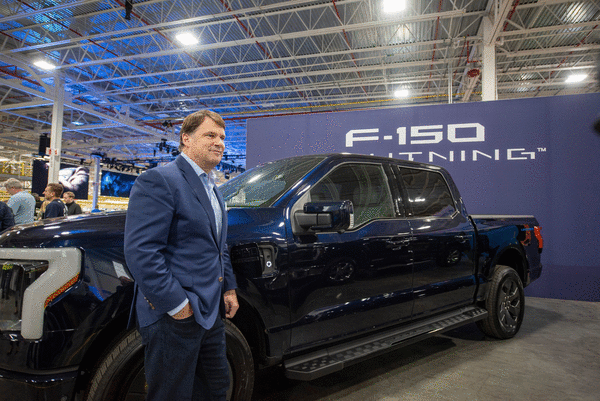
Ford in December said it would take a $19.5 billion write-down as part of a pivot away from EVs. It discontinued the all-electric F-150 Lightning truck, scrapped plans for an electric commercial van and full-size truck for 2028, and moved to dissolve a joint venture with Korean battery partner SK On while converting EV battery plants to make stationary energy storage products instead.
GM reported a $1.6 billion hit in October related to its own EV pivot. That included canceling plans to build electric pickups at Orion Assembly in Michigan, reducing battery module assembly capacity, and ending the development of hydrogen fuel cell technology. The Detroit-based automaker also said it was ending production of electric delivery BrightDrop vans at a plant in Ontario.
Stellantis similarly dialed back its electrification efforts. The transatlantic automaker killed plans for a Ram all-electric pickup, cancelled a Jeep plug-in hybrid truck, and brought back its famous Hemi V-8 gas engine in some vehicles. The brand, amid other USA-tinged advertising from its parent company, called the Hemi return a "Ram-demption."
A joint-venture battery plant Stellantis has with Samsung SDI is pivoting to make energy storage batteries after EV demand fell. And CEO Antonio Filosa says the automaker is more interested in beefing up its hybrid powertrain offerings in the United States going forward, rather than adding to the plug-in lineup.
Profits, sales, stock performance
New tariffs have hit profits at automakers, though they’ve mostly been able to stave off major cost increases.
Ford is forecasting a net impact of $1 billion in 2025 from tariffs on operating profit as the company moves to find savings on logistics, in supply chain and in other parts of the business. In December, the automaker increased its operating profit guidance to $7 billion for 2025, which would be down more than 30% from 2024.
Looking ahead, multiple fires at a major aluminum supplier, scrapped EV products and redeployment of plants for alternative programs will show up in financial reports into 2027.
Ford sales fluctuated throughout 2025, though November was its ninth month of outpacing the industry average. The company in April began offering discounts previously reserved for employees in an effort to buoy consumer confidence amid tariff chaos, but the expiration of the federal plug-in vehicle tax credit has tanked EV sales.
Despite challenges, investors appear optimistic for the automaker’s continued growth following significant announcements on its strategy. Its share price is up more than $3 over the past year to $13.28.
GM CEO Mary Barra earlier this year projected total tariff costs to hit between $4 billion and $5 billion, but later lowered estimated costs to closer to $3.5 billion to $4.5 billion. Overall, the automaker weathered rapid market changes profitably, beating analyst expectations in its latest earnings report. The company expects to bring in net profits between $12 billion and $13 billion in 2025. Final profit numbers will be released next year.
The company's sales have been strong throughout the year, and its stock performance has been even stronger. GM's share price began the year at about $51 and currently sits just below $83. That gain is an impressive 60% boost since Jan. 1. Tesla Inc., by comparison, is up about 21% for the year.
Stellantis’ recent profit and sales problems persisted for much of 2025. The company, once among the most profitable automakers in the world, lost $2.7 billion globally in the first half of the year, and its U.S. sales slide continued until the third quarter, when it finally saw year-over-year improvement.
The company board this year sought to restore stability following the dismissal of former CEO Carlos Tavares in 2025. Stellantis installed Filosa, a 25-year veteran of the automaker, as CEO in May after bringing back popular retired executive Tim Kuniskis to lead the Ram brand in December 2024.
Stellantis in October said that it was starting to see signs of commercial progress, but executives have warned their turnaround strategies will be slow to come to fruition. The company's stock price has recovered from a September dip below $9 per share but still appears poised to end the year down more than 13%.
China's continued growth
The United States' chief geopolitical rival continued its rapid automotive growth in 2025, boosting its share in key markets and again dominating the global EV sector.
Cutthroat competition in China has led to persistent overproduction, and current conditions have made it nearly impossible for Chinese automakers to turn a profit, according to a Reuters report. But amid that struggle, brands like BYD Co. and SAIC Motor Corp. are making major inroads abroad.
Chinese automakers nearly doubled their market share in the European market during the first half of 2025, now exceeding 5% of new vehicle sales, according to data from JATO Dynamics Ltd. In Mexico, imports from China accounted for more than 20% of new light-duty vehicle sales in November, per data from Mexican bank Banco BASE. Chinese imports represented close to 0% of sales before 2018.
The United States, unlike its allies, still effectively bans the domestic sale of Chinese nameplate vehicles. The European Union has tariffs of up to 35.3% on such vehicles but allows their sale and production within member countries. Mexico, amid pressure from the Trump administration, will soon levy 50% tariffs on Chinese autos.
Detroit's legacy automakers in the United States, to some extent, ramped up their response in 2025 to Chinese upstarts like BYD.
Ford unveiled its Universal EV Platform and Production System, a long-term move to boost EV competitiveness, even as the company pulls back on some investments. The manufacturing system will leave behind the moving assembly line that founder Henry Ford pioneered more than a century ago and offer a mid-size electric truck starting in 2027 for as low as $30,000 following a $2 billion investment in its Louisville Assembly Plant.
The automaker also announced a partnership with French rival Renault for EVs in Europe and that it would explore commercial vehicle collaboration.
Some automakers have teamed up with Chinese firms: Stellantis started to see the fruits of a partnership with Chinese automaker Leapmotor, for example, with the company's EV sales in Europe growing rapidly in 2025, thanks in part to the existing Stellantis dealer network there.
Plans are in place to execute a similar expansion in South America. Leapmotor's CEO said recently the company aims to sell 1 million cars globally in 2026, and plans to grow that to 4 million in a decade.
HQ moves
Ford in 2025 made a splashy move from its 1 American Road world headquarters to the company's new product development center known as “the Hub” off Oakwood Boulevard across from the Henry Ford Museum. The automaker's once-iconic Glass House headquarters at Southfield Road and Michigan Avenue will be demolished starting next year.
The new digs, executives said, will match a new mentality focused on cross-departmental collaboration between employees and save time traveling across Dearborn for product reviews and meetings.
GM, meanwhile, prepared throughout 2025 to move its HQ out of the Renaissance Center and into the new Hudson’s Detroit building downtown. That move is expected to begin in early 2026.
Stellantis saw new signs of life at its sprawling North American base in Auburn Hills, with some new staff added and more time being spent in-office by employees. New CEO Antonio Filosa, who is Italian, said he will be based in Michigan and not Europe.
Recalls
Ford in July set a record for the total number of recalls issued in a single year. As 2025 comes to a close, that number has reached more than 150.
Although warranty costs and repairs hit its financial results throughout the year, results from J.D. Power and Consumer Reports suggest the newest vehicles coming off production lines show marked improvement.
Stellantis recorded the second-most recalls of any manufacturer with 53, and GM ranked third at 27. GM's most notable recall was related to a federal probe of nearly 900,000 trucks and SUVs for engine failures, which drew a June lawsuit. Stellantis experienced a series of high-profile recalls this fall on the Jeep brand's plug-in hybrids.
Owners were especially frustrated by a battery recall for the hybrids that warned them to stop charging and park away from structures following a number of recent vehicle fires — the third time some Jeep drivers had received those instructions in recent years.
The brand's CEO asked owners to "Please accept our sincerest apologies" as the company looks ahead to a clean slate in the new year.
©2026 www.detroitnews.com. Visit at detroitnews.com. Distributed by Tribune Content Agency, LLC.









Comments