What we learned from Bears' Caleb Williams, including why fines won't deter QB's use of special cleats
Published in Football
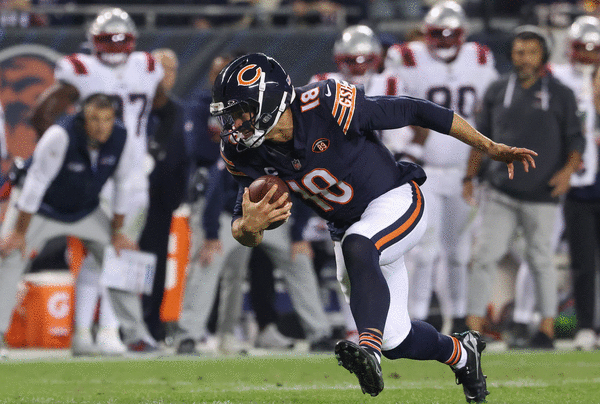
CHICAGO — Chicago Bears quarterback Caleb Williams said he believes his newly adopted Caddix-branded cleats have helped him avoid injuries, and he plans to wear them even if he keeps getting fined.
“(I’m) focused on my health,” Williams said after practice Wednesday at Halas Hall. “I’m focused on being able to be out here for the guys. And if that can give me a small percentage up and it works, then that’s what I’m going to do.”
Williams reportedly was fined $11,941 for wearing shoes displaying the logo of specialized athletic footwear company Caddix, which doesn’t have an official partnership with the NFL, during the Bears’ 31-23 road win against the Atlanta Falcons in Week 6.
As of Wednesday afternoon, he had yet to be fined for Week 7’s 30-24 home win against the New England Patriots.
According to the NFL’s and NFL Players Association’s collectively bargained on-field code of conduct, players can be fined for any part of the uniform that contains an “unauthorized logo/branding or intellectual property.”
Under that policy, players can be fined $11,941 for the first offense and $23,882 for the second offense.
Here’s what else we learned about Williams on Wednesday:
Williams further defends wearing the cleats
He has been wearing Caddix cleats since at least the preseason. Williams was wearing them during his lone preseason appearance against the Cincinnati Bengals.
But he said he’d been “trying to get in them for about a year. And I heard about them through one of my trainers from back home.”
It’s part of an ongoing makeover to his physical regimen, which has included losing weight and making major changes to his diet.
“As we’ve known for the past couple of years now, I’m huge into my body,” Williams said. “I’m huge into trying to stay on the field. I’m huge into trying to be healthy. It’s a rough game. So the cleats, they’ve been great. They’ve been super comfy and they’ve worked.
“They are a science type of cleat. It’s something that focuses on when you plant on the hard plants on turf or grass, they call them ‘SmartStuds,’ and they move when you move in these hard plants. They take tension off of your tendons, your joints and all of that. So over the course of a long career or over the course of a long year, when you can take some percentage — it could be 1 (percent), it could be 50, it could be 12, it could be whatever. When you take that percentage off consistently over a period of time, you get to have the chance, a higher chance, of being healthy. And so that’s what I focus on.”
According to the company’s claims on its website, “SmartStuds flex and rotate to release your foot from the turf, reducing the rotational torque that can lead to knee, hip and ankle injuries.”
Williams added that other NFL players have worn them. Bengals quarterback Joe Flacco and Jacksonville Jaguars wide receiver Jakobi Meyers are among them.
It should be noted that Williams was wearing Caddix when he had a noncontact right hamstring injury that kept him out for three games.
Williams was asked if he believed the severity of the injury would’ve been worse but didn’t speculate.
“Obviously if I had that answer, I’d be a trillionaire and sitting somewhere nice,” he said with a laugh. “I don’t know that, but I think it does. I think my joints, my ankles and my knees and my feet haven’t bothered me as much from the other cleats that I’ve worn, that you’ve seen me wear throughout the week or throughout games and throughout the weeks of games where you’re consistently playing and you get up one day and your knees hurt or your ankles are hurt and your feet hurt or anything like that.
“Like I said, they’ve worked for me and I feel that I feel a difference. That’s my opinion, and somebody else can have another.”
Has Williams sped up his clock a little?
Against the Patriots, Williams’ 3.12-second average time to throw was slightly faster than his season average of 3.22 seconds, according to NFL Pro’s Next Gen Stats. Williams called it a “conscious effort.”
“The opportunities, I think of me getting the ball out, have shown up more, just reading the defense, seeing the defense and then believing in my guys, being confident, having an open communication throughout the games, throughout practice, of where they’ll be so I can get the ball out faster and trust them and throw with anticipation,” he said. “And when those times do show up, let’s light up the scoreboard or let’s light up when the second play starts.”
Williams’ time-to-throw averages in his last two games, since returning from the hamstring injury, were quicker than his first two games, with his 3.02-second average against the Falcons in Week 6 the quickest.
For context, his Week 7 time-to-throw average (3.12) was still third-longest among quarterbacks — behind the Patriots’ Drake Maye and Kansas City Chiefs’ Patrick Mahomes (both 3.17) — and his season average of 3.22 is longest in the league, just like his 3.20 average was in 2025.
It should be noted Williams routinely buys time in the pocket, likely inflating his numbers, and his yards per attempt (9.3) against the Patriots matched his performance against a Carolina Panthers weaker defense in Week 1.
Coach Ben Johnson noted the uptick in Williams’ processing has been building since last season, but he wants to strike a balance with his quarterback.
“We try to keep it consistent to where all these banked reps and the things that he’s seen each play against coverage-wise, it does accelerate his ability to go through a progression and check the ball down if primary or No. 2’s not there,” Johnson said. “We talk every week, we watch the tape and we’re looking at it. … Were we able to stay in the pocket just a tick longer to deliver the ball or did we need to break it there?
“We don’t want to take that magic out of his play whatsoever. And yet, I do think you’re seeing just a tick more of him playing on time and on rhythm, and that allows our pass catchers to come alive also.”
Williams agreed.
“Whatever shows up, do what I’ve got to do,” Williams said. “That’s my mindset.”
The offense is humming, and so is Williams
The Bears enter their Week 8 matchup against the Seattle Seahawks on Monday night with the third-ranked offense. Williams has been the chief conductor, and he has leaned on an unusual method to keep him steady: humming.
“It’s calming,” he said. “It calms your nervous system.”
Novak Djokovic has used humming to soothe frustrating moments on the tennis court. Former MLB pitcher Trevor Bauer said in a 2014 post on his YouTube page that he would hum favorite songs before innings, adding “it’s important to me that I hum it because the vibrations in your brain help you relax, help you focus your brain, same kind of reason that people will hum when you’re meditating.”
That seems to align with Williams’ beliefs.
“I’ve always been super-conscious of mind, body and spirit,” Williams said. “This is such a — not nerve-racking as in nervous (profession) — but it’s a game that shocks your nervous system. Especially the hits and the emotions and all these different things.
“My breath and humming, I just learned it throughout the years. Breath, that was the first thing I learned. And then humming came along a few years later.”
And he has passed it on to teammates.
“I tell my guys sometimes when I walk into the huddle, ‘Everybody take a deep breath. Let’s focus up and go get this,’” he said.
Injury updates
The first official injury report isn’t due until Thursday, but running back Kyle Monangai (thumb/toe) did ride a bike off to the side Wednesday during the portion of practice that was open to the media. Linebacker T.J. Edwards (hamstring) was spotted at practice for a second consecutive day.
Cornerbacks Malik Muhammad II (toe) and Tyrique Stevenson Sr. (undisclosed) weren’t spotted. Muhammad left game against the Patriots in the third quarter and didn’t return.
____
©2026 Chicago Tribune. Visit chicagotribune.com. Distributed by Tribune Content Agency, LLC.




Comments