Why Warriors' Steph Curry is unbothered by contract situation: 'I'm not going anywhere'
Published in Basketball
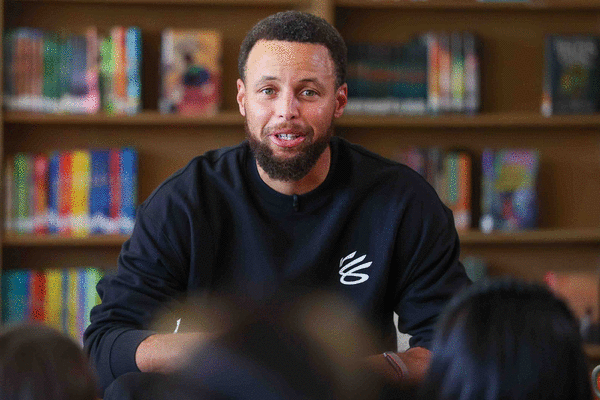
OAKLAND, Calif. — Steph Curry is in no rush to sign a contract extension that would all but guarantee he would finish his career as a Warrior.
But playing in anything but a Golden State uniform? Curry emphatically squashed that notion on Wednesday afternoon.
“This is a very unique situation, and I’ve been pretty straightforward and honest about it,” Curry said at Oakland’s Madison Park Elementary. “I’m not going anywhere.”
Curry, who turns 39 in March and is entering his 18th NBA season, has been eligible since Aug. 29 to sign a two-year, $136.7 million contract that would run until 2029, but he's yet to put pen to paper on any new contract. Despite being primed to enter the upcoming season on a lame-duck contract, Curry did not believe the uncertainty will have any impact on the team.
The Warriors are no stranger to this situation. Coach Steve Kerr worked under an expiring contract last season, and negotiations on a new deal lasted until May.
Curry hinted at a willingness to take less than the maximum if it helped the team build a contender around him, and noted he was in no rush to get a deal done.
“There are just dynamics of where we’ve been the last four years, where we’re trying to go, and things that are related to my contract can determine a lot of different things,” Curry said, adding, “I’m still having those conversations … I’ve told everybody that you’ll know when I’m making a decision that’s right and ready to move forward, but it’s not a distraction for me at all, and hopefully not for the team either.”
Star big men Nikola Jokic and Karl-Anthony Towns headline the upcoming free-agent class. With Jimmy Butler and Draymond Green’s contracts expiring after this season, the Warriors could have around $80 million in cap space to work with in the 2027 offseason.
Golden State, which begins training camp on Tuesday in Hawaii, has brought back the majority of last season’s 37-45 team that lost in the play-in tournament. Their only new non-draft additions have been veteran minimum signings, Brandon Williams and Georges Niang.
Though he dealt with injuries that limited him to only 43 games last season, Curry was still an elite player whenever he touched the floor. He averaged 26.6 points per game, and his 4.4 3-pointers made per game would have led the league if he had played enough games (58) to qualify.
Curry was not worried about managing the patellofemoral pain syndrome (runner’s knee) that made him miss over two months, but rather characterized it as a natural byproduct of being a 38-year-old professional athlete.
He and his team have followed what he called a “prescriptive plan” to bring the knee back to full strength while also making sure he did not overwork the joint during the offseason.
“Because I missed so many games last year, that’s going to be top of mind and obviously it should be,” Curry said. “But anyone at this age with this amount of miles, you’re going to be managing something. It’s kind of part of the longevity aspect of this, and I’m not afraid of it.”
Wednesday’s event was in conjunction with Eat. Learn. Play, Curry’s organization that has spent the past seven years working with various Oakland schools to help children live healthy lives.
ELP, which recently renovated its 25th Oakland schoolyard, received an international spotlight during July’s ESPY’s awards, when ESPN honored Curry with the Muhammad Ali Humanitarian award for his work in the East Bay.
ELP CEO Christopher Helfrich said the organization has seen an uptick in support from the community since that night.
“A moment like that gives us visibility and momentum,” Helfrich told the Bay Area News Group. “Our job is to turn that momentum into impact. What we’ve seen in terms of more people following, subscribing, donating or paying, there’s been a tangible increase.”
Rather than building a 26th new schoolyard, ELP’s event promoted eye health, with Curry speaking to children about his own battle with an eye condition called Keratoconus, which causes blurry vision.
Despite being the most accurate of deadeye shooters, Curry didn’t have 20-20 vision until he began wearing contacts in 2018. Working with medical technology company Glaukos, he promoted his new campaign “Could it be KC,” which aimed to spread awareness of and encourage testing for the condition. He read books to the elementary kids, and then shot baskets with them outside.
“I knew I had some blurry vision, it’s called ghosting, where you see shadows, light sensitivity, headaches and all that type of stuff,” said Curry who only went to be tested after former general manager Bob Myers told him to seek an exam after he noticed Curry squinting on the sidelines.
Almost a decade later, Curry is enjoying clear vision and navigating his most notable contract situation since he signed the four-year, $44 million deal that helped start the dynasty.
With the start of training camp less than a week away, Curry reiterated he has no desire to play anywhere but the Bay Area.
“It’s not like free agency or anything (like that) is of interest to me,” Curry said. “As long as I can go out and hoop and play and impact games like I can, then that’s the most important part. Wherever we land, will be the right decision.”
©2026 MediaNews Group, Inc. Visit at mercurynews.com. Distributed by Tribune Content Agency, LLC.






Comments