'We can't go on like this': UConn's Dan Hurley weighs in on Protect College Sports Act
Published in Basketball
STORRS, Conn. — The Protect College Sports Act has drawn passionate support, and just as passionate opposition as it works its way through congress. The bipartisan bill is meant to create unified standards for college athletics and end the perceived chaos of recent years.
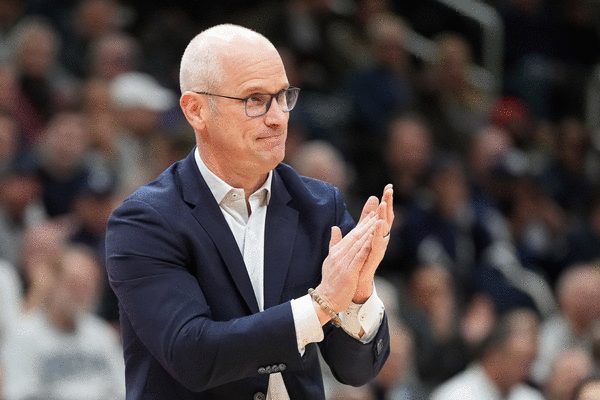
UConn men’s basketball coach Dan Hurley weighed in after the Huskies’ practice Tuesday, offering support for the legislation.
“We need something, even if it’s not perfect,” Hurley said. “We can’t go on like this. If you just do a one-time transfer, (changing) the transfer rule would solve a lot of the problems.”
There are opponents of the bill in both parties. Senator Chris Murphy (D-Conn.) has been one of the Protect College Sports Act’s most vociferous opponents, seeing the bill as a rollback the benefits of college athletes have won after decades of fighting.
“What this bill does at its core is protect a system of exploitation,” Murphy posted on his website. “This bill protects the billions of dollars that coaches and sports industry executives are making over the suppression of compensation for some of the most highly valued athletes in the world. This bill seeks to give an unprecedented antitrust exemption to an industry that is violating the law every single day.”
The Protect College Sports Act was introduced May 27, co-sponsored by Sens. Ted Cruz (R-Texas) and Maria Cantwell (D-Wash.), and advanced out of the Senate Committee on Commerce, Science, and Transportation by a bipartisan 19-9 vote on June 18. The bill has undergone the usual series of amendments and adjustments, eliminating, for instance, a cap on power conferences adding teams that would have squelched UConn’s long-held aspiration of joining a conference with greater revenue. That has since been changed, which helped the bill gain the endorsements of the major conferences and many of the senators representing their states. Sen Tommy Tuberville (R-Ala.), the former college football coach, initially opposed the bill, but came around to support it in August. On Sept. 15, the Senate voted 74-24 to invoke cloture, ending debate and moving the bill toward a final Senate vote which could advance it to the House of Representatives.
As with almost any legislation, the rhetoric has been heated while the negotiations go on. In September, Randy Levine, vice chairman of The President’s Savings College Sports Roundtable wrote pieces for Sports Business Journal, and a letter to The Hartford Courant, strongly supporting the bill and calling out its opponents, including both Connecticut Senators. Richard Blumenthal (D-Conn), who has introduced legislation in this area in the past, also wrote a piece for The Courant.
“Congress must act — with urgency — to pass strong protections for college athletes and level the playing field,” Blumenthal wrote. “But as written, the Protect College Sports Act trusts the NCAA to police itself and further entrenches the current elite conferences hurting schools like UConn. I can’t support the bill until it’s made better.”
Hurley and UConn’s compliance staff met Tuesday afternoon to discuss the evolving bill and the university’s position. UConn’s hierarchy generally supports the bill. In the current climate, where there are few boundaries to what colleges can pay athletes, its athletic programs will be badly out-resourced and outspent by schools in the Big Ten, Big 12, ACC and SEC.
“We’ve had some conversations,” Hurley said. “We’ve tried to express from a UConn standpoint what it’s actually like to be on the front lines with this, with players and families.”
Hurley supports the concept of “athletes’ empowerment” but believes college sports are now in chaos. The NCAA has been vulnerable to lawsuits as it tries to re-establish rules of eligibility. A bid to give athletes five years of eligibility within a five-year span after leaving high school was challenged in court, and a number of older athletes have been declared eligible this summer. Over the last couple of years, there have been controversies involving athletes with professional experience being allowed to return to play in college.
“This current … what I call a racket,” Hurley said. “There’s a reason people are trying to sue their way back into college when just a couple of years ago, they couldn’t wait to get out of college.”
For decades, players transferring had to sit out a year before playing for their new school, which discouraged transfers. Now, there is unlimited transfers and it is not unusual for athletes to play at as many as four schools before they are done. The College Sports Act aims to limit athletes to one transfer without having to sit out, and puts some limits on compensation.
“I heard for so many years that the players needed to get paid, the players needed the ability to transfer, they should be able to transfer,” Hurley said. “The bill allows for both of those things to happen. For me, that was the only thing that was ever wrong with college sports, that players need a little bit more flexibility on a one-time transfer thing and players need to be compensated. But in sports, you need rules, and we should all just follow the rules. … We all knew through our compliance people that the 5-for-5 was coming. They were telling us for the (current senior class) it would be in effect, and guys like Alex (Karaban) and Tarris (Reed Jr., both in the pros) wouldn’t benefit from it, the next class would. We also understood in some way they would crack down on these (older) international players that were playing in these leagues, or G League players that don’t belong in the college game.”
This week, Murphy proposed amendments that would allow college athletes to unionize and subject coaches to the same “transfer” rules as athletes.
“If you look at any sports league, the NBA has a (salary) cap,” Hurley said. “I don’t know how you could collectively bargain if you have 354 men’s basketball teams that have 15 players, what does that collective bargaining look like? How many football teams are there? How many players on a football team?”
Hurley feels an “anti-coach” vibe in the opposition to the Protect College Sports Act. He is in the middle of a six-year, $50 million contract that runs through 2030, and many basketball and football coaches have changed schools for enormous compensation, most notably Lane Kiffin, who left Mississippi for LSU on the eve of the football playoffs last November.
“All the people with an opinion on it, ‘this is pro sports,’ but college should be a training ground,” Hurley said, “a really important developmental stage in 18-22 year olds’ lives. This is a critical point in an 18-21-year-olds’ life to develop habits, behaviors, mindset, character, work ethic, things that no one seems to consider. It’s all about playing development. And (the narrative) is very anti-coach. For a lot of 18, 19. 20-year-olds, the most important person they’ve ever had in their life is a coach who holds them accountable on a daily basis, teaches them work ethic, just characteristics and qualities, sacrifice, teamwork, how to communicate, leadership, all these things. Our game is chaotic and I don’t think it’s overall healthy for the players for the long term. These are not NBA level, world class level players, these are guys coming straight out of high school that need a lot of development, need a lot of coaching, need a lot of development off the court. They’re very young men that if they’re not taught to stay somewhere, address their deficiencies, develop a work ethic, develop traits, toughness, it’s going to be very bad for them (later in life).”
©2026 Hartford Courant. Visit courant.com. Distributed by Tribune Content Agency, LLC.






Comments