Michael Rand: The Wolves' LaMelo Ball trade was years in the making. Here's all that went into their roster reset.
Published in Basketball
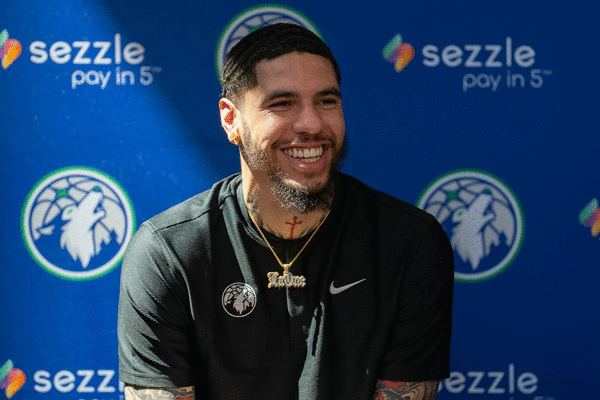
MINNEAPOLIS — For Timberwolves fans and perhaps even other NBA organizations, this offseason might have felt like a sudden transformation.
The Wolves dramatically remade their roster around under-26 players by trading away two productive power forwards in Julius Randle and Naz Reid while acquiring LaMelo Ball as part of the four-team deal and later signing Jonathan Kuminga in free agency.
But as Timberwolves general manager Matt Lloyd shared on Friday’s “Daily Delivery” podcast, there is nothing sudden about the ideas or deals that come from his boss, President of Basketball Operations Tim Connelly.
Roster-building at this scale is a meticulous process that can involve years of conversations that culminate in a frenzied and exhilarating conclusion.
Ball was the centerpiece of the offseason makeover as a 25-year-old gifted point guard with good size (6-7). Lloyd elaborated on what it took to put the trade together.
“The opportunity to acquire LaMelo, I mean, it was the product of a lot of phone calls over several years. It’s not something that just comes up,” Lloyd said. “It’s constant communication with Jeff Peterson, the president of basketball operations in Charlotte, who’s a good contact, a good friend. And those discussions started to heat up around the draft.”
The framework fell into place on the second night of the draft and was finalized at 6 a.m. the next morning. But the groundwork was laid long before that.
Transforming the roster is a constant process of evaluation, but in this case it took root in the Wolves’ 2025 conference finals loss to Oklahoma City. Lloyd said the organization wanted to keep that roster intact to give it a chance to develop chemistry while also acknowledging that the Wolves might eventually need to get younger and faster. A conference semifinal loss to San Antonio in May added evidence to that belief and perhaps intensified their admiration for what Ball could potentially bring to the roster.
“Was there a way to enhance our shot creation, enhance our three-point shooting, our size in the backcourt, get a little bit more switchable, get a little bit more athletic,” Lloyd said, “and have more options to throw at these two teams in the conference that we are going to be competing with for several years.”
Trading Randle and Reid left the Wolves incredibly thin at power forward. They signed Trey Lyles and pursued LeBron James, but deep into the summer it was still a question mark. Behind the scenes, though, the Wolves were putting in the work to land Kuminga — another player who fits their young veteran timeline.
Anthony Edwards actively recruited Kuminga to join the Wolves. And Lloyd talked to Kuminga’s agent, Aaron Turner, so often that his wife asked him to add up just how frequently they talked. The answer: 94 phone calls between Lloyd and Turner during a roughly six-week span between mid-July and late August.
By the time Kuminga was ready to make a decision and chose Minnesota, “everything just kind of came together,” Lloyd said.
Part of this year’s roster transformation comes from the belief that young veterans like Edwards, Ball, Jaden McDaniels and Kuminga are ready to be leaders even in the wake of several offseason veteran departures. That, too, is a product of watching those players, particularly Edwards, evolve over time.
“For all the things that he’s addressed in his game and the things that he’s addressed in physically as he’s grown, the thing that we should all be most proud of and most grateful to watch is how he’s expanded as a leader and as a winner,” Lloyd said. “It’s a big responsibility to walk in here every day, for Tim, for me, for our basketball operations staff, and meet his standard. Because he’s the one that sets the standard in the building, and it’s our responsibility to try to meet that every single day.”
Lloyd has been with Connelly for almost the entirety of his four-year tenure in Minnesota, meaning he has seen three major roster resets predicated on big trades: the Rudy Gobert trade in the summer of 2022, the Karl-Anthony Towns trade on the eve of training camp in 2024 and this year’s trade for Ball.
Being in the room for those conversations is “exhilarating,” Lloyd said, even if things can get hectic. As the Towns trade was being finalized, Lloyd said Connelly was driving to KAT’s house to talk to him and head coach Chris Finch was at a concert. He was tasked with talking through the move with ownership.
“He’s the premier dealmaker in the NBA,” Lloyd said of Connelly. “He’s always on, and he’s always kind of locked into what ways can we improve the team. What are the steps that we can take to put people in a position to succeed.”
Will this roster makeover work? The Wolves won 49 regular-season games each of the last two seasons, and betting sites have set their preseason over-under at 48.5. It might be a whole lot of change that gets them back to the same place. It could also be a big step up or down.
“These moves were big swings, but they’re big swings that we believe in,” Lloyd said. “They’re big swings that were researched. They’re big swings that were thought about.”
©2026 The Minnesota Star Tribune. Visit startribune.com. Distributed by Tribune Content Agency, LLC






Comments