Underground dams? They may be a storage solution as Idaho's water flows away
Published in Science & Technology News
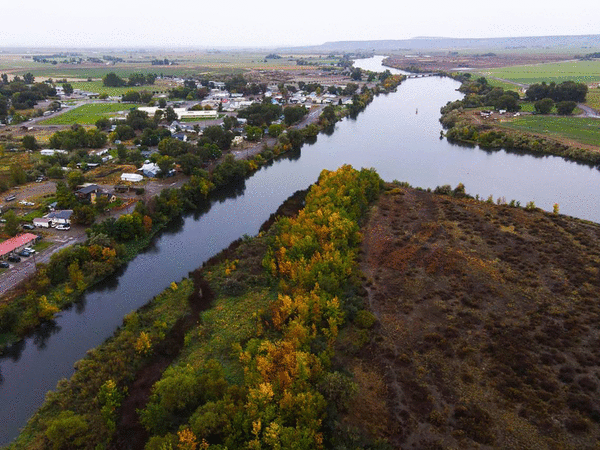
BOISE, Idaho — As spring rolls into Idaho every year, the snow starts to melt and the chilly water flows down the mountains through soil and streams. Water that isn’t trapped in dams or pulled from wells or rivers eventually reaches the Pacific Ocean.
These high spring flows are sorely missed come summer, especially in years like this, when the state’s water issues rise to the surface — 77.5% of Idaho is in a drought.
“We’re sending a lot of water out to the ocean,” said Bruce Savage, professor and chair of the Department of Civil and Environmental Engineering at Idaho State University.
Savage is leading a team of researchers to figure out whether something unusual could help save some of this runoff for when it’s badly needed: subsurface dams.
A subsurface dam is just what it says — an underground barrier that stops the flow of groundwater. The barrier can be designed so that some water can still get through, but excess water can be stored until it’s needed, according to Savage. This water could later be drawn out of the subsurface basin or released through the barrier to follow its natural course and replenish downstream rivers and aquifers.
Although a subsurface dam stores less water than an aboveground dam, its construction is less disruptive to the surrounding environment, and the water is more protected from contamination and evaporation.
Subsurface dams have been used to store groundwater in other countries, notably in Japan, but Savage’s team has not found evidence of their use in the U.S. However, the individual components of subsurface dams are regularly employed in some states.
“The ability to put in a cutoff wall to hold back water is fairly common. We use it in civil engineering all the time around construction sites,” Savage said.
Subsurface barrier walls are frequently used to block saltwater intrusion and protect buildings from groundwater, for example.
“It’s encouraging that the individual pieces of this concept are already being used,” said Savage. “The research question is whether they can be successfully combined in Idaho’s high-elevation, snowmelt-driven aquifers.”
Streams are the starting point in search for possible sites
While Savage combs through existing research on subsurface dams and researchers at Boise State University look into possible designs for cutoff walls, Mel Campbell is mapping every stream in Idaho to scope out potential locations.
Campbell, who graduated from ISU with a master’s degree in geographic information science, explained that underneath streams, groundwater flows through loose layers of gravel and sand.
Using the streams as indicators of the groundwater flowing beneath them, Campbell is building a model to identify the best potential sites in Idaho for a subsurface dam. The model includes information about the stream and surrounding area, such as elevation, slope of the stream, how straight the stream is, the number of streams nearby, average precipitation and geology of the bedrock layer.
Higher-elevation streams are better because the water, fed by snowmelt and glacial lakes, is more protected from contamination. The slope of the stream needs to be steep enough that water will flow into the area and seep into the ground, but not so steep that the water runs off before it can hit the subsurface area where the dam would be.
The ideal location would be a wide area of groundwater flow that tapers into a narrow region. “Where it narrows, right there is where we would build that wall underneath. So it’d be kind of like an underground storage basin with a tiny outlet,” said Campbell.
The geology of an area is one of the most important factors in Campbell’s calculations.
“The surface has to be permeable enough for water to infiltrate into the ground. And then, underneath the surface, the bedrock layer has to be impermeable and fairly rigid and strong to hold up this wall,” Campbell said.
The model also accounts for major geologic faults because the bedrock layer in those areas is more likely to have cracks and fissures, according to Campbell.
Campbell is still tweaking the model to identify the best potential locations for a subsurface dam, but the top contenders so far are spread across Idaho: a couple in the southeastern part of the state south of the Eastern Snake River Plain Aquifer; a couple north of the aquifer; and a couple of others that are in central Idaho.
“I think that it would be very beneficial to water users around the aquifer,” Campbell said.
The Eastern Snake River Plain Aquifer provides drinking water for nearly 300,000 Idahoans, according to the Idaho Conservation League, and its levels have been falling for decades. A subsurface dam could store spring runoff in the mountains and then release the water later in the year to replenish the aquifer and help meet the water demand for both personal and agricultural use.
The next phase is fieldwork and feedback
The subsurface dam project is still in the exploratory phase, and Savage emphasized that a lot of research and outreach would happen before any concrete plans could be made.
At the potential sites identified by Campbell’s model, field researchers would need to analyze the geology of the subsurface and measure the amount and flow of the groundwater. Savage said that in the next phase of the project, they plan to ask water leaders throughout the state for their feedback on any key issues that should be considered with a subsurface dam.
The team also will carefully evaluate possible effects of a subsurface dam on any nearby water users, as well as on wildlife.
“It’s important to stress that this is not a complete barrier,” Campbell said. “Water will still flow across the surface, and groundwater will still flow through it. We’re just reserving some of it for use later.”
This project is a collaborative effort between engineers, geoscientists and sociologists from Idaho State University and Boise State University, and is funded by a grant from I-CREWS: Idaho Community-engaged Resilience for Energy-Water Systems.
©2026 The Idaho Statesman. Visit idahostatesman.com. Distributed by Tribune Content Agency, LLC.






Comments