SpaceX launches SOS satellites, brings on sonic boom landing back at launch site
Published in Science & Technology News
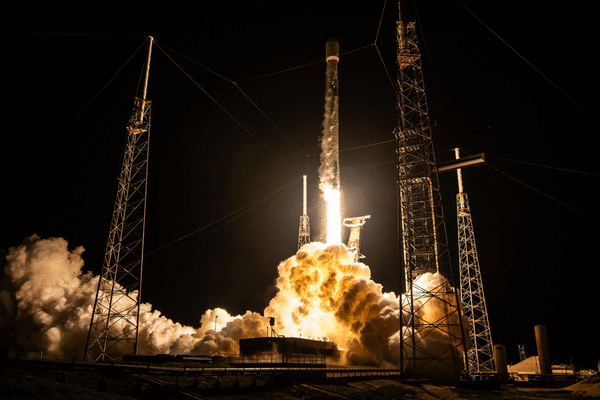
ORLANDO, Fla. — SpaceX launched eight satellites responsible for emergency SOS alerts on Saturday night and made a land recovery of the rocket’s booster that brought a sonic boom to parts of Central Florida.
A Falcon 9 rocket on the Globalstar 2-R Launch 1 mission lifted off at 9:12 p.m. from Cape Canaveral Space Force Station’s Space Launch Complex 40.
The first-stage booster for this mission made its 14th trip to space and made a recovery touchdown at Landing Zone 40 adjacent the launch pad.
“There is the possibility that residents of Brevard, Orange, Osceola, Indian River, Seminole, Volusia, Polk, St. Lucie, and Okeechobee counties may hear one or more sonic booms during the landing, but what residents experience will depend on weather and other conditions,” said a SpaceX advisory ahead of the launch.
The payload for the flight is a set of HIBLEO-4 replenishment satellites for Globalstar, which will be the first of two missions to update the Louisiana-based communication company’s 17-satellite constellation.
These satellites support direct-to-handset emergency SOS alerts on Apple products.
The mission had initially been targeting launch in May, but was pulled from the manifest without explanation, although the booster for the mission has been switched since the originally announced date.
The launch was the 52nd on the Space Coast from all providers, with SpaceX responsible for all but seven of them.
United Launch Alliance has flown five, including one Vulcan and four Atlas V rockets. Blue Origin has flown New Glenn once. And NASA flew its Space Launch System rocket topped with the Orion spacecraft on the historic Artemis II mission that sent humans on a flyby mission around the moon.
ULA won’t fly Atlas V again until Boeing’s Starliner is ready for its return to space, and Vulcan is awaiting fixes by Blue Origin to the BE-4 engines it supplies to ULA. Vulcans use two BE-4 engines on its primary stage and the fixes were announced following the revelation that a BE-4 valve was the likely culprit behind a massive launch pad explosion at Canaveral’s Launch Complex 36 in May.
Blue Origin is enacting the same fixes for its New Glenn rocket engines, which use seven BE-4s, while having to also rebuild the pad at LC-36 before New Glenn can try and launch again.
ULA and Blue Origin, though, have said they plan to launch their respective rockets again before the end of the year.
NASA meanwhile won’t fly its SLS again until Artemis III, which is targeting flight in mid 2027, although NASA Administrator Jared Isaacman on Friday said the agency is targeting the stacked rocket’s initial rollout to KSC’s :Launch Pad 39-B for testing as early as November.
©2026 Orlando Sentinel. Visit orlandosentinel.com. Distributed by Tribune Content Agency, LLC.






Comments