An oil company wants to restart fracking off the California coast. The state's top coastal officials say no way
Published in Science & Technology News
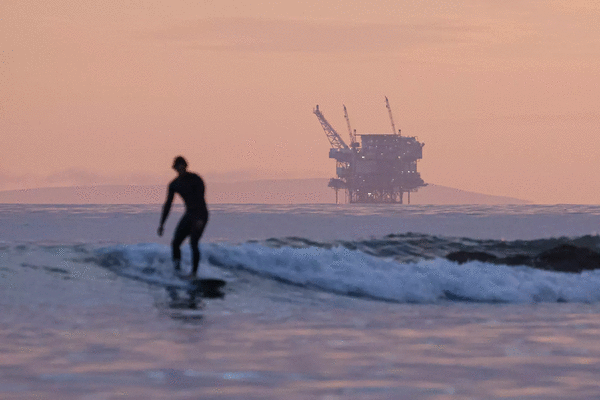
SANTA CRUZ, Calif. — Just days after the Trump administration launched proceedings that could limit California’s ability to protect its iconic shoreline, the state’s top coastal officials reasserted their authority by voting unanimously against an oil company’s controversial bid to restart underwater fracking operations.
This is the first time the California Coastal Commission has officially reviewed the issue of offshore fracking. Until now, the practice had been quietly rubber-stamped by the federal government without the state’s knowledge.
The proposed fracking plan would quadruple production on an aging offshore platform in the Santa Barbara Channel. The process ekes out oil from older wells, and involves cracking the bedrock several thousand feet below the seafloor by injecting chemical fluids with intense pressure.
“This is just simply one of those cases where the juice isn’t worth the squeeze,” said Coastal Commissioner Ray Jackson at a meeting Thursday in Santa Cruz County. “This creates far too many opportunities for something to go wrong, and when something does go wrong, it’s our oceans, beaches, wildlife and coastal economy that pay the price.”
The rejection of the plan comes at a time when Trump officials have sought to open the California coast to more offshore oil drilling, more rocket launches and possibly even floating nuclear reactors. The administration’s latest attempt to wrest local control from California officials has homed in on stripping authority granted to the state by the Coastal Zone Management Act, or CZMA. The federal law gives coastal states the right to review and object to any project in federal waters that clashes with state policy.
Citing California’s “environmental extremism,” Trump officials earlier this week ramped up an investigation that was framed as a performance review of the state’s compliance under the CZMA. More than 17,800 people have submitted written comments during the public review period, and hundreds of environmentalists, elected officials, Indigenous leaders, business coalitions, community activists and everyday Californians flooded this week’s in-person hearing to question the political motives of the review and to voice support of the state.
Many of those speakers gathered again at Thursday’s coastal commission meeting to see the CZMA in action. Commissioners listened carefully to dozens of public comments and weighed the technical responses provided by the Oxnard-based oil company, DCOR LLC, against the detailed analysis from the commission’s staff and lawyers.
“This offshore fracking proposal really illustrates the importance of having the state have a say in projects that affect its coastal resources,” said Maggie Hall, deputy chief counsel at the Environmental Defense Center. “If we didn’t have the role of the Coastal Commission and their right to review projects that arise under federal jurisdiction ... none of these issues would have been brought to light today — and importantly, there would never have even been a public process.”
Offshore fracking had been occurring quietly off the California coast for decades until about 2014. That’s when the defense center — along with the Center for Biological Diversity, Santa Barbara Channelkeeper and Wishtoyo Chumash Foundation — filed a Freedom of Information Act request and discovered that federal officials had approved at least 51 permits for offshore hydraulic fracturing and acidizing without notifying the state. The industry uses the terms “enhanced recovery” and “well stimulation techniques” to describe these controversial methods to extend the life of an oil well.
The environmental groups went to court, got an injunction and litigated until 2022, when the 9th U.S. Circuit Court of Appeals found that federal regulators had failed to comply with the National Environmental Policy Act and the Endangered Species Act when approving the permits. The ruling also made clear that the Coastal Commission needed to be brought into the approval process under the CZMA.
DCOR, which owns and operates 20 of the 27 remaining offshore oil platforms in California, now wants to resume fracking off Platform Gilda, about nine miles off the Ventura coast. The company’s proposed well stimulation plan would increase oil production at Gilda from 1,100 barrels to 4,000 barrels (168,000 gallons) a day.
Fracking operations would be carried out on 16 existing oil wells over a five-year period, and company officials said the procedure would take about 14 days per year to complete.
Environmentalists worry this could open the door to more offshore fracking and have expressed concerns about seismic hazards (Platform Gilda is located near several active earthquake faults) and harm to marine life (not all the chemicals used in fracking fluid have been studied, but commission staff noted that it does include known carcinogens and hormone-disrupting chemicals.)
“The term ‘fracking’ does not adequately describe the violent process that forces toxic chemicals into the wells under high pressure to break through the rocks,” said Susan Jordan, a resident of Santa Barbara and founder of the California Coastal Protection Network. “DCOR is the poster child for why the coastal commission must retain its ... ability to challenge yet another very bad idea that will increase the risk of a spill off our coast.”
A broader issue is the fact that Platform Gilda has been operating for 45 years — which commission analysts say is more than twice its expected lifespan. They noted that a nearby oil rig, Platform Grace, has already ceased operating due to declining production and is now being decommissioned. With production at Platform Gilda dwindling to 1,100 barrels per day, staff said the rig would also run its course if it weren’t for fracking.
Similar concerns with aging infrastructure have escalated tensions with a Houston-based oil company, Sable Offshore Corp, that acquired and just restarted an operation that had gone dormant in 2015 after a corroded pipeline spilled more than 120,000 gallons of oil in the Santa Barbara area. (That company bypassed state oversight by going directly to the Trump administration and is now entangled in more than 10 lawsuits.)
DCOR’s operations, commission staff noted in their analysis, have also been involved in two of the three most significant offshore oil spills in the last five years, including a pipeline rupture in Huntington Beach in 2021 and a gas leak and fire off the coast of Carpinteria earlier this year.
At Thursday’s meeting, DCOR officials said they have been proactively communicating with the commission and answering questions promptly and in good faith. They emphasized the company’s “dedication to safety, our commitment as a reliable operator, and our belief that the application will be carried out in a manner consistent with the California Coastal Management Program and the Coastal Zone Management Act.”
In a detailed letter to the commission, Dale Bradley, DCOR’s chief operating officer, addressed each of the commission’s reasons for objection and noted that “DCOR views the [proposed well stimulation treatments] not only as a means of improving recovery from its existing lease, but as a contribution to the broader national interest by securing a responsibly produced and regulated domestic energy supply.”
It is unclear how the company will proceed. If DCOR still wants to pursue fracking, it could either challenge the commission’s decision in court or appeal to U.S. Commerce Secretary Howard Lutnick, who could possibly overturn the commission’s decision on the grounds of national interest or national security.
Lutnick was also the Trump official who ordered the controversial CZMA performance evaluation that could decertify the coastal commission’s review power.
Supporters of the commission have emphasized this week that for the last five decades, the state-federal partnership under the CZMA had been mostly smooth through every presidential administration until Trump’s.
Out of the more than 3,700 actions on federal land and in federal waters that have come before the coastal commission for review since the 1970s, the commission has aligned with the actions 96% of the time.
“It’s important to note that the vast majority of the time, the coastal commission doesn’t actually object to projects, but when they do, it’s warranted,” said Hall, of the Environmental Defense Center. “These are meaningful policies that provide real protections for our coast and wildlife.”
©2026 Los Angeles Times. Visit at latimes.com. Distributed by Tribune Content Agency, LLC.






Comments