Solidarity against ICE is not one-size-fits-all for immigrant-owned cafes and restaurants in Chicago
Published in Variety Menu
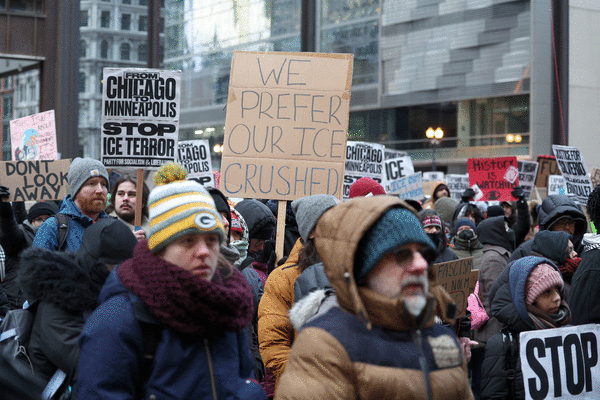
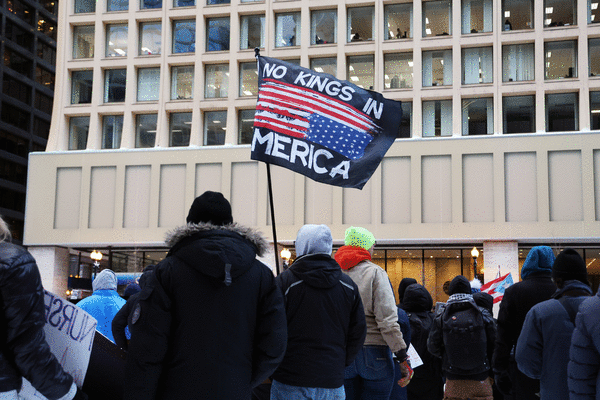
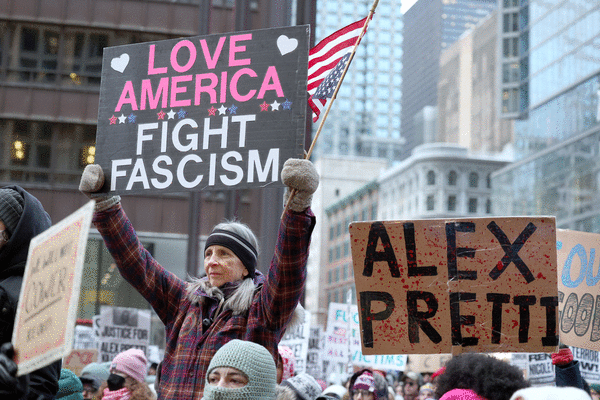


CHICAGO -- Last month, a national shutdown swept the country, urging people to observe a day without school, work or shopping as a way to demand changes to federal immigration enforcement. At Chicago’s Daley Plaza in the Loop, hundreds gathered despite the cold. Dozens of businesses closed shop. Many others, however, stayed open. But not because they wanted to.
The economic blackout on Jan. 30 was a protest against U.S. Immigration and Customs Enforcement actions following the fatal shootings in Minnesota of Renee Good, a 37-year-old mother of three, who was killed by an ICE officer on Jan. 7, and Alex Pretti, a 37-year-old VA nurse, killed by border patrol agents on Jan. 24.
Leading up to the demonstration against ICE, many restaurants and cafes took to social media to decry the Trump administration’s actions, but explained to customers that they were not in a financial position to close in solidarity, with payroll and rent on the horizon.
Hundreds of businesses in Chicago, notably in immigrant neighborhoods, are still trying to recover from a downturn in sales after being hit from all sides by intense immigration enforcement activity that swept the city in recent months. As many brace for another such storm, the burden of balancing activism and survival has gotten heavier.
“These are very interesting times, and I think it’s important for everyone to know that solidarity can look a little different to everybody, especially for a Hispanic-owned, or immigrant-owned small business,” said Raoul Adwan, owner of Thrd Coffee in the city’s Bucktown neighborhood. “For us, we’re in our slow season, and losing just one day could mean a lot and we have to be responsible for our staff.”
Thrd Coffee stayed open for the nationwide blackout. Adwan, who is half Mexican and half Bolivian, said some of his baristas told him they preferred the coffee shop stay open because they needed the shifts. He also noted that an elderly taquero who Thrd Coffee partners with was confused about why his restaurant saw fewer customers than usual that day.
“I wish we were in a better position to participate,” Adwan said, adding that activism sparked on social media has its limitations. “But I was like, ‘man, how is it possible that I only found out about this the day before?’”
Alma Blancarte-Mora, co-owner of Bueno Days in Little Village, learned of the call for a shutdown a few days beforehand, so she was able to more easily close. But the coffee shop paid staff that Friday to help with back-of-house tasks and ongoing marketing projects.
“We strongly believe that being in America, economic disruption is the only way that we may be able to get heard. If they won’t listen through protests or through people educating themselves on what is possible, maybe they’ll listen if businesses close and people don’t spend money,” said Blancarte-Mora. “But you can’t just call someone off, especially out of our younger staff. Everyone has responsibilities and things that they need to pay for.”
As another step in solidarity, Blancarte-Mora and her husband, shop co-owner Cristóbal Mora, sell shirts and tote bags that say “Made Possible by Immigrants.” On the back the shirts list actions of humanity that are “free”: choosing compassion over control, defending freedom for all, celebrating duality.
“When everything started happening with ICE, we were like, ‘What is Bueno’s way to say what we truly feel? It’s very easy to get enraged and angry at everything that’s going on, and we thought — what we do, and our everyday lives as U.S. citizens, is not possible without immigrants,” said Blancarte-Mora. “It’s disheartening to see what’s going on because so many beautiful things in our country are made by immigrants. It was our way to say that immigrants are what make America beautiful.”
The merchandise, designed by Mora, is available in store and online, and will be a continued part of the Bueno Days brand.
Blancarte-Mora said many restaurants, bakeries and cafes that stayed open did so partly because they had already stocked perishable inventory for that day.
“And although still a risk for us because we do have dairy and make all of our syrups and all of our drinks in-house, it was just something that we were willing to risk because the message was more important,” she added.
For Eyad Zeid, owner of Nabala Cafe in Uptown, the decision not to participate somewhat landed on the cafe’s supply of milk, syrups and pastries, but the financial risks of closing the shop on its busiest day of the week ultimately outweighed everything else.
“Since we’ve opened, there’s been a lot of different calls for a general strike in the last two-plus years and every time, there’s no real plan in place, there’s no real organizing, it’s mostly ‘Hey, there’s this thing on Instagram. Are you going to participate?’” Zeid said. “But I think from the perspective of any small business in Chicago, the margins are super, super thin and shutting down for a day without an explicit purpose and actual accomplishment that will come from it is really difficult.”
Large-scale protests or single-day actions to disrupt the economy seldom result in immediate policy changes, a common challenge in advocacy work, said Brayden King, professor of management and organizations at Northwestern University.
“You have to ask, what’s the incremental added effect of having people unite around this boycott and others that will come after it, and I think lots of people, including the owners of these businesses, are asking, ‘Is it worth it for us to bear the pain, when we’re not the one causing it?’” King offered. “In the cases where the government is the target, whether these strikes or shutdowns are effective hinges on a lot of things, but mainly it’s about people’s voices being heard.”
Protests and strikes that pop up in response to federal immigration tactics create visibility, but for economic disruption to make a dent, the movement would have to span a longer period of time, King said.
“Let’s say you need to go buy diapers, you’re not going to do without diapers and suddenly start using cloth diapers — so you may support the boycott on Friday and then go buy the diapers on Saturday. That has negligible economic impacts because you’re just transferring your purchase from one day to another,” King said. “From a macro perspective, ongoing organizing has to cause people to change their behavior.”
Zeid, Nabala Cafe’s owner, admits that he’s more cynical about the impact of a shutdown. But Nabala Cafe has been at the forefront of Palestinian activism for more than two years, becoming a true “third place” for the community. Eyad reiterated that solidarity looks different for different people, and that for Nabala Cafe, their physical store is how they’ve shown up for vulnerable groups.
“Having places to gather that are free and outside of the home is crucial to just a well-functioning society in general,” Zeid said. “Nabala Cafe especially is a spot that is used and frequented by activists and organizers, and I think that’s kind of our bread and butter.”
Zeid said he’s encouraged by the growth of cafes and small businesses that double as places to gather in turbulent times or simply to find like-minded people on social justice issues. But there are limitations too, on what can become a traditional third place.
“Coffee shops are as close as they come to third places. Culturally, it’s really become a part of the ethos of what it means to be a coffee shop — we won’t kick you out if you don’t buy anything, you can sit (for hours) alone or with people, yes there are some rules at different places, but in general, they’re pretty accessible,” he said.
A couple of days before the Jan. 30 economic boycott, Zeid posted on Instagram that he would remain open, explaining that the business is already scraping by and that losing a day of sales would not be feasible, especially without a plan from local on-the-ground organizing groups. The post garnered hundreds of comments. Many were annoyed, while others agreed that a better approach should be taken next time, with organizers mobilizing weeks or months ahead of schedule.
The U.S. doesn’t have an extensive history of general strikes, particularly since the mid-20th century, said Bob Bruno, director of the labor studies program at the University of Illinois. That’s in large part because of legal barriers.
The National Labor Relations Act has governed the rights of American workers to organize, strike and collectively bargain since 1935. Though the law protects the rights of private-sector workers to join unions, it also puts significant limits on the issues over which they can legally walk off the job. Generally speaking, strikes must be connected to the direct economic interests or working conditions of a particular workplace to be legal, and unions are typically hesitant to endorse strikes that would leave their members open to getting fired.
Saru Jayaraman, president of One Fair Wage and director of the Food Labor Research Center at the University of California at Berkeley, told the Tribune that grassroots strikes such as the one on Jan. 30 are not typically endorsed by labor unions due to a lengthy endorsement process.
“These are really popping up from just outrage on the streets, but I will say I have seen a ton of labor folks at these rallies so even if the institutions are not endorsing, I think there’s a lot of personal support for mass action,” Jayaraman said.
The strike instead was organized through National Shutdown, a decentralized grassroots movement across multiple cities, and was endorsed by 50501, CodePink, Defend Immigrant Families Campaign, the Council on American-Islamic Relations, the Palestinian Youth Movement and several other groups.
“Everybody has to discover for themselves what level of risk and sacrifice they’re willing to partake in. But change will not happen without that,” she added. “Ultimately, the power that we have is our ability to withhold our labor.”
Jackson Flores, executive director of DishRoulette Kitchen, a nonprofit providing funding and education to small businesses across Chicago, said real impact goes beyond a single event and comes from consumers making longer-term choices about how they spend their money.
Jackson noted that dozens of restaurants donated to mutual aid organizations on Jan. 30 as a show of solidarity, and continue to do so. Adwan, of Thrd Coffee, donated 20% of sales to the Illinois Coalition for Immigrant and Refugee Rights. Justin Lerias, pastry chef and owner of Del Sur Bakery in Lincoln Square, donated 100% of the shop’s profits from that day’s sales and raised $3,229 for ICIRR. Boka Restaurant Group also supported ICIRR in lieu of closing its restaurants, donating $50,000 toward the coalition and the National Immigration Law Center.
At Thrd Coffee, customers can also purchase solidarity stickers designed by Studio Malt. The stickers feature the Morton Salt logo of a girl holding an umbrella and pouring a box of salt. On the bottom of the sticker, it says “(expletive) ICE.”
“It always boils down to the hospitality industry, despite its own struggles, continuing to support immigrants in more ways than one,” Jackson said.
____
Chicago Tribune’s Talia Soglin contributed.
©2026 Chicago Tribune. Visit at chicagotribune.com. Distributed by Tribune Content Agency, LLC.





Comments