The women who walk with dogs
Published in Cats & Dogs News
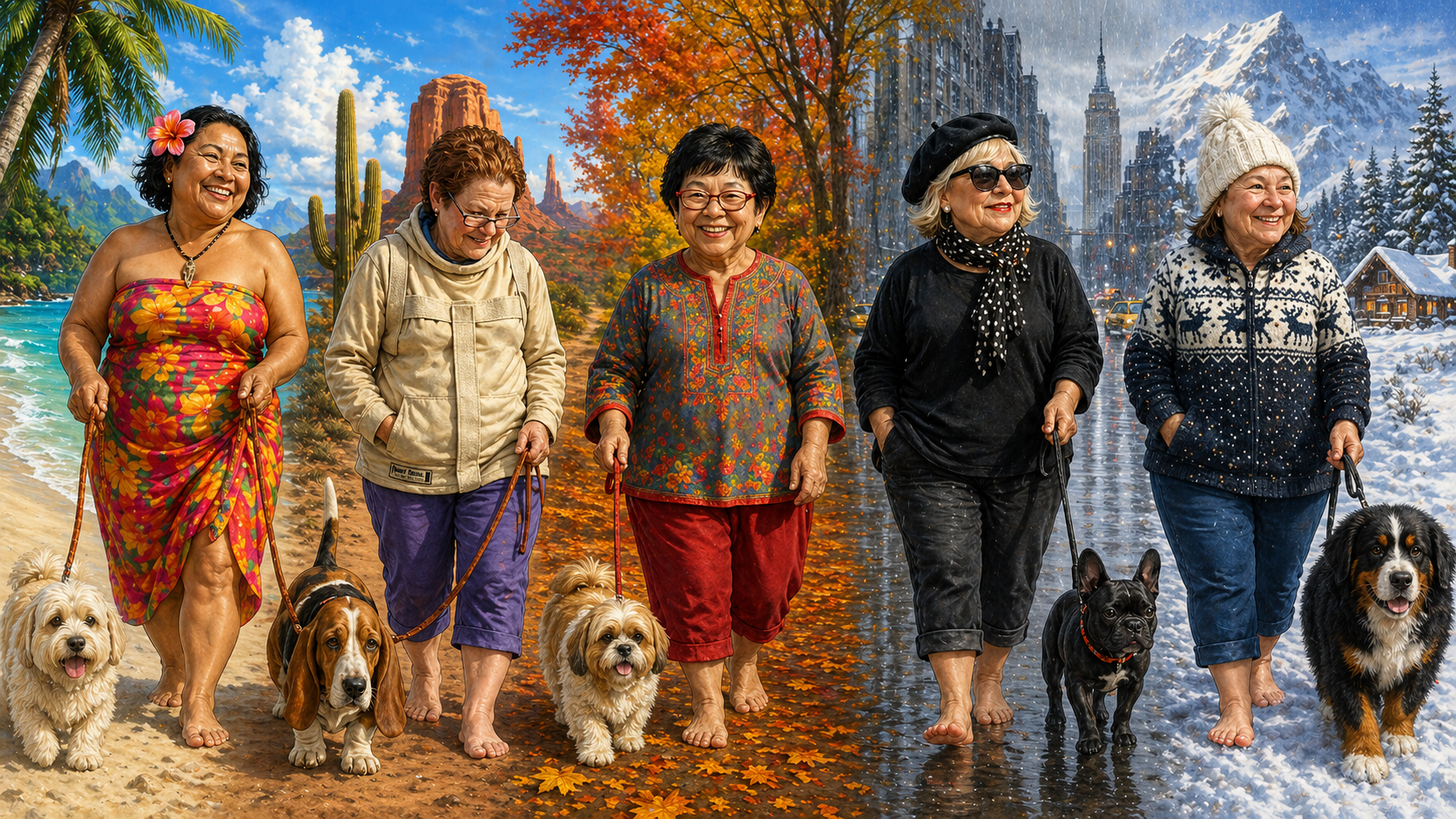
The first thing people notice is not the women themselves, but the pattern.
Five images, posted hours apart from different parts of the world, somehow feel synchronized. A shoreline at dawn. A desert trail under high sun. A park thick with autumn leaves. A rain-darkened city street. A snow-covered path at the edge of a quiet village. In each, a woman walks with her dog—unhurried, attentive, grounded.
They do not walk together.
But they move as if they do.
Online, they’ve come to be known—somewhat awkwardly, and to their mild amusement—as “the women who walk with dogs.” There is no official name, no formal group structure, no leadership. Just a loose, ongoing conversation shared across a handful of social platforms, where photos, brief reflections and occasional videos create the impression of something coordinated, even choreographed.
“It’s not organized,” said Lila Moreno, 62, in a phone interview from her home near a tropical coastline. “It just… lines up.”
Moreno is one of five core participants who, over time, have come to define the rhythm of the group. Though they’ve never all met in person, their posts often appear in a sequence that feels intentional, even when it isn’t.
“You’ll see one, then another, then another,” she said. “And suddenly it looks like we planned it.”
They didn’t.
A connection that doesn’t require proximity
What binds the walkers is not location, but attention.
Each woman describes a similar practice: daily walks with her dog, undertaken with a deliberate awareness of surroundings, movement and emotional state. The dogs are not just companions, but participants—guides, in a sense, shaping the pace and direction of each outing.
“We follow their curiosity,” said Karen Holt, 64, who walks in a high desert environment. “They notice things we overlook. When you let that lead, something shifts.”
Holt was among the first to connect with Moreno online, after recognizing a familiar tone in her posts. Over time, others joined—Mei Lin Chen, 67, whose walks wind through autumnal parks; Margaret Doyle, 70, navigating a rain-slicked European city; and Ingrid Solberg, 66, whose snowy landscapes have drawn particular attention.
None of them use the word “spiritual” lightly, but all acknowledge that their walks carry a deeper significance.
“It’s not about exercise,” Chen said. “It’s about presence.”
That presence, they say, extends beyond the individual. Each walk becomes a point in a larger, loosely connected network—five separate experiences that, when viewed together, suggest a shared rhythm.
“We’re not in the same place,” Doyle said. “But we’re in the same moment, in a way.”
Reading the ground, following the dog
Central to the walkers’ philosophy is a simple idea: that dogs experience the world differently, and that paying attention to those differences can reshape human perception.
“They’re always reading the ground,” Moreno said. “The scents, the textures, the changes we don’t even register.”
By slowing down and allowing their dogs to set the pace, the women say they’ve developed a heightened awareness of their environments. Small details—a shift in wind, the sound of distant traffic, the feel of sand or pavement underfoot—become more pronounced.
“It’s like tuning an instrument,” Holt said. “You start to notice when something is off, or when everything is aligned.”
The alignment they describe is subtle, difficult to quantify, and often fleeting. But it’s enough to keep them returning, day after day, to the same simple act of walking.
Their online exchanges reflect this focus. Posts are brief, often just a sentence or two, accompanied by an image. There is little commentary, little debate. Instead, there is acknowledgment—a quiet recognition of shared experience.
“You don’t need to explain everything,” Chen said. “Sometimes it’s enough to say, ‘Yes, I felt that too.’”
Different climates, shared rhythm
The visual contrast between the walkers’ environments has become one of the most striking aspects of their online presence.
Moreno’s posts often feature bright sunlight and open water, her dog moving easily along warm sand. Holt’s images, by contrast, are defined by stark desert landscapes, where shadows stretch long across dry ground. Chen’s autumn scenes are dense with color and texture, while Doyle’s city walks unfold against a backdrop of rain and reflective pavement.
Then there is Solberg, whose snowy terrain introduces an element of quiet extremity.
Her photos—footprints trailing behind her and her dog through fresh snow—have drawn both admiration and concern. Like the others, Solberg walks with a deliberate awareness, but her environment adds an additional layer of intensity.
“It’s very still,” she said. “The snow absorbs sound. You can hear your own breathing, your dog’s movement. It’s very clear.”
In many of her posts, Solberg is barefoot, a detail that has sparked ongoing curiosity among followers.
“It’s not a statement,” she said. “It’s a practice.”
Grounding, literally
For Solberg, walking barefoot in the snow is an extension of the group’s broader emphasis on connection.
“You feel the ground directly,” she said. “There’s no barrier.”
She is quick to note that the practice requires adaptation and caution. It is not something she recommends casually, nor does she frame it as a test of endurance.
“It’s about listening,” she said. “If your body says stop, you stop.”
The other women occasionally walk without shoes in less extreme conditions, describing it as a way to deepen their awareness. It is not central to the group’s identity, but it is part of the shared vocabulary—a small, tangible expression of a larger idea.
“You notice more,” Holt said. “That’s really what it comes down to.”
An unintentional audience
As the walkers’ posts have gained visibility, their audience has grown. Followers often comment on the apparent coordination of the images, noting how the sequence of climates creates a narrative of movement across the globe.
The women find this interpretation both flattering and slightly misleading.
“We’re not performing,” Doyle said. “We’re just walking.”
Still, they acknowledge that the visual continuity has an impact. It suggests a kind of unity that extends beyond geography—a reminder that similar experiences can occur in very different places.
“That’s what people respond to,” Chen said. “The idea that you can be wherever you are, and still be part of something.”
For now, the walkers have no plans to formalize their connection. There will be no website, no scheduled events, no attempt to scale what they do into a broader movement.
“It works because it’s simple,” Moreno said. “You walk. You pay attention. You share, if you want to.”
And if the posts happen to align—if five separate paths appear, briefly, to become one—that is simply part of the pattern.
“We don’t force it,” Holt said. “It just happens.”
Across sand, stone, leaves, pavement and snow, five women continue to move through their respective worlds, guided by the quiet, steady presence of the dogs at their sides.
Separate paths.
Shared rhythm.
========
Elara Finch is a features writer covering culture, human interest, and unconventional communities. She focuses on quiet movements that reflect broader shifts in how people find meaning. This article was written, in part, utilizing AI tools.







Comments