The Private Lives of Indoor Cats
Published in Cats & Dogs News
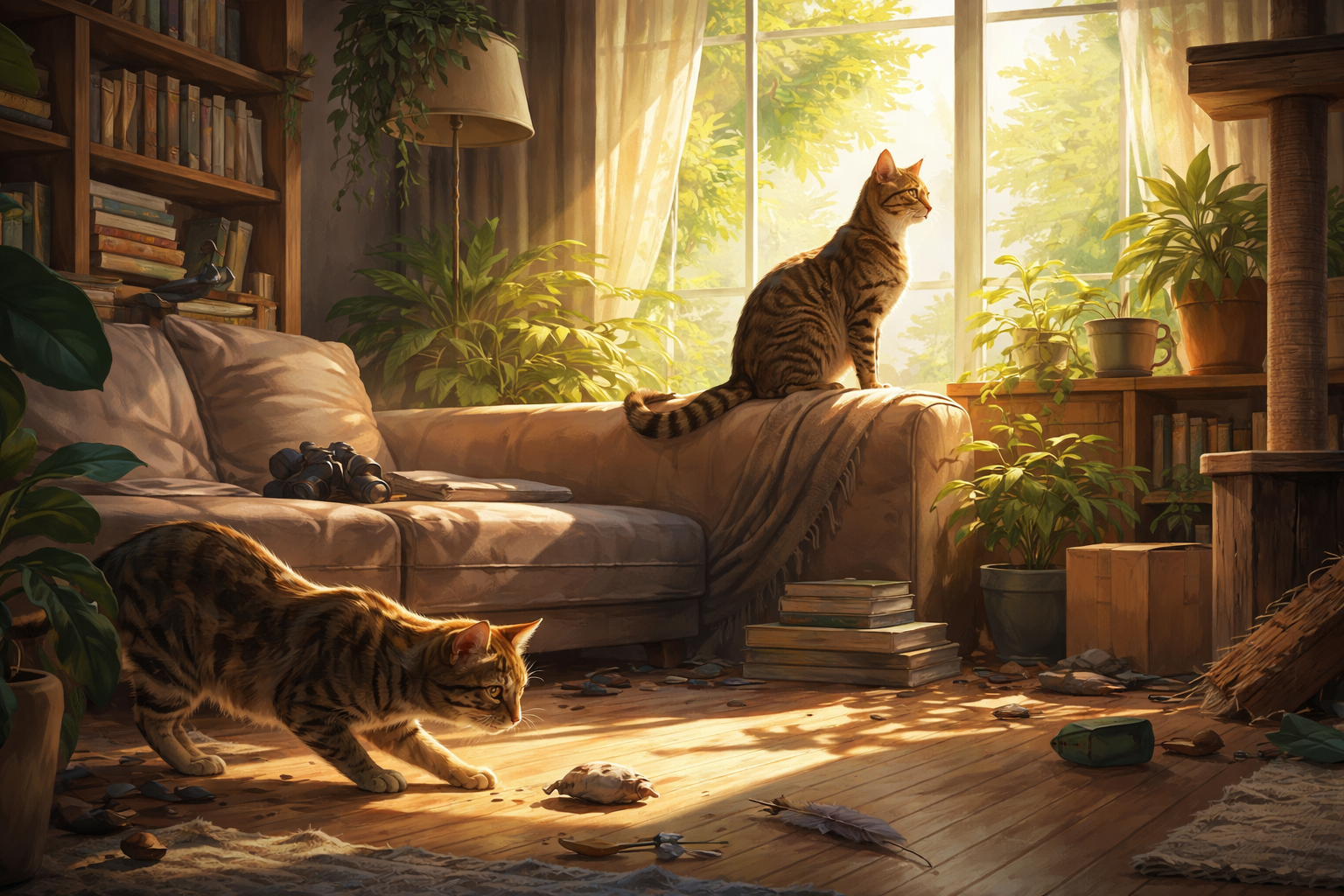
Indoor cats live among us like quiet roommates. They nap in sunlit rectangles, request meals with impeccable timing, and observe human activity with a level of judgment normally reserved for Victorian aunts. Because so much of their day appears uneventful, it is easy to assume that indoor cats live small, repetitive lives—safe, yes, but dull.
The truth is stranger and far more interesting. Indoor cats inhabit a dense inner world shaped by memory, sensory mapping, routine, and imagination. While their territory may be limited to a house or apartment, their mental landscape is vast, structured, and constantly in motion.
When No One Is Watching
Cats are famously different animals when they believe they are alone. Many owners have witnessed it by accident: a cat sprinting down the hallway at full speed, leaping onto furniture with acrobatic precision, or engaging in an intense wrestling match with an invisible opponent—only to freeze the moment a human enters the room.
These behaviors are not random bursts of energy. They are rehearsals.
Ethologists believe cats run through sequences of hunting, escaping, climbing, and territorial patrol as a form of mental and physical maintenance. In the wild, these behaviors are constant. Indoors, cats condense them into short, efficient sessions, often timed for when the house is quiet and predictable.
This is not boredom breaking through. It is competence being practiced.
The Architecture of Invisible Territory
An indoor cat does not perceive a home as a single space. It is a layered map of zones, paths, and strategic vantage points. The back of the couch is a lookout. The hallway is a transit corridor. The windowsill is a border checkpoint. The bedroom closet is a refuge.
Cats memorize this architecture with extraordinary precision. They know which floorboard creaks, which chair leg shifts, which human route is most likely to result in food. Even minor changes—a moved chair, a new box, a closed door—are logged, evaluated, and integrated into the map.
This is why cats often react strongly to rearranged furniture. It is not stubbornness or anxiety. It is cartography. Their world has changed shape.
The Inner Theater
One of the most misunderstood aspects of feline behavior is what owners often describe as “staring into nothing.” A cat may fixate on an empty corner, eyes half-lidded, tail twitching slightly, as if watching a ghost.
In reality, cats are replaying memory and anticipation loops.
Research into feline cognition suggests that cats are capable of recalling past events and projecting likely future outcomes, particularly around routine. When a cat stares at a doorway at 4:58 p.m., it is not hoping dinner will appear. It is reviewing the pattern that has led to dinner hundreds of times before.
This internal simulation is part of why cats appear patient yet precise. They are not passive. They are waiting with intent.
Silence as a Sensory Space
Indoor cats experience silence differently than humans do. What feels like quiet to us is often a rich sensory field to a cat: distant vibrations, air movement, subtle mechanical hums, and sounds beyond human hearing.
In these low-stimulus periods, cats often become more alert rather than more relaxed. Ears swivel. Whiskers angle forward. Bodies settle into a posture that looks restful but is primed for movement.
This is the cat’s natural state. Constant noise—television, music, conversation—forces cats to filter aggressively. Silence allows them to perceive the full texture of their environment.
It is no coincidence that many cats choose early morning or late night for their most active behaviors. The world is finally speaking at a volume they can understand.
Private Rituals and Repetition
Many indoor cats maintain rituals that humans never fully notice. A specific route through the house. A precise order for inspecting rooms. A repeated interaction with a particular object—a doorknob, a rug edge, a curtain cord.
These behaviors are not compulsions. They are stabilizers.
Cats rely on repetition to confirm that their environment remains safe and predictable. Each completed ritual is a quiet affirmation: nothing has changed in a way that requires alarm. In multi-pet or multi-human households, these rituals help cats maintain a sense of control in a shared space.
Interrupting them too often can create stress. Respecting them builds trust.
The Myth of the “Inactive” Cat
An indoor cat that sleeps 16 hours a day is often labeled lazy. In reality, that sleep is dense with neurological activity. Cats cycle through light and deep sleep rapidly, consolidating memory and resetting sensory systems.
What looks like inactivity is recovery from constant awareness.
Cats do not disengage from their environment the way humans do. Even while resting, they are tracking smells, sounds, and movement. Their stillness is active. Their rest is purposeful.
This is why indoor cats often seem to “wake up instantly.” They were never fully gone.
Watching Us Watch Them
Cats are not indifferent to human behavior. They study it.
Indoor cats learn the rhythms of their humans with astonishing accuracy: work schedules, mood shifts, illness patterns, emotional stress. They often position themselves to observe rather than participate, gathering data from a safe distance.
This observation is not purely utilitarian. Cats form expectations about us. They know who is gentle when tired, who is loud when excited, who is likely to drop food, who is safe to approach during sadness.
Their private lives include us as recurring characters, not as central figures but as predictable elements of the landscape.
Why Understanding This Matters
Misunderstanding the inner lives of indoor cats leads to misguided attempts at enrichment. Constant stimulation, forced interaction, and over-handling can overwhelm animals that already manage complex internal worlds.
True enrichment for cats respects their autonomy. It provides choice, vertical space, quiet observation points, and predictable routines. It allows for solitude without interpreting it as rejection.
An indoor cat does not need to be entertained constantly. It needs to feel that its invisible life is allowed to exist.
The Cat You Don’t See
The cat curled on the sofa is not idle. It is navigating a remembered world, anticipating events, maintaining territory, and listening to layers of reality humans barely perceive.
Its private life unfolds mostly without witnesses. That is not a failure of bonding. It is a sign of trust.
Cats do not invite us into every part of their inner world. They do not need to. The privilege lies in sharing space with a creature whose life is richer than it appears—and quieter by design.
========
Marrow Ellison is a longtime animal welfare writer and former shelter volunteer whose work focuses on the unseen emotional lives of companion animals. She lives with two indoor cats who tolerate her curiosity with grace and mild contempt. This article was written, in part, utilizing AI tools.








Comments