In the Bay Area, even parenthood can feel out of reach
Published in Family Living
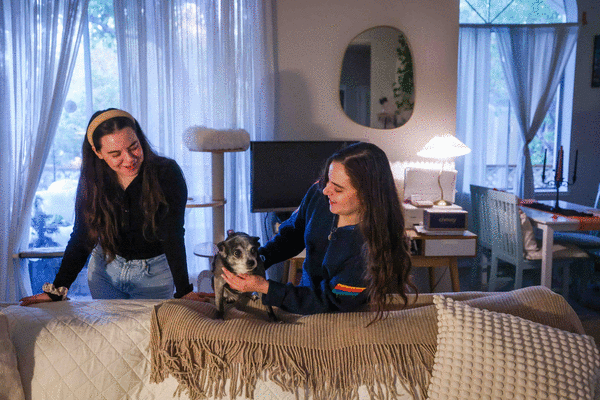
SAN JOSE, Calif. -- Over the years, Stephanie Wallace and her twin sister, Della, have recruited extra roommates to make ends meet, first their brother, Joshua, then his girlfriend, Diana, as rent climbed to $3,700 on their two-bedroom apartment in San Jose. Still, they scrimp on groceries to pay the utilities and are planning to get rid of their second, gas-guzzling car.
There’s no room for Stephanie’s boyfriend, and at 31 years old, she doesn’t see how they could afford a child, much less carve out space for a nursery. What would they do, she asked, “make a little room in the living room?”
“If I can be honest, I don’t think I could afford a kid any time,” Wallace said. “I feel like if I do think of having one, it might happen in like eight years, when I’ll be almost 40, and then my mom would be really sad.”
Wallace is one of numerous Bay Area young people who say they are delaying having children or deciding against them altogether. Among childless adults younger than 50, 56% say they are unlikely to have them, and 58% of that group say they can’t afford to raise children here, according to a new survey conducted by Embold Research for Joint Venture Silicon Valley and the Bay Area News Group.
Their decisions come as birth rates have fallen to historic lows in California and across the country, contributing to declining school enrollment and raising longer-term concerns about the workforce and programs that support older Americans.
Numerous factors are contributing to declining birth rates in the Golden State and across the country, from women’s pursuit of higher education to postponing marriage and starting families later. Even states with low housing prices have had large birth rate declines, according to the Public Policy Institute of California, which cautions that the causes are complex and not fully understood.
Among Bay Area adults younger than 50 without children who say they are unlikely to have them, the most commonly cited reason is the especially high cost of living here, according to the Silicon Valley Poll. Nationally, while affordability is a factor, the leading reason cited by that group is personal preference, according to a 2024 Pew Research Center survey, with 57% saying they “just don’t want” children. Another 36% cited being unable to afford a child as a major reason.
“The top reason people give in Silicon Valley is it’s too expensive — that was a pretty significant finding,” said Russell Hancock, President and CEO of regional think tank Joint Venture Silicon Valley. “We also have poll information that people are cutting back everywhere in their lives. They’re delaying important medical procedures. They’re not buying houses. They’re stacking up in houses. They’re cutting back on groceries. They’re cutting back on incidental expenses. So all of those things are happening in Silicon Valley, and people are choosing not to have children or not to have as many children.”
California’s birth rate fell from 20 births per 1,000 residents in 1992 to 10.1 in 2025, according to PPIC.
The total fertility rate — an estimate of how many children a woman would have over her lifetime based on current age-specific birth rates — dropped 33% in California, from 2.21 children per woman in 2007 to 1.48 in 2023. That’s well below the replacement level of about 2.1 needed to keep a population from declining without migration, according to PPIC. Nationally, the fertility rate fell from about 2.1 to 1.6 over roughly the same period.
Declining births contribute to falling school enrollment across the Bay Area, where districts have closed schools, cut positions and reduced budgets. Oakland Unified cut 400 positions last year, and in the South Bay, parents protested the closure of five San Jose Unified elementary schools last year.
Over time, sustained low birth rates could also mean fewer workers providing for the healthcare and other needs of an aging population, Hancock said.
It’s a lot of pressure to heap on young people trying to make ends meet in the Bay Area. But they have reason to worry. The survey also showed that nearly 2 in 3 parents with incomes below $150,000 cannot consistently make ends meet and save money while raising children. And 83% of those making less than $150,000 say they have cut back on groceries or other necessities, while 75% say they have taken on debt or used credit cards to cover expenses.
The income disparities among workers in the Bay Area also factor in. Just 35% of parents with children at home making less than $150,000 say that working hard can still lead to a good life, compared with 55% of parents who make more than $150,000. The survey of 1,801 Bay Area adults, provided in English, Spanish, Vietnamese and Chinese, was taken from Aug. 5-18. It has a margin of error of 2.6 percentage points for the full sample; results for smaller subgroups are less precise.
Jeff Vincent, UC Berkeley’s associate director at the Center for Cities and Schools, says he often hears the pervasive gloom from his students.
“I hear a lot of those individuals saying, ‘I’ve already kind of given up. Like, I haven’t even hardly started my career, and I really don’t think I will ever be able to afford children, especially if I want to stay in the Bay Area,'” he said. “They’re getting a degree at a high caliber university and probably have good job prospects. But the pessimism I see is really alarming.”
The survey shows that affordability is a primary factor in forgoing parenthood. But residents describe other considerations, too — from demanding jobs that bring workers far from their family support system to concerns about climate change.
Take Ben Sindle. He’s 28 and moved to Berkeley from Virginia for his battery engineering job in San Leandro.
“You always hear it takes a village to raise a child, and I think that for a lot of younger people nowadays, there’s also the aspect of you don’t really feel like you have that,” he said. “A lot of people, especially in the Bay Area, are transplants from other places.”
His single life now is consumed by his $125,000-a-year job and the daily commute that goes with it. At the end of the day, he has little more than three hours left for himself, for grocery shopping and laundry and cooking and cleaning, much less a social life. A child would have to squeeze into that, he said.
“So then you have two parents that are working, and one mostly to pay for daycare, so, well, what’s the point?” he asked. “It’s not simply, ‘can I afford to have kids?’ It’s more like, can I be present in a child’s life and do family things any more than what I’m currently doing?”
At the end of the day, he said, “it’s like, could I have a house and two cars and a picket fence kind of lifestyle that my parents were able to? Absolutely not.”
Katelin Hess of San Leandro expressed numerous reasons to avoid becoming a mother. Not only did she have a difficult childhood, she said, but now as an adult she takes care of her disabled mother full time.
“There’s trauma. There’s the political environment. There’s family. I have no support,” Hess said. “I’m the only family taking care of my mom. I don’t want that responsibility to befall on my child to take care of me. I never want that to happen.”
She is so certain she doesn’t want to become a parent that she had a surgical tubal ligation at age 26 to prevent pregnancy.
When the doctor asked whether Hess was “100% sure about this,” Hess replied, “if I have a kid, I’m coming for you for the college money.”
Separate research from the Public Policy Institute of California shows that women are starting families later and having fewer children. More women are completing college degrees than men, and they’re getting married later. In 2024, the median age at first marriage for women was about 30 in California and 29 nationally, according to an analysis of Census Bureau data. Nationally, it was about 20 in the 1950s.
But cost alone doesn’t explain the decline: Even states with low housing prices have seen large drops in birth rates.
Foreign-born Latinas have seen particularly steep declines in California, with their total fertility rate falling from 3.17 children per woman in 2008 to 1.95 in 2024, according to PPIC.
Wallace, who rents the two-bedroom San Jose apartment with her siblings, says her household is already sacrificing in nearly every aspect of their lives to pay the rent that was just raised 5%. She said she hasn’t had a regular doctor’s visit since high school because she can’t afford it.
“There’s this joke with younger people that you need to have a roommate in order to make the ends meet,” Wallace said. “If you want to have furniture, get another roommate. If you want more things, just get another roommate.”
Her twin sister, Della, who works in retail making about $63,000 a year, said she can’t imagine having children until her late 30s, when she finishes her marketing degree and has a higher, steady income. Even then, her siblings have discussed continuing to live together to support each other raising children.
“It’s definitely a struggle and a thought process,” Della Wallace said. “So that’s why having kids or anything like that is something that we’re not thinking of as a main priority.”
Stephanie Wallace makes $73,000 a year as a contractor organizing commuting benefits for Amazon employees — most of them engineers — who often trek from the more affordable Central Valley to the Sunnyvale office.
“If they can’t afford it, how could we afford it?” she asked.
Her 40-year-old boyfriend doesn’t want children anyway, she said, “just because of the state of the world.”
Wallace can’t see herself moving back to her hometown of Merced where her mom lives, even if it is cheaper. Her job is here and she otherwise likes the Bay Area.
So she’s intent on making the best of what she has.
“We have our cats and dogs. I feel like we’re happy with them,” Wallace said. “At this point, they’re like our babies.”
©#YR@ MediaNews Group, Inc. Visit at mercurynews.com. Distributed by Tribune Content Agency, LLC.








Comments