When roundabouts go wrong, then what?
Published in Automotive News
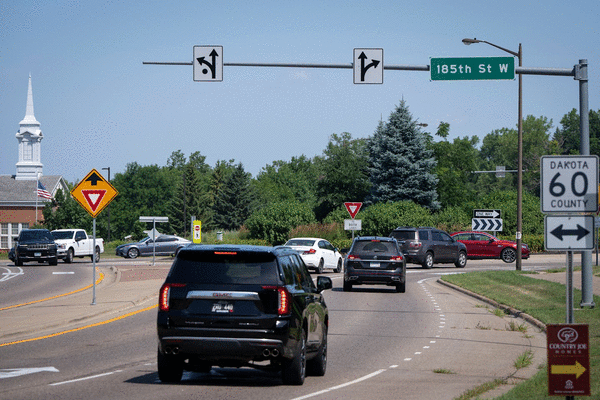
Roundabouts have emerged in force on Minnesota roads in the last two decades, now numbering nearly 600.
Drivers tend to love or hate them — specifically, they hate the way other drivers use them. But they’re beloved by traffic engineers, who praise the way they keep vehicles flowing and reduce serious crashes.
Once in a while, though, they don’t quite hit the mark. Occasionally, a roundabout can cause backups, or even an increase in crash injuries. Then what?
That’s what Dakota County, Minnesota, is trying to figure out with a roundabout at an intersection in Lakeville. It’s one of just a handful of “two-by-two” roundabouts in Minnesota, which apparently can confuse drivers as they navigate two lanes entering and exiting in all four directions.
Some combination of high traffic volume and design seem to have made it the most crash-prone location in Dakota County. Most of them are fender-benders.
“There’s a crash here almost every other day,” said Tyler Krage, Dakota County’s traffic engineer.
Roundabouts have been common in other countries for a long time, but they’re relatively new in the U.S., and in Minnesota, which got its first in the 1990s.
In the last two decades, the number of roundabouts in Minnesota has grown from fewer than 50 to nearly 600 across the state, according to data from transportation engineering firm Kittelson & Associates.
What’s behind that rise? Speed and safety.
Roundabouts tend to keep traffic moving more smoothly than stoplights. Plus, the collisions tend to be less likely to cause injuries, compared to the T-bone and head-on collisions at stoplights.
“It ends up being more of an angle hit as opposed to a 90-degree hit,” said Ken Johnson, Minnesota Department of Transportation assistant state traffic engineer. “When you have that situation, you’re going to have likely a fender bender as opposed a fatal or serious injury crash."
For instance, a MnDOT report found roundabouts reduce serious and fatal crashes by more than 80%.
That’s especially true of single-lane roundabouts, which Johnson said reduce all types of crashes.
But two-lane roundabouts, like the one in Lakeville, can be a different story. Those can actually increase the number of fender benders, though traffic engineers don’t necessarily see that as a deal-breaker.
"We’re reducing the risk of someone losing their life or having an injury that they’re going to feel for the rest of their life,“ Johnson said.
The Lakeville roundabout was built in 2015, at a time when traffic was increasing at the intersection. Very quickly, the number of collisions began to increase, from six to 10 per year to many times that — and nearly 180 in 2024.
Most collisions only involved property damage, but there were some minor injuries, and in 2022, one serious injury.
Dakota County has tried tweaks over the years, but the issue — seemingly some combination of design, traffic volume and the number of lanes — remains.
"Drivers might not be necessarily clear on what lane they need to be in," Krage said. “They’re driving into that other lane."
MnDOT has learned a lot about roundabout design in the last 30 years, Johnson said.
Most roundabouts in Minnesota have one lane, or have two lanes on one road and one on the other.
Nationally, Krage and colleagues identified more than 400 two-by-two roundabouts, and only four had comparable traffic volumes to the one at 185th and Kenwood in Lakeville. All had similar crash issues.
Of the three double-lane roundabouts Krage has identified in Minnesota, the one in Lakeville has the highest traffic volume by far.
“When you couple the two-by-two with a high volume, does that exacerbate some of the two-by-two problem?” Krage said. “That’s kind of what we’re trying to figure out.”
MnDOT doesn’t have any three-lane roundabouts in Minnesota, though some countries, and some U.S. states have tried that, Johnson said. Instead, MnDOT would put in a stoplight.
Another solution? Adding right-turn lanes that reduce traffic in a roundabout, he said.
“We’ll also sometimes put in a signal when we can’t get the right of way in order to build a roundabout,” he said.
Dakota County is far from making a decision on the future of Lakeville’s troubled roundabout.
Krage presented three options to the Lakeville City Council this month. One would improve sightlines around the mound at the center, move crosswalks, and add pedestrian beacons and possibly mumble strips, which are quieter than rumble strips but serve to alert drivers to keep them in the correct lanes.
Another would, in addition to those fixes, add bypass lanes to reduce traffic in the roundabout by letting drivers make right turns without entering the circle.
A third would remove the roundabout and return stoplights to the intersection.
Such roundabout removals are rare.
West Richland, Washinton, removed one — converting an intersection to traffic signals — as increases in traffic volume led to backups.
Houston, Texas, removed a roundabout just a year after its installation after improper use led to crashes. Mayor John Whitmire told the local ABC affiliate that removing one didn’t mean the end of roundabouts across the city.
The same is true in Dakota County.
“We don’t want people to think that we don’t want to build roundabouts," Krage said. More so, he said, it’s a matter of figuring out the safest and most cost-effective way for drivers, walkers, rollers and bikers to navigate an intersection.
©2026 The Minnesota Star Tribune. Visit at startribune.com. Distributed by Tribune Content Agency, LLC.






Comments