Report: Iceberg lettuce was correlated with cyclosporiasis in Michigan
Published in Health & Fitness
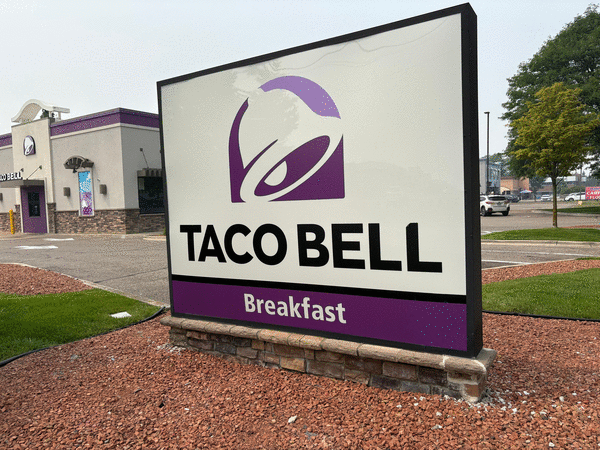
DETROIT — A new report on Michigan's cyclosporiasis outbreak confirms what was already suspected: that iceberg lettuce and consumption at Taco Bell were correlated with the state's largest-ever outbreak of the parasitic illness.
The Michigan Department of Health and Human Services has reported 14,510 cases of cyclosporiasis, which usually causes frequent, watery and explosive diarrhea, as of Aug. 27.
According to a new report in the journal NEJM Evidence on Sept. 2 by MDHHS, local and state health officials interviewed 3,114 people who got sick with cyclosporiasis through late July.
Of those, 69.6% reported consuming food purchased from a single restaurant chain. The chain, labeled "Chain A," isn't identified in the paper, but the Michigan Department of Health and Human Services confirmed it's Taco Bell.
MDHHS found that among an early subset of 190 patients who ate Taco Bell menu items, 170 (or 89.5%) reported consuming an item containing iceberg lettuce.
The authors of the paper said they are reporting the interim investigation findings to "help inform state and national responses to this outbreak."
"It's really important as part of any outbreak investigation to make sure that we are writing up the scientific aspects of that outbreak investigation and sharing with the rest of the scientific community," said Dr. Natasha Bagdasarian, the state's chief medical executive and one of the authors of the article.
A total of 6,065 cases were reported to the Michigan Department of Health and Human Services from June 22 through July 22. MDHHS' investigation was just on those who were interviewed, Bagdasarian said.
The Centers for Disease Control and Prevention said in mid July that data showed that shredded iceberg lettuce served at some Taco Bell locations was contaminated with Cyclospora and "making people sick." Salad supplier Taylor Fresh Foods voluntarily recalled on July 17 all iceberg lettuce grown in central Mexico that was identified as the potential source of the Cyclospora outbreak, the company said.
MDHHS staff evaluated the 946 patients who did not recall consuming food at Taco Bell. The authors said that 729 of them had "available food exposure data" for any lettuce product (iceberg, romaine, mesclun or pre-made salad mixes), and the remaining 217 patients either replied “unknown” or did not reply.
Bagdasarian said MDHHS' findings show that independent of Taco Bell, exposure to iceberg lettuce was associated with the illness.
She also said correlation doesn't imply causality. Even though Taco Bell and iceberg lettuce were correlated with the symptoms of cyclosporiasis, officials can't at this time say that those factors caused the symptoms.
Bagdasarian said her department intervened ― it sent out press releases as early as the end of June advising people on specific steps to take ― because of signals it had received.
"We did this very early public health intervention in warning the public because we felt it was in the public's best interest," she said.
MDHHS’ data also showed that the number of people becoming ill peaked twice: once in late June and once in early July. This suggests that there were two distinct batches of contaminated produce or a single contaminated lot with staggered distribution, the report said.
Bagdasarian said the data in the paper is as of July 22. The data on MDHHS’ website is more updated than that of the paper, and the second peak is “in fact even higher.”
“We believe that it is likely that ... there were two very contaminated batches of produce that came into our state,” she said.
_____
©2026 The Detroit News. Visit detroitnews.com. Distributed by Tribune Content Agency, LLC.









Comments