Tiny chip restores reading to people with age-related blindness
Published in Health & Fitness
Age-related blindness affects more than 5 million people worldwide and for years scientists have not been able to reverse the most common cause: age-related macular degeneration.
Until now.
A team of Stanford scientists created a Photovoltaic Retina Implant Microarray, or PRIMA, implant smaller than a sesame seed. The implant can be placed behind the eye, and combined with a pair of high-tech glasses, the pair can restore sight to parts of the eye, they reported.
With digital enhancements enabled by the device, such as zoom and higher contrast, some participants could read with the equivalent of 20/42 vision.
“All previous attempts to provide vision with prosthetic devices resulted in basically light sensitivity, not really form vision,” Daniel Palanker, professor of ophthalmology and a co-senior author of the paper, said in a statement. “We are the first to provide form vision.”
The glasses include a small camera that captures images and projects them in real time via infrared light to the PRIMA chip at the back of the eye. The chip converts images into electrical stimulation, effectively taking the place of natural photoreceptors damaged by degeneration. And best yet: the light it receives through the eye is enough to power the chip.
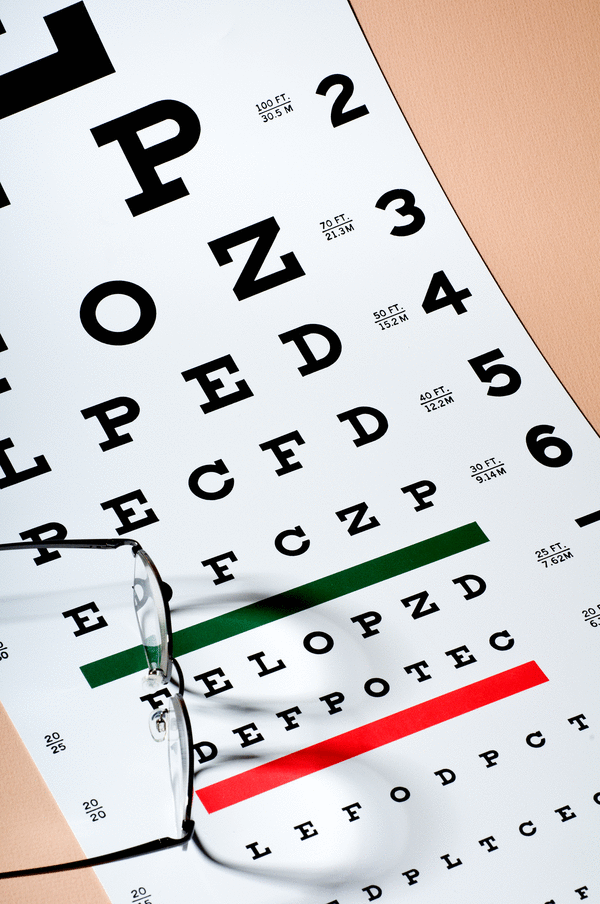
In their first human trial, the team enrolled 38 participants with vision worse than 20/320 to receive an implant in at least one eye. Then 32 were able to be assessed 12 months later, of whom 27 showed a measurable improvement in vision equal to reading two more lines on an eye chart. One improved by 12 lines, they wrote.
Participants in the trial had an advanced form of age-related macular degeneration, known as geographic atrophy, that gradually erodes central vision.
“The projection is done by infrared because we want to make sure it’s invisible to the remaining photoreceptors outside the implant,” Palanker said.
The design allows patients to use their natural peripheral vision along with the prosthetic central vision, aiding orientation and navigation.
“The fact that they see simultaneously prosthetic and peripheral vision is important because they can merge and use vision to its fullest,” Palanker said.
While most participants could make out patterns immediately, all patients’ vision improved with training, they said. The glasses allowed adjustments to contrast, brightness and magnification up to 12 times.
The team published its findings in the New England Journal of Medicine in October of 2025.
For now, the PRIMA implants provide only black-and-white vision, and most patients experienced some complications, from tearing in the peripheral retina to hemorrhaging.
The team is working on chips that will offer higher resolution and as solutions for other types of blindness.
©2026 The Baltimore Sun. Visit at baltimoresun.com. Distributed by Tribune Content Agency, LLC.









Comments