As health insurance costs rise, Nevada hospitals see more uninsured patients
Published in Health & Fitness
At the beginning of this year, Las Vegas insurance broker Harry Mex’s cellphone started ringing more than usual.
Clients were calling Mex after learning what they would have to pay for health insurance in 2026. Some said their monthly premiums had doubled or tripled even though their incomes had not changed. Others were facing higher deductibles.
The increases came after the pandemic-era enhanced federal tax credits that lowered premiums for people buying coverage under the Affordable Care Act expired at the end of last year. Some of Mex’s clients buy coverage through ACA, also known as Obamacare, because they earn too much to qualify for Medicaid, are too young to qualify for Medicare or lack affordable coverage through an employer.
Nevada ACA plan enrollees are now paying an average monthly premium of $234, an $82 increase from last year, according to Nevada Health Link, the state’s ACA health insurance marketplace.
Mex, founder and CEO of Stratford Oak, said insurance companies sent letters last fall warning customers that their rates would increase this year, but many of his clients disregarded them.
“It’s a lot more expensive now,” Mex said. “People are paying more for insurance that gives them less coverage than they had before.”
The number of Nevadans with ACA coverage has fallen, too. Recently released data from federal health officials shows that 99,663 people had active coverage in February, down 8,086, or about 7.5 percent, from a year earlier.
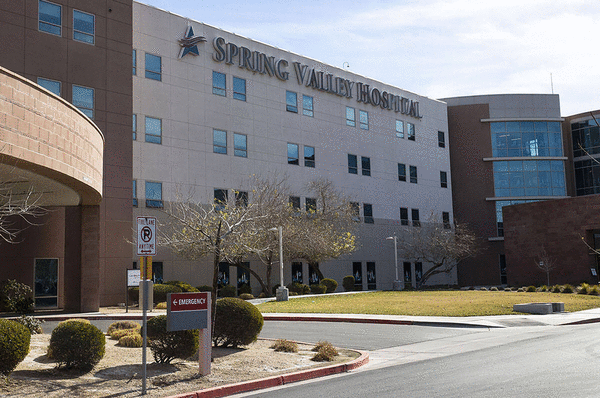
The changes to ACA are beginning to show up at Southern Nevada hospitals, where some providers are seeing more uninsured patients and others struggling to pay their medical bills. At the same time, hospital executives are planning for potentially greater financial pressure in 2027, when major changes to Medicaid are scheduled to take effect.
Mex said younger adults, particularly those 28 or younger, are among the clients he has most often seen dropping health insurance coverage completely. Some families with children have also gone uninsured as monthly premiums climb beyond what they can afford.
UMC: ‘There’s nothing about this that’s alarming’
At University Medical Center, self-pay emergency department visits — generally patients without insurance who are billed for their own care — averaged 801 a month from January to July, up nearly 18 percent from the same period in 2025, according to hospital data. And during the same period, total emergency department visits averaged 7,559 per month, up just about 7 percent from last year.
“There’s nothing about this that’s alarming at this point,” UMC Chief Financial Officer Jennifer Wakem said.
Still, UMC is considering deeper discounts for uninsured patients, Wakem said.
The county hospital has an eligibility team that screens uninsured patients to determine whether they qualify for Medicaid, charity care or another assistance program. Wakem said the team has encountered patients who previously had ACA coverage but dropped it and are now uninsured. Other patients are keeping insurance but choosing less expensive plans with higher deductibles.
“A lot of people are like, I just want insurance, but they don’t think through that deductible,” Wakem said.
Patrick Kelly, president and CEO of the Nevada Hospital Association, said comprehensive statewide data is not yet available to measure how much the uninsured population has changed this year. But he said the issue has come up in conversations with hospital leaders.
“People just say, ‘Oh boy, we’re seeing more uninsured patients’” this year, Kelly said.
Hospitals are also seeing more insured patients struggle to pay their share of medical bills, he said.
Federal law generally requires emergency departments to screen patients for emergency medical conditions and provide stabilizing treatment, regardless of insurance status or ability to pay. As the number of uninsured patients grows, hospitals could face pressure to raise prices or cut costs elsewhere.
In 2024, Nevada had the fourth-highest uninsured rate among all U.S. states, at 11.4 percent, according to health policy research organization KFF.
Dignity Health-St. Rose Dominican, a nonprofit that operates eight hospitals in the Las Vegas Valley, said in a statement that it has seen a slight increase in charity care requests. But Dignity spokesperson Baha Eldin said it is too early to know whether the increase is being driven by a greater number of uninsured patients or other changes in people’s insurance coverage.
Valley Health System, which has seven hospitals in Southern Nevada and is owned by publicly traded hospital operator Universal Health Services Inc., said costs associated with treating patients who pay only part of their medical bills or cannot pay at all are currently elevated.
“Continued increases in the uninsured population create financial pressures that can make it more challenging for healthcare providers to invest in workforce, expand services, and maintain access to care,” VHS spokesperson Gretchen Papez said in an email.
Bigger concern coming in 2027
For UMC’s CFO, this year’s increase in uninsured patients after the enhanced ACA tax credits expired is not what worries her the most.
Wakem is looking ahead to Medicaid changes scheduled to begin taking effect in 2027 that could leave many more Nevadans without coverage. She pointed to one provision that will require most able-bodied, non-pregnant adults ages 19 to 64 who do not have young children to document at least 80 hours a month of work, education or community service.
State health officials told state lawmakers in April that roughly 70,000 Nevadans could lose coverage due to the work requirements.
Wakem said UMC is working with state officials to determine how many local recipients could be affected. UMC officials, though, don’t currently anticipate reducing services because of increases in uninsured patients.
“We’re not looking to cut anything back at this point,” Wakem said.
UMC is also planning to create and grow higher-margin services that are less reliant on Medicaid — including inpatient physical rehabilitation services — to help offset potential financial pressure, Wakem said.
Other local hospital operators are preparing for future Medicaid changes, too. Valley Health System’s parent company is investing more in areas that are growing and rely less on Medicaid — such as outpatient care and behavioral health services, Universal Health Services executives told investors last month.
___
©2026 Las Vegas Review-Journal. Visit reviewjournal.com.. Distributed by Tribune Content Agency, LLC.






Comments